
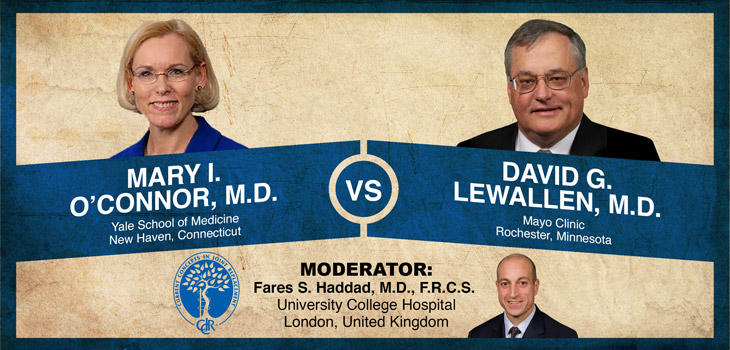
Moderator Haddad: Mary, going to war with one bullet. That’s pretty hard isn’t it. What happens if someone drops the implants or what happens to that patient?
Dr. O’Connor: You always have to have your back-up plan. In the knees that I’ve done, I’ve never had to convert to an off-the-shelf. We did drop one poly insert and had to go to a second one, which was a 1mm size difference so it wasn’t anything horrible. But it wasn’t my first choice. One of the points that I want to make is the difference in one of the studies that Dave showed…if you’re talking about patient-specific instrumentation, that is not a custom total knee. That is you spending a lot of money, in my opinion, on cutting guides that are just putting in an off-the-shelf component. I really don’t see any benefit to that.
Moderator Haddad: David, before you come back, just for me to understand…the customized knee design is based on the disease state on a supine CT and you’re hitting everybody with neutral alignment. Is that right?
Dr. O’Connor: Yes, so it’s neutral mechanical axis alignment and looking at the anatomy, so the implant is made based on the anatomy of the patient, modeling away the osteophytes and areas where there is disease. This implant is not something that I use for patients that have significant deformity. I would put that caveat in there. But for the vast majority of your knees, in my hands it is superior. Cost, in our institution, has been minimized with aggressive negotiation. Implants come in one box with your cutting guides, so there is a lot of OR efficiency that can also be gained.
Moderator Haddad: David, if you’ll answer the questions…what’s your thought about the translatability of this process?
Dr. Lewallen: There’s no question that this can be done and be done well with good results in the hands of experienced surgeons, high volume folks. And importantly, people have a mental image of what a total knee is supposed to look like and are willing to bail and correct something if it doesn’t look right. Right? You need to have some operator control. This isn’t auto pilot. Fifty percent of surgeons are below average—it’s a math problem. So, the trouble is how are we going to translate this generally…is this appropriate for general use…and I think at the current time the answer to that is no. I’m willing to yield, perhaps with data and enhancements in the future, perhaps this will have a role in some way, but I don’t think now it’s right for primetime.
Dr. O’Connor: Fundamentally I think this is a better implant design A custom knee is able to reproduce the patient’s anatomy. I believe that when I’m putting those components in, my risk of some subtle malrotation of the femur versus the tibial component is minimized because this is essentially all computer planned and navigated prior to me entering the operating room. Fundamentally it’s an improvement over what we’ve been doing for decades with off-the-shelf components. Yes, there have been improvements with off-the-shelf with greater variations in size. We have different appreciation of AP and ML ratios.
But it doesn’t fundamentally address the question that one individual’s knee is shaped differently than another’s. I truly believe that this is the next step in the evolution of how we’re going to have better outcomes with total knees. Some of our knees off-the-shelf do great. And we say, “See, it’s fabulous. Look how great this patient is.” But when you look at the data, it shows the variation in distal femoral offset in the joint line, you can envision that those patients who are doing great are the ones where their anatomy is so suitable for an off-the-shelf.
That’s not all our patients. We know this from the functional data and the patient satisfaction. In my opinion the superiority of customized components is clear and convincing.
Dr. Lewallen: We look forward to the prospective randomized, blinded trials, which will convince the curmudgeons like me that it’s actually true. I’m concerned we’re seeing a placebo effect. You tell somebody you’ve got something new and great; they’re going to have a better result if they believe that.
Dr. O’Connor: The placebo effect does not translate into better function. The functional data that we have shows these patients can walk faster, timed up and go, up and down stairs is better. Their functional level is higher. And I believe that translates into why they have higher degrees of satisfaction.
Dr. Lewallen: The Schwarzkopf data and the author concluded that it didn’t make a difference clinically.
Moderator Haddad: We’re not going to get agreement here. Great passion, great arguments and debate to continue.
Please visit www.CCJR.com to register for the 2020 CCJR Spring Meeting — May 17-20, in Las Vegas.
