
Overview:
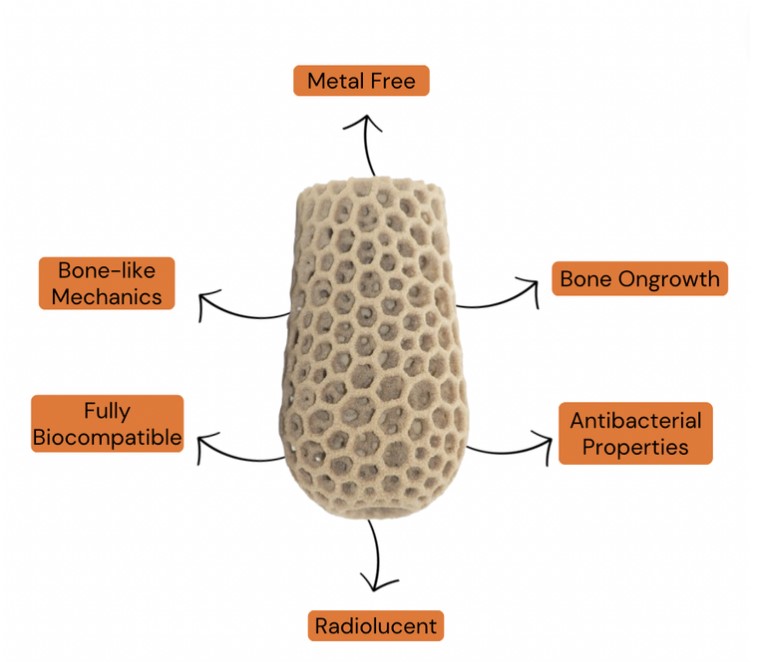
Time to take a long hard look at non-metal constructs? We’re referring to PEKK, not PEEK. PEKK is antibacterial, a bio-mechanical twin to cortical bone, hypoallergenic, modifiable in the OR, and a friendlier implant than metal. Yes, it’s time.
Not likely, right?
You can count on one hand how many base materials are used in orthopedic surgery—titanium, cobalt chrome, PEEK—with metal dominating, particularly for 3D printed titanium implants. And yet.
And, yet.
And yet, if there were a way to meet or exceed metal’s performance and complex design innovation, most surgeons would take a long hard look at polymer constructs.
For five major reasons:
- Metal complicates post-op visualization
- Metal often leads to stress shielding and loosening
- Metal implants cannot be modified by the surgeon in the O.R.
- Some patients have an allergic response to metal
- Biofilm formation and infection risk come with using metal
Which leads us to Scott Defelice’s obsession.
Scott DeFelice’s Obsession
An economist undergrad with a master’s degree in marketing from the University of Strathclyde in Glasgow, DeFelice began his formal career in 1988 at Oxford Polymers, a Connecticut-based marketing and sales organization which sold engineering thermoplastics throughout the northeastern part of the United States. Eleven years after he joined Oxford Polymers, the company made a strategic decision to spin out a new company—Oxford Performance Materials (OPM) with Scott DeFelice as its new CEO. His charter? Develop a new line of polymers based on DuPont’s polyaryletherketone (PAEK) family of thermoplastics. DeFelice’s two-decade-long fascination with poly-ether-ketones took root.
If you stick ‘aryl’ between poly and ether, you get polyaryletherketone, or PAEK, which was originally designed to meet structural strength and performance requirements of the aerospace industry.
In the early 1980s, ICI (Imperial Chemical Industries) developed PEEK (polyetheretherketone), which was later spun out to become Victrex and its biomedical subsidiary Invibio. Today, PEEK is the most commonly used polymer for spinal implants.
DeFelice, however, was focused on another version of PAEK, one that changed the formula by doubling up on the ‘ketone’ to create a polyetherketoneketone or PEKK. PEKK was originally developed by DuPont, and OPM has subsequently developed its own patented “low temperature” synthetic method.
OPM’s OXPEKK® technology, which DeFelice has been steadily improving since 2000, is arguably equal or superior to metal constructs in musculoskeletal surgery.
PEKK in 2024
Here’s a partial list of PEKK’s attributes as a musculoskeletal implant:
- Antibacterial properties; no biofilm formation
- A near bio-mechanical twin to cortical bone
- Hypoallergenic
- Modifiable for a more precise anatomical fit
- Better inherent osseointegration than metal
Strategically, this combination of features could improve outcomes (fewer periprosthetic infections, reduced rates of stress shielding or allergic reactions, and a better anatomical fit) and reduce revision surgeries saving musculoskeletal care providers hundreds of millions of dollars.
Since 2006, DeFelice has been piling up key PEKK milestones:
- 2006: first machined PEKK spinal cages
- 2010: FDA clears first PEKK tissue marker
- 2012: FDA clears first PEKK craniomaxillofacial device (OsteoFab®)
- 2015: FDA clears first OsteoFab PEKK VBR spinal implant
- 2016: PEKK Wins Best Technology in Spine Award
- 2017: FDA clears PEKK spine implants made with OsteoFab process
- 2019: FDA clears PEKK suture anchor for multiple indications
In addition to 3D printing PEKK implants, OPM sells PEKK in powder, rod, and pellet forms.
As Scott DeFelice explained to OTW: “We’re basically saying, ‘this $60 billion orthopedic industry that’s built upon this metal platform is starting to show its warts’. Titanium and cobalt chrome have serviced millions of patients in the industry for decades, yet we now know that metal constructs can be too strong, too stiff, limit the surgeon’s ability to modify in the O.R., and can raise infection risk.”
“PEKK essentially solves all these problems. Mechanically, it’s just right for the human body. It’s biologically right. Bone grows on it. It prohibits infection. There’s either no or very limited bacterial colonization. We’ve implanted more than 100,000 PEKK spinal implants, over 5,000 personalized PEKK implants for CMF, lower & upper extremity and oncology, and our material has been used for dental implants for over a decade.”

To cap it all off, DeFelice told OTW, OPM is now offering patient-matched spine and trauma implants. With 3D printed PEKK, DeFelice gives surgeons patient specific, anatomically precise musculoskeletal implants.
Proof Points and Study Data
In 2019, The Spine Journal published a head-to-head, PEEK vs titanium vs PEKK, osseointegration comparison. Conclusion: “PEKK implants demonstrated bone ingrowth, no radiographic interference, no fibrotic tissue membrane formation, significant increase in bony apposition over time, and significantly higher pushout strength compared to standard PEEK. The PEKK implant displayed bone growth characteristics comparable to Ti-coated PEEK with significant improvements in implant integrity and radiographic properties.”
In a 2021 Northeastern University study PEKK was compared to titanium vs UHMWPE (ultra-high-molecular-weight polyethylene) vs PEEK and showed significant antibiotic resistance in contrast to the other three materials. This chart illustrates the study conclusions:
- The surface energy of PEKK increased the adsorption of key antibacterial proteins: mucin, casein and lubricin
- Significantly decreased colonization of antibiotic-resistant bacteria on both polished and unpolished PEKK samples compared to PEEK, Ti and UHMWPE
Comparting Cortical Bone to 3D-Printed PEKK
This study, conducted by Northeastern University, concluded that PEKK, when compared to PEEK, titanium and cobalt chrome, was most similar to cortical bone in terms of:
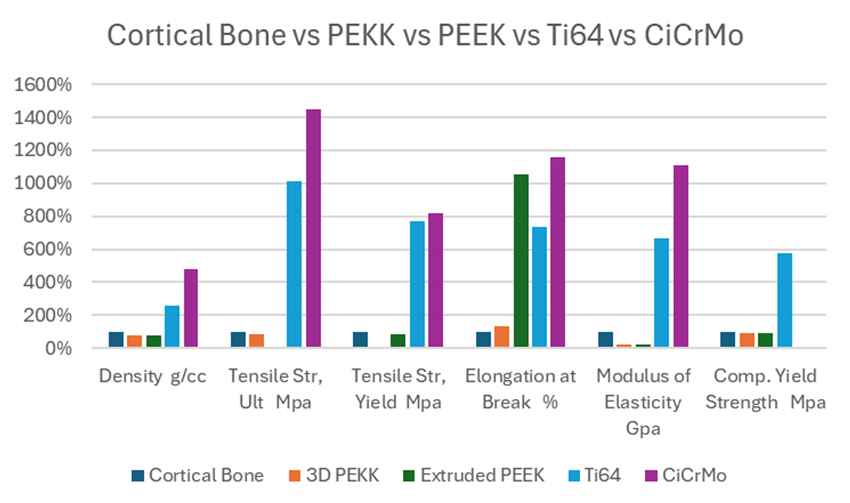
- Density
- Tensile strength – 2 measures
- Elongation at break point
- Modulus of Elasticity
- Yield strength
Metal: Too Stiff, Too Strong, Too Much Infection Risk
As OPM’s CEO Scott DeFelice told OTW: “Titanium and cobalt chrome have serviced the industry for decades, for millions of patients and we know that metal constructs can be too strong, too stiff and, if the surgeon is a biofilm amateur, can raise infection risk.”
“PEKK essentially solves all these problems. It’s mechanically right. It’s biologically right. Bone grows on it. It prohibits infection. There’s either no or very limited bacterial colonization.”
With more than 100,000 PEKK spinal implants successfully implanted, could a metal-free MSK surgery future be unfolding?
The simple answer is “Yes.”
Furthermore, when considering OPM’s ability to customize and personalize implants using 3D printed PEKK (I believe I saw that OPM had only a 3-day turnaround on patient-matched CMF cases) then why wouldn’t surgeons begin using a more compatible, infection resistant material like PEKK? For more information: https://www.oxfordpm.com/
