
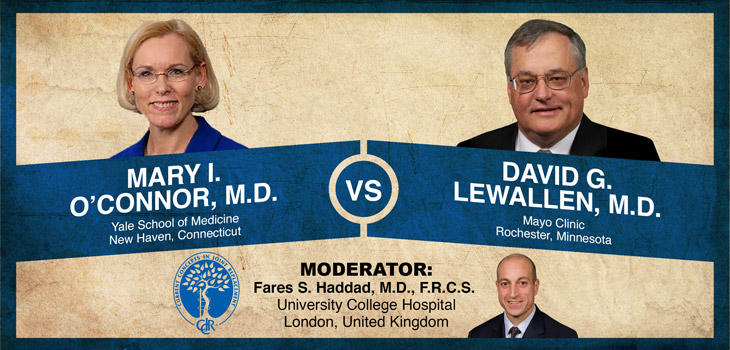
The other thing is the patient’s state of mind. We all know that depression has an adverse effect on outcome. My wife ran off with the tennis coach; my dog died; my truck quit—I’m depressed. A year from now new girlfriend, new dog, bought a new car. I’m not depressed anymore.
If you’re optimistic, you’re going to live longer; you’re going to better with cancer therapy; you’re going to have less pain after total knee arthroplasty. That’s in the literature.
If you’re a pessimist like me, you curl up and die when you get cancer because bad things happen and you don’t even go for your chemo, right? It makes a difference. And we’re not going to fix that with metal.
Yes, implant design is important. We’re all for that. But remember there’s been a change in the increasing fidelity and choices of sizes with off-the-shelf implants. It’s improved over the last 10 years.
Ask yourself, is it the arrow or the archer? Implant design or surgical technique? Why do implants fail? I can tell you, having dealt with overhang, I’m an expert on overhang. It’s painful psychologically, but it doesn’t really cause pain symptoms, I don’t think.
The social, psychological, medical comorbidities aren’t going to be helped, I think, by covering the bone a little bit better. What about all of the problems that we know increase the risk of complications? How are we going to fix those with implant design and J-curves?
A lot of the painful knees I see have no sign of arthritis on the pre-op X-ray. You’re not going to fix that with improved implant design.
Surgical technique is a common cause of failure in my practice. I’m not going to fix surgical technique with a new implant design.
Is there an advantage to improved implant design? I think there is. Can it be done in all or most patients? And will the benefits of a new design justify the extra costs in time and money?
We’ve seen some of these studies (Schwartzkopf, et al., 2015; Arab, et al., 2018; Ogurs, 2018; Zeller, et al., 2017). There are some apparent benefits. But does it matter? Are all of those differences between customized implants and off-the-shelf implants clinically significant?
The literature shows that customized implants really don’t make a difference.
In one study on bicompartmental, 5% converted, 29% re-operated (Ogus, 2018). A prospective multicenter study showed no difference in pain relief or Knee Society scores (Dirks, et al., Orthopaedic Journal of Sports Medicine, 2017).
Do the benefits of a customized implant justify the extra radiation for the CT, the time, the effort and the expense? I think the answer is clearly “No.”
We need, at this point, validated designs, improved poly, instruments that allow you to get it in straight. Learn to do soft tissue balancing. Take advantage of the increases in fidelity of choices. And find what works with you and stick with it.
As far as customs, for me it’s simple. It’s like shoes. Expectations have a lot to do with satisfaction, perceived fit, pain level, functional limitations. There was a day when people paid a lot of money for torture and took it because it was the expectation. We’re in a new era and I will admit that we need to stay tuned. While there may be customization in all our futures, it’s not right now.
