
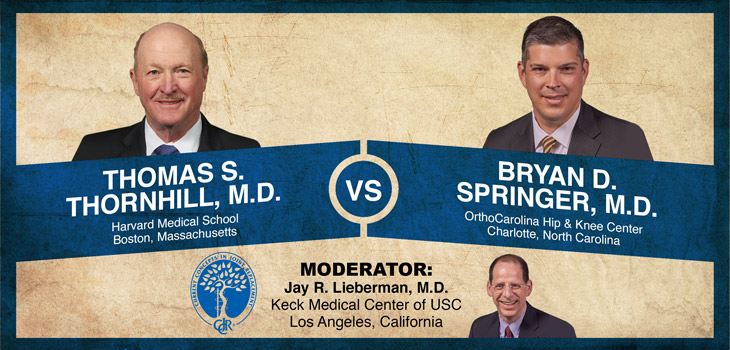
Moderator Lieberman: Tom, let’s say a bad rheumatoid or a patient just has PCL insufficiency and so, you have to use a PCL sacrificing knee. What technique do you use when you do that? Similar techniques, similar flow?
Dr. Thornhill: Oh yeah, no, no, no, no. Yes. My increase in PS knees from the past year has actually doubled. I’ve done two this year. (laughter) The one thing that we didn’t talk about…the PCL, the ACL. I know Adolph said 65% of the people with total knees have an intact ACL. That’s not been my experience. ACL’s intrasynovial. The PCL is extrasynovial. It’s even intact in rheumatoids because it’s outside the synovium. So, yes, I use the same gap balancing technique because you can do it in a PCL sacrificing…
Moderator Lieberman: You mean measured resection technique.
Dr. Thornhill: No, no. I do gap balancing if I do a PS. And I do the same with revision. You can’t do it in a CR like in a tight varus knee as I demonstrated. And by the way, when Bryan left, we did tell him to look for some other way to do a total knee. (laughter) He’s a terrific surgeon. He’s a great guy and he had the foresight to marry a wonderful woman from West Virginia, so that’s our connection.
Moderator Lieberman: Bryan, one of the issues when you’re doing the gap balancing technique is that sometimes, let’s say, you have a bad varus knee. The lateral soft tissues are really stretched out, and so it seems like when you put the lamina spreader in there you can spread it out. How do you manage that? I think that’s one of toughest things when you’re doing the gap balancing technique. Because you’re really not gap balancing completely. You want to go through that because I think that’s important for the audience.
Dr. Springer: Sure. The issue is how far do you take your medial release until you get to the point where you’ve made the medial side of the knee incompetent. Even in most bad varus knees, you can release the posterior medial corner. You can medially reduce the tibia. You can remove all the osteophytes. And in the majority of cases you are able to catch up in that situation. I think that the issue you get into is when you over-release, people immediately go for the superficial MCL and then they create that medial-sided laxity.
The unanswered question is how much laxity you will accept on the lateral side of the knee. I think as Dr. Thornhill mentioned there is some inherent lateral laxity that’s more than the medial side of the knee and maybe one of the disadvantages of gap balancing is you tend to probably over-release trying to create that symmetry that you want. I like to put my knees in very tight, so I don’t like to see a lot of laxity on the medial or the lateral side. And I tend to try and shy away from techniques like aggressively pie-crusting and things like that. It gets to the issue of how much laxity you’ll allow on the lateral side of the knee.
Moderator Lieberman: Thank you very much. Superb job gentlemen.
Please visit www.CCJR.com to register for the 2019 CCJR Winter Meeting, – December 11 – 14 in Orlando.
