
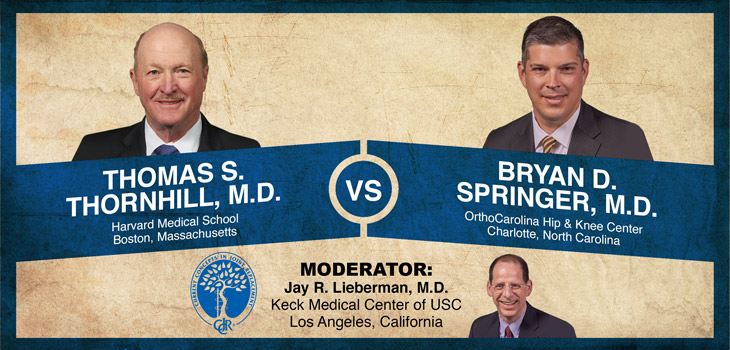
This week’s Orthopaedic Crossfire® debate was part of the 34th Annual Current Concepts in Joint Replacement® (CCJR®), Winter meeting, which took place in Orlando. This week’s topic is “Measured Resection Trumps Gap Balancing in TKA.” For is Thomas S. Thornhill, M.D., Harvard Medical School, Boston, Massachusetts. Opposing is Bryan D. Springer, M.D., OrthoCarolina Hip & Knee Center, Charlotte, North Carolina. Moderating is Jay R. Lieberman, M.D., Keck Medical Center of USC, Los Angeles, California.
Dr. Thornhill: Let me just tell you, it doesn’t really matter whether you do gap balance or measured resection. The techniques are often combined.
Bryan Springer is a former fellow, he’s a colleague, he’s a friend, he’s got a West Virginia connection, but Bryan, I am going to beat you like a rented mule. Because there’s not much difference between the two.
Measured resection, you’re doing the distal femur, the chamfers, the proximal tibia and the patella. The only real difference is determining femoral rotation. I use measured resection for doing that and part of it is the fact that I am a cruciate retainer. So, I maintain the joint line, reproduce more normal kinematics, easier soft tissue balance and, to me, it’s an easier workflow.
Gap balancing has a different work sequence. You have to remember when you cut the cruciate, you open up the flexion space and it needs to be 2mm smaller. And the extension mechanism plays a very key role in flexion. But I use gap balancing in almost every revision situation.
The first thing you need to do in measured resection is to assess the character of the knee. Is it tight? Is it loose? Does it have a flexion contracture? Is it varus, valgus, correctible or over correctible?
In a valgus knee, relatively loose, almost comes into a full extension, but if it’s got laxity on the medial side, you don’t do a big medial resection…in fact, I’ll leave a little bit of the meniscus just to get into the right arena.
I then do the preliminary soft tissue balance based on the resection I made, the soft tissues, and I cut the femur by measured resection.
And yes, you do tend to take off less so you don’t elevate the joint line because you’ve maintained the flexion space with the PCL [posterior cruciate ligament].
Now rotation. This is where the difference is. I do it based on landmarks. And I’ve used a posterior axis—doesn’t work very well on valgus knees—I’ll use the epicondyle…sometimes hard to find…I tend to use the transtrochlear line, or Whiteside’s line, but it’s not always from the top of the notch to the bottom of the trochlea, but rather a combination.
All component systems have different sizers. If I have a varus knee and I’ve done my cut, if I put a spacer in there, I am still way too tight on the medial side of the knee because I haven’t cleared everything out. What I will then do is look at the posterior cruciate, which is the lateral ligament of the medial side of the knee, where rotation occurs.
But remember the lateral space in flexion is looser so you never truly get a flexion space that’s equal.
The tibial cut is a measured resection cut. The patella cut is a measured resection cut. I do a final soft tissue balance. You can do it with the trial components, which I do. You can, if you want, look at spacers as long as you have a check.
I don’t think they’re that much different. You check the flexion. You must get into full extension and then flexion to gravity will tell you, once the capsule is closed, that the extension mechanism is clearly back in place. This will now tell you roughly what you’re going to aim for for post-operative flexion.
So, I use measured resection in primary total knee because I am a cruciate retainer. I think it’s easier for me. I think it actually helps balance the flexion space and it’s an easier workflow.
Bryan, there’s a movie coming out, in which I starred, called Total Kneecall and it will be coming to a theater in Charlotte within the next several years and I will get you a free ticket.
