
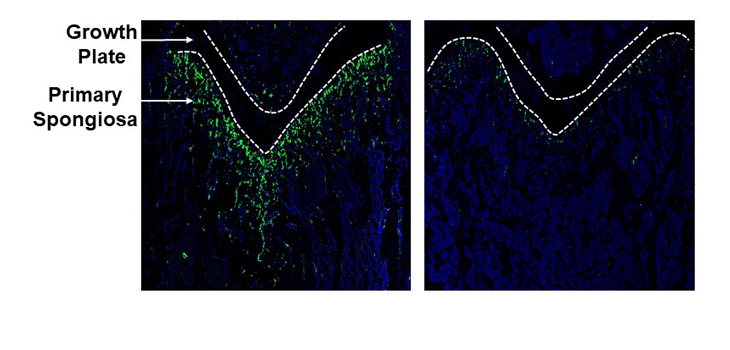
“Glucocorticoid-induced osteoporosis is the most common form of secondary osteoporosis. Long-term treatment of glucocorticoids has been widely used in the management of chronic inflammatory childhood illnesses such as rheumatoid disorders, Crohn’s disease, nephrotic syndrome as well as rare genetic diseases such as Duchenne muscular dystrophy.”
“Although the use of glucocorticoid has led to improved outcomes and survival rates, it is at the cost of substantial adverse effects on bone. Epidemiologic studies have shown an up to 34% prevalence of vertebral fractures in children and youth with long-term glucocorticoid therapy.”
“This study aims to understand how epigenetic mechanisms control bone growth/accrual during childhood and adolescence. We found that mesenchymal stem/progenitor cells (MSPCs) in primary spongiosa of long bone during late puberty undergo a normal programed senescence, which is epigenetically controlled by a polycomb histone methyltransferase Ezh2 and its H3K27me3 mark. Premature acquired senescence during early puberty leads to impaired angiogenesis and osteoblastogenesis as well as bone loss in later adult life.”
“Glucocorticoid treatment also caused early onset cellular senescence in primary spongiosa of long bone during early pubertal mice.”
“Importantly, GSK-J4, a specific H3K27 demethylase inhibitor, elevated H3K27 methylation, blocked the early onset cellular senescence, and rescued the bone-loss phenotype induced by glucocorticoid treatment. Our finding establishes MSPC senescence as a normal programmed cell fate change in postnatal skeleton and demonstrate proof-of-concept for targeting Ezh2-H3K27me3 in juvenile osteoporosis.”
