
Overview:
FDA grants 510(k) clearance to a novel autobiologic matrix for rotator cuff repair.

The U.S. Food and Drug Administration (FDA) has granted 510(k) clearance to an autobiologic matrix for rotator cuff repair.
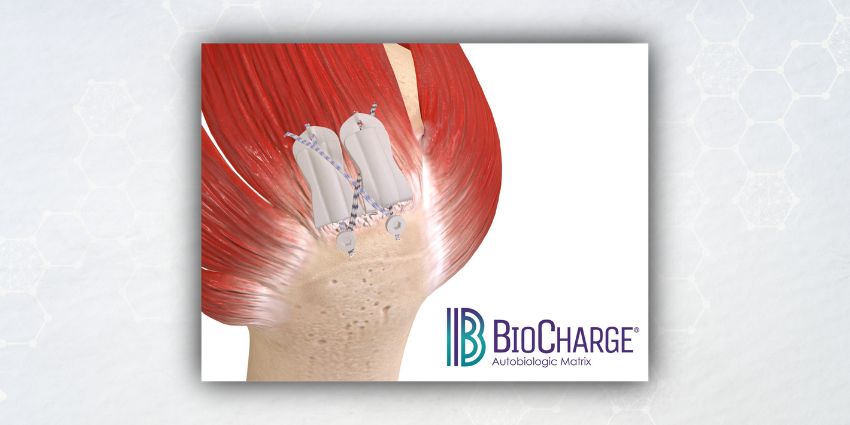
According to the FDA summary document the synthetic implant is a “bioresorbable wick accessory to be used in conjunction with suture anchors for rotator cuff repair.”
It is “placed over the tendon and is designed to facilitate tendon-bone reattachment.” The new product from Atreon Orthopedics LLC is an “electrospun, non-woven, microporous, microfiber matrix” and is “made from two types of polymer fibers: Poly(lactide-co-caprolactone) (PLCL) and Polyglycolic acid (PGA).”
This novel, single use device, according to the 510(k) summary document, is intended to be used “in conjunction with suture anchors for the reattachment of tendon to bone in rotator cuff repairs.”
Predicate Device
In order to qualify for shorter and earlier 510(k) clearance a device must be substantially equivalent to a predicate device.
Here, Atreon’s device, brand named BioCharge®, was deemed substantially equivalent to the predicate, also developed by Atreon, Rotium™ Bioresorbable Wick, which, according to the 510(k) summary document, is “intended for use, indications, environment of use, principles of operation, materials of construction, body contact, packaging, technological characteristics, sterilization, labeling, shelf life, or performance are unchanged.”
Atreon Orthopedics and BioCharge®
Atreon Orthopedics LLC, based in Dublin, Ohio, is marketing its rotator cuff wick as BioCharge® Autobiologic Matrix.
According to Atreon Orthopedics, the implant is the “first-of-its-kind fully resorbable synthetic scaffold designed to supercharge tendon healing with a significantly simplified surgical technique.” The implant utilizes Atreon’s electrospun nanofiber platform technology.
BioCharge, as an onlay scaffold, encourages the patient’s natural healing response via its wick active biology. It also discourages the formation of scar tissue thanks to its promotion of cellular activity. The scaffold also, per the press release, reinforces the suture-tendon interface to “minimize suture cut-through failure risk.”
Atreon CEO Ronald Bracken told OTW, “We’re excited to expand our rotator cuff augmentation portfolio, building on the proven success of our flagship product, the Rotium Bioresorbable Wick.”
Bracken continued, “Retear rates remain high due to the complexities of tendon disease. With the introduction of BioCharge, Atreon is the only company offering solutions engineered to support native remodeling at both the tendon-bone and tendon-suture interfaces, resulting in improved treatment options for surgeons and their patients.”
Following the 510(k) clearance of the BioCharge Autobiologic Matrix, Atreon also received 510(k) clearance to expand the use of its Rotium Bioresorbable Wick to all tendon repairs. According to the press release, Rotium is now being “adopted for a wider range of high-volume tendon repair procedures, including Achilles, triceps, patellar, quadricep, gluteus medius and various applications for the foot and ankle.”
