
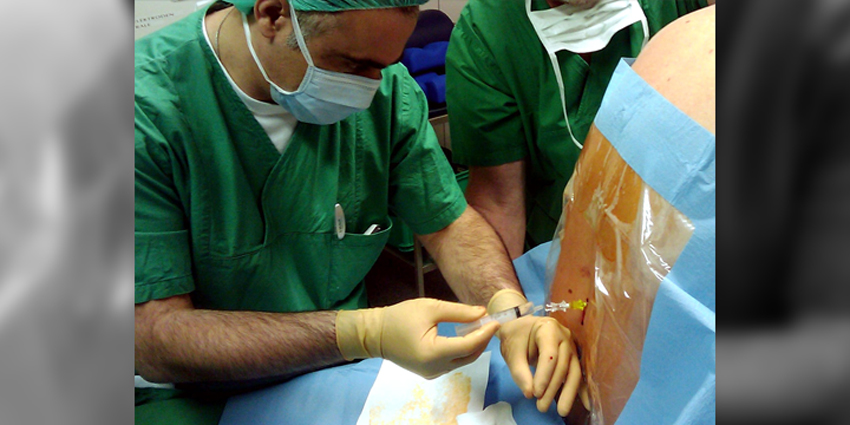
A new study from the Hospital for Special Surgery (HSS) and Weill Cornell Medical College has teased out new information about how to employ, indeed predict the effectiveness, of erector spinae plane blocks to impede pain signals in MIS spine interventions.
The new paper, “Predictors for Failure to Respond to Erector Spinae Plane Block Following Minimally Invasive Transforaminal Lumbar Interbody Fusion,” was published in the December 1, 2024, edition of Spine.
“Multimodal analgesia has been an important research topic in recent years especially in light of the efforts to reduce postoperative opioid consumption when possible and appropriate,” explained Sheeraz Qureshi, M.D., co-chief of HSS Spine.
“Erector spinae plane blocks have been shown in multiple studies to reduce opioid consumption and postoperative pain levels in other areas of surgery (breast, thoracic). Erector spinae plane blocks may be an important part of perioperative pain management especially in the context of developing an ambulatory Minimally Invasive Transforaminal Lumbar Interbody Fusion (TLIF) protocol, however, not all patients respond equally to erector spinae plane blocks. We were curious about the predictors of poor patient responses to erector spinae plane blocks.”
For this study, the HSS team collected retrospective data from 134 patients who had been treated with an MIS TLIF intervention and who had received erector spinae plane blocks by a single anesthesiologist perioperatively at a single institution (HSS).
The research team found that 49 patients (36.6%) did not respond to an erector spinae plane block.
The team found that the following independent variables were predictive for failure to respond to erector spinae plane blocks following MIS TLIF:
- female sex,
- preoperative opioid use,
- anxiety requiring medication, and
- hyperlipidemia.
“A history of preoperative opioid use was definitely not a surprising risk factor, given what we know about the impact of chronic opioid use on pain perception and modulation,” noted Dr. Qureshi to OTW.
“Some other potential risk factors we were considering were greater intraoperative blood loss and preoperative symptom duration, among others. Hyperlipidemia was a surprising predictor and given its complex interactions with our nervous system and vasculature; it’s difficult at this point to make any conclusions.”
Pain Sensitivity, Anxiety
“There are multiple studies, both in human and animal models, investigating the potential link between gender and differences in pain sensitivity. This is a multifaceted and complex topic. However, some literature seems to suggest that women have greater sensitivity to pain. More research is certainly needed in this area, but this could be one factor that impacts erector spinae plane block responsiveness among many others.”
Regarding anxiety’s role, Dr. Qureshi told OTW, “Anxiety requiring medication was also not a surprising predictor given the existing studies in the literature that show that preoperative anxiety and high levels of catastrophizing have been shown to be associated with longer-term post-surgical pain.”
“Anxiety is also a multifactorial phenomenon and may be related to chronic changes in the nervous and endocrine system that then may impact postoperative pain. While we don’t want to make premature conclusions, we believe anxiety may continue to emerge as a predictor of erector spinae plane block responsiveness and as a predictor of outcomes in other multimodal analgesia studies in the future.”
“While erector spinae plane blocks are fairly new to the scene compared to other perioperative pain management modalities, they have been shown to be a safe and effective component of multimodal analgesia in various surgical subspecialties.”
“Our hospital and care team are always striving to be on the forefront of new and developing methods to improve patient outcomes and comfort following spine surgery. If we can better understand the predictors of erector spinae plane block responsiveness, this will allow our care team to better counsel patients on perioperative expectations, which is a critical aspect to patient education.”
