
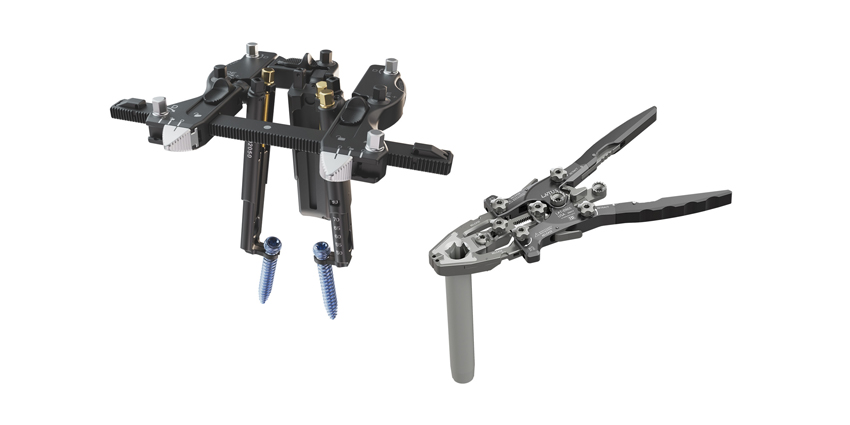
Sometimes, it all comes down to a good retractor. Start well, end well.
To that end, a new, 2-access (not 2-axis?) retractor for MIS lateral spine surgery along with a novel pedicle-based retractor system have been launched by Lewisville, Texas (population 112,000, just outside Dallas) based Orthofix Medical.
The 2-access systems for minimally invasive spine (MIS) procedures are brand named: the Lattus Lateral Access System and the Fathom Pedicle-Based Retractor System.
One feature of the Lattus Lateral Access System is independent blade retraction strength with a “down-and-out” splay feature.
Kevin Kenny, president of Orthofix Global Spine, explained the benefit of that feature to OTW: “The independent blade retraction feature enables the surgeon to manipulate one blade at a time to fully customize the access to the anatomy.”
“The down-and-out splay feature allows the blade to stay level as the surgeon angles the blades for greater visualization of the spine. Keeping the blade level is advantageous as it reduces the potential for tissue to come up under the blade.”
“The Lattus Lateral Access System addresses five important areas of lateral spine surgery,” explained James Lynch, M.D., a spinal neurosurgeon and president of the Swift Institute in Reno, Nevada,
- “access to the spine,
- preparation or removal of the disc,
- interbody placement,
- plate fixation, and easy integration with intraoperative monitoring through an advanced interface.”
“This improved lateral portfolio optimizes each procedural element, from access to fusion, so that I can efficiently and effectively treat each patient’s unique spinal condition.”
Giving Surgeons a Retractor Length Choice
The Fathom Pedicle-Based Retractor System has three points of active telescoping blade fixation, meaning that the surgeon can control the length of each blade and set a customized lateral to medial tilt.
Fathom’s benefit, explained Dr. Kenny, is the variable blade length. With that, “The surgeon can adjust the retractor based on the patient’s anatomy.”
“Other retractor system force surgeons to choose between a pre-set cranial/caudal blade length. With Fathom’s telescoping cranial/caudal blades, a surgeon can now dial in the precise length needed for each patient which is unique compared to all other pedicle-based retractor systems available on the market.”
Orthofix’s Kenny added: “We are pleased to offer two truly market differentiating access systems. The Lattus Lateral Access System, when paired with our innovative WaveForm 3D printed interbody implants, integrates seamlessly into our lateral access procedural solution.”
“Likewise, the Fathom Pedicle-Based Retractor System integrates with our Mariner MIS pedicle screw system and the 7D FLASH enabling technology platform to meet surgeon’s needs and greatly expands our ability to provide full procedural solutions in the OR.”
“Fathom also enables a reproducible surgical workflow, enhances visualization with minimal soft tissue disruption, and complements the complete TLIF [transforaminal lumbar interbody fusion] procedural solutions offered by the Company.”
Finally, “When using Fathom, a surgeon’s first step in performing a TLIF is always to place screws into the pedicles. This approach helps surgeons orient themselves around the pedicles first, and quickly move forward with the remaining steps in the procedure (decompression, disc prep, etc.).”
“Orthofix is committed to not only launching differentiated products in the market, but we are also making a deliberate effort in advancing each of these procedures. Both access systems give us the ability to now integrate numerous products seamlessly into the procedure, all working hand-in-hand. This is something that our surgeon partners are extremely excited about.”
