
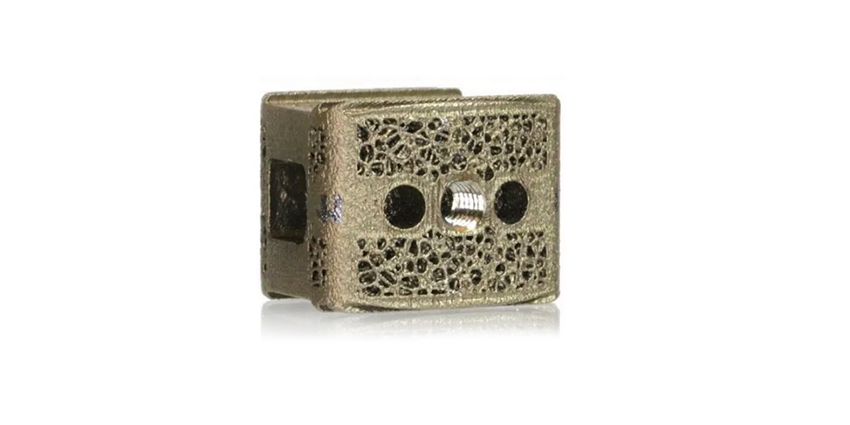
The U.S. Food and Drug Administration (FDA) has granted 510(k) clearance to an intervertebral body fusion device that is surface treated with hydroxyapatite.
According to the FDA 510(k) summary document, the implant is a “spacer which inserts between vertebral bodies in the anterior column of the cervical spine” and is a 3D printed titanium structure whose surfaces have been “treated with a 20-40 nanometer thin hydroxyapatite (HA) surface treatment.”
The system is “indicated for intervertebral body fusion of the spine in skeletally mature patients” and “designed for use with autogenous bone graft to facilitate fusion. One device may be used per intervertebral space.” Moreover, “the implants are intended to be used with legally cleared supplemental spinal fixation cleared for the implanted level.”
The manufacturer is Tallahassee, Florida-based VySpine and the brand name is UniVy™ OsteoVy™-Ti Cervical IBF System.
The implant is “intended for use at one level in the cervical spine, from C3 to T1, for treatment of cervical degenerative disc disease (DDD is defined as neck pain of discogenic origin with degeneration of the disc confirmed by history and radiographic studies).” The system is to be used in “patients who have six weeks of non-operative treatment.”
The system features “VySpine’s NanoVy-HA technology in partnership with Promimic AB.” Mölndal, Sweden-based BPromimic AB creates and markets biomaterials for improved osseointegration.
The process of surface-treating the implant with hydroxyapatite is itself a novel and branded process—NanoVy-HA. According to the company, NanoVy-HA is a process in which the 3D printed UniVy OsteoVy-Ti implant is surface-treated with hydroxyapatite. Unlike traditional coating which tends to be 50 micrometers thick, NanoVy-HA surface treatment is only 20 nanometers thick.
According to VySpine, “the NanoVy-HA coating penetrates the unique porous lattice structure of the UniVy OsteoVy-Ti implant” and “NanoVy-HA’s combination of high wettability and optimal surface chemistry, with optimized nano-roughness, mediates bioactivity and specific protein adsorption to the implant.” Additionally, “these properties regulate cell behavior and influence tissue regeneration by increasing the osteoblast functions, building more bone faster.”
A device must be substantially equivalent to a predicate device to qualify for the shorter and earlier 510(k) clearance. According to the 510(k) summary document, the UniVy, OsteoVy-Ti Cervical IBF System components are substantially equivalent to the primary predicate device, UniVy OsteoVy-Ti Cervical IBF System, and the secondary predicate device, Alphatec IdentiTi NanoTec.
