
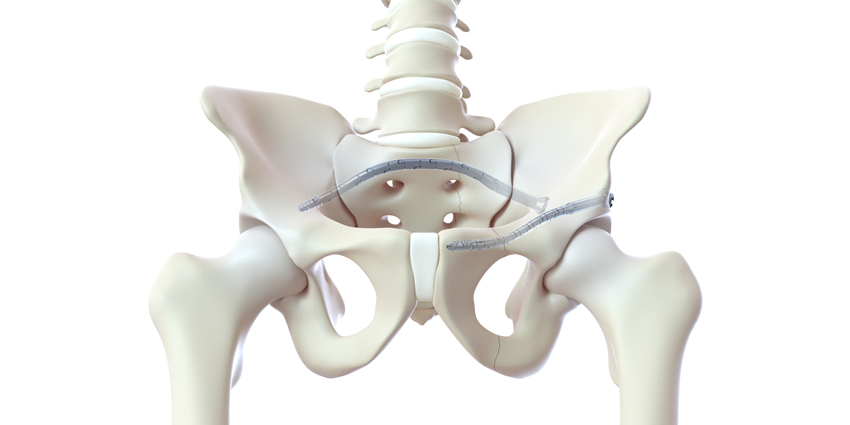
CurvaFix, Inc., based in Bellevue, Washington, has just launched a smaller diameter, 7.5mm, version of its novel curved and steerable fixation nail.
CurvaFix President and CEO Steve Dimmer tells OTW that the company was responding to surgeon requests for a 7.5mm implant so that CurvaFix technology could be used for certain types of pelvic fractures in smaller patients.
“I’ve been pleasantly surprised with the flexibility of the CurvaFix devices, and I believe they will continue to play a role in pelvic fixation, especially in osteoporotic patients,” said Brett Crist, M.D., Director of Orthopaedic Trauma Service and Orthopaedic Trauma Fellowship at the University of Missouri in Columbia.
“We recently treated a 63-year-old morbidly obese female (BMI 46.5) patient who sustained a low energy fall two years prior, resulting in pelvic fragility fractures. Her treatment had been non-operative management, leaving her wheelchair-dependent before eventually being referred to me.”
“Based on her pre-operative CT scan, sacral dysmorphism, and bone quality, I thought the 7.5mm CurvaFix Implant would work well and that the maneuverable ball-tipped guide wire would aid us in being able to align the rami for fixation. Pleased with the stability that the 9.5mm CurvaFix device provides in osteoporotic patients, I wanted to use the smaller device to be able to place it in the smaller corridor.
“Overall, I was very pleased to be able to use the new 7.5mm CurvaFix devices for the left and right rami nonunions and the second sacral corridor while also being very satisfied with the smoothness of the anterior ring fixation,” continued Dr. Crist.
“Following two years of being dependent on a wheelchair, this patient was discharged from the hospital with a walker within 24 hours of her CurvaFix procedure. Moreover, her Visual Analog Scale for pain (VAS) was between an 8 and 9 prior to her surgery, and within 12 hours of the procedure, her VAS pain score was down to a 3.”
“The new 7.5mm device is designed to simplify surgery and provide strong, stable, curved fixation in smaller patients,” said Steve Dimmer. “Additionally, our novel device has been shown to offer many geriatric patients immediate pain relief and early mobility, which is critically important in older patients where mobility is such a key to life.”
Indeed, one estimate indicates that the incidence of geriatric pelvic fractures is growing at 9% per year, bringing the estimated number of geriatric pelvic fractures to over 150,000 in 2023, 80% of whom are female.1
As for what makes the 7.5mm CurvaFix Implant provide “immediate” pain relief, Dimmer commented to OTW, “Fractures hurt when they move, and CurvaFix IM Implant holds the fracture very still during the healing process, so pain is greatly reduced. The implant follows AO principles of fracture management by holding fracture segments in a load sharing configuration where the bone and the CurvaFix IM Implant share the functional load to minimize motion across the fracture (which causes pain). The advantage of a CurvaFix procedure is that force vectors are widely distributed across both the bone and the longer, wider, curved implant.”
Despite recommendations that surgery should be considered for most patients with fragility fractures of the pelvis, says CurvaFix, only 10% receive surgery today. “For non-operative patients, conservative treatment generally consists of bed confinement, pain control, and mobility assistance if weight-bearing can be tolerated. Often, conservative treatment leads to lengthy hospitalizations, high nursing home admittance, and a high one-year mortality rate.”
Reference:
