
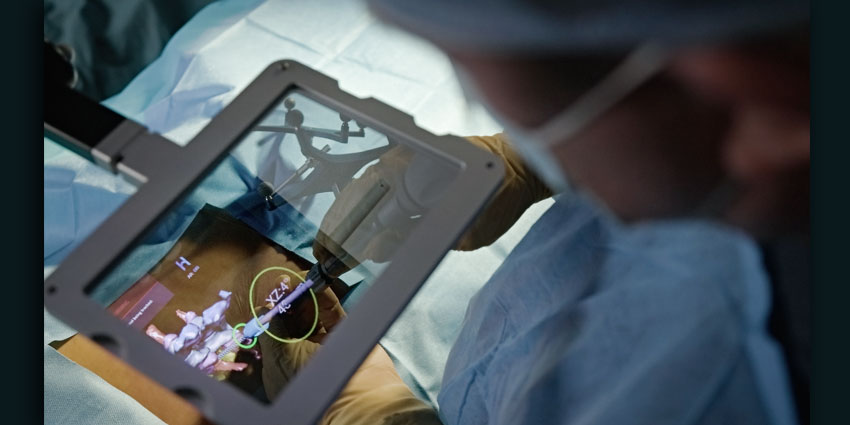
In the shadow of spinal hardware manufacturers NuVasive, Alphatec, SeaSpine and Spinal Elements, just 16 miles north of downtown San Diego and 8 miles from the University of California San Diego campus, in a fairly non-descript office building, is an artificial intelligence and augmented reality company which claims to have the most comprehensive platform of neural networking AI and augmented reality tools of any company in spine.
OTW had a chance to spend a half day at their crowded offices where we put on the glasses to view a holographic display, wiggled a spinous process in an alternative reality of some kind, met a handful of AI engineers and saw first-hand a neural network algorithm that has “learned” the human anatomy.
Most of this company’s employees have PhDs or advanced degrees. The executive team and its board of directors are a who’s who of top medical entrepreneurs. Some have been in digital technology or spine for over 40 years.

With $50 million in cash and over 200 employees, this company wants to lead spine surgeons into the digital technology future and create the conditions for better, more reliable spine surgery outcomes.
Its booth number at NASS on October 12 will be 4841. Its name is Surgalign Holdings, Inc.
Neural Networking Artificial Intelligence in Surgeon’s Hands
The reason neural networking has captured the enthusiasm of both investors and such advanced technology visionaries like former Google CEO Eric Schmidt and, yes, the incubator of so much advanced technology over the years, DARPA (Defense Advanced Research Projects Agency), is because it is the first demonstrably successful example of artificial general intelligence.
Artificial general intelligence, aka: AGI, is artificial intelligence that is not task specific. It, like human intelligence, can tackle unrelated problems, learn from experience (which means it writes its own code) and can make decisions without human direction.
The most famous close example of AGI at work is the way an AI program, AlphaGo, won a game, GO, which had been considered to be incalculable by computers. GO has 10127 possible moves. That’s the number 10 followed by 127 zeros. Is there even a word for that number?
AlphaGo beat the world’s champion player. And it did so by inventing entirely new moves. AlphaGo learned to play the game in just a few months—and then innovated in ways that had escaped 1,500 years of human intellectual effort.
Surgalign is building an AI platform to deploy across the spine care continuum, taking advantage of the power of convolutional neural networks, a type of deep learning within the field of AI/machine learning. The company and its engineers are applying this technology to learn spine anatomy and then embedding this AI in augmented reality and robotics systems.
And putting it into surgeons’ hands.
Vision and Reality
Surgalign’s team, led by CEO Terry Rich, is betting on an artificial intelligence, augmented 3D reality and a robotic assisted future. Underlying the whiz bang aspects of that is a fundamental, unsolved problem in spine surgery—stubbornly sub-optimal patient outcomes.
Of course, spine patient outcomes are better and more consistent than 10 or 20 years ago. But, as the following quote from a recently published clinical paper: “Artificial Intelligence-Driven Prediction Modeling and Decision Making in Spine Surgery Using Hybrid Machine Learning Models,”[i] make clear, outcomes need to improve.
“Interestingly, the increase in performed surgeries is not directly proportional to improved patient outcomes. Impaired quality of life, persistent pain, and functional problems are reported in up to 40% of patients undergoing low back pain surgery and 20–24% undergoing revision surgeries. Indications influencing the decision as to whether a patient should undergo surgery are not entirely based on guidelines but rather on discussions between the surgeon and patient, as well as the expertise and skills of the surgeon. Furthermore, there are no clear guidelines on surgical techniques for treating degenerative spinal diseases; as such, it remains unclear as to whether one treatment approach might perform better in particular cases than another.”
Rich believes that Surgalign’s investment in AI will ultimately answer some of these challenges.
The Surgalign Product Portfolio Today
Today, Rich and his team, are commercializing a market basket of products that were acquired from Surgalign’s predecessor company, RTI Surgical. They are:
- The Streamline® TL Spinal Fixation system, for degenerative and complex spine procedures; the Streamline® MIS Spinal Fixation System, a broad range of implants and instruments used via a percutaneous or mini-open approach and the Streamline® OCT system, for Occipito-cervico-thoracic posterior spine surgery.
- The Fortilink line of interbody fusion implants: Fortilink®-TS, Fortilink®-L, Fortilink®-A, Fortilink®-C IBF system (a cervical interbody fusion device with TETRAfuse® 3D incorporated).
- The TETRAfuse® 3D technology, which is 3D printed with nano-rough features that have been shown to allow more bone cells to attach to more of the implant, increasing the potential for fusion.
- A line of cervical products including: CervAlign® ACP System, a comprehensive anterior cervical plate system.
- The Coflex® Interlaminar Stabilization device, the only FDA PMA-approved implant for the treatment of moderate to severe lumbar spinal stenosis in conjunction with decompression.
- The HPS® 2.0 Universal Fixation System, a pedicle screw system used for posterior stabilization of the thoracolumbar spine that includes a unique dynamic coupler, shown to preserve motion and reduce the mechanical burden on adjacent segments.
- The SImmetry® SI Joint Fusion System for MIS SI joint fusion and includes joint decortication, bone grafting and fixation.
- A wide variety of biologic and bone grafting products:
- Viable cell allograft: ViBone® and ViBone® Moldable, viable cellular allograft bone matrix products intended to provide surgeons with improved results for bone repair.
- DBM allograft: BioSet®, BioReady®, and BioAdapt®, DBM putty, putty with chips, strips—configured for various surgical applications while providing osteoinductive properties.
- Synthetic Bone Substitutes: nanOss® and nanOss® 3D Plus, osteoconductive nano-structured hydroxyapatite (“HA”) and an engineered extracellular matrix bioscaffold collagen carrier.
In the trailing 12 months, Surgalign sold about $83 million of these products. Most recently, it introduced HOLO Portal™, its first product in their digital surgery strategy and a component of its planned HOLO™ AI portfolio.
FDA Cleared HOLO for Commercial Sale This Year
The FDA cleared Surgalign’s HOLO Portal™ for commercialization in the U.S. this past January 14, 2022. The HOLO Portal™ is a surgical guidance system that employs augmented reality and artificial intelligence to intraoperatively assist the spine surgeon. It combines image-based guidance, AI generated spine segmentation and screw planning, and a unique holographic display.
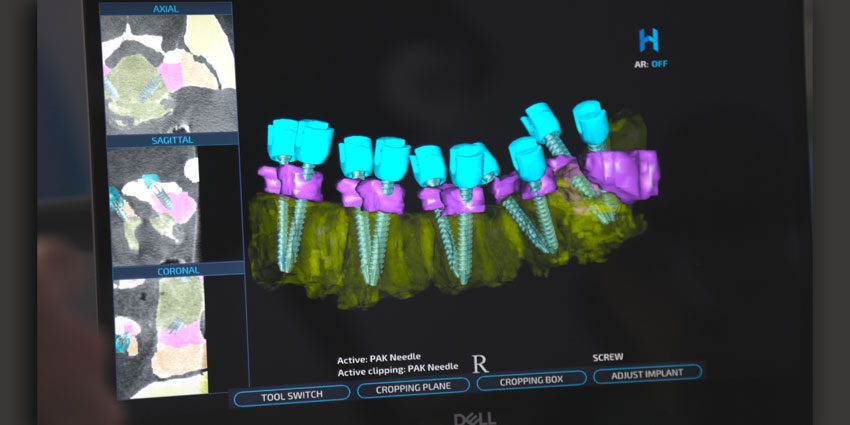
The HOLO Portal™ software includes several convolutional neural networks to segment and group patient anatomy based on intraoperative CT scans. This results in a patient-specific 3D model that is automatically labeled with anatomic structures for use during surgery.
Using this patient specific model, HOLO Portal™ software measures pedicle sizes from the patient-specific 3D model. The system then suggests a trajectory and the appropriate screw size based on a surgeon-defined pedicle fill ratio. The resulting surgical plan is designed to maximize construct stability and eliminate time spent manually planning trajectories and measuring screw sizes.
Once the segmentation and screw plan are generated, HOLO Portal™ displays the surgical plan intraoperatively through the interactive AR display and provides a 3D guidance overlay on the patient’s anatomy. 3D trajectory and targeting are superimposed on surgical instruments in real time within the surgical field.
Keeping the Focus on the Surgical Field
Surgalign’s innovative design may reduce the surgeon’s cognitive load by providing intuitive guidance that allows the surgeon to keep focus on the surgical field. Surgalign believes that HOLO Portal™ technology may help surgeons achieve better surgical outcomes, reduce complications, and improve patient satisfaction.
The Most Advanced AI Technology in Spine
To drive the evolution of digital health is Surgalign’s ultimate objective. Rich and his team have developed an artificial intelligence platform called HOLO™ AI, which connects and integrates diagnostics, pre-op planning, clinical intervention, and post-op care—in short, the continuum of care.
HOLO™ AI is designed to generate insights that can improve outcomes, reduce complications, and raise patient satisfaction levels.
Rich believes that HOLO™ AI is one of the most advanced AI technologies in the market, with applications beyond the spine and outside operating room.
For example, Surgalign’s HOLO Portal™ surgical guidance system, a component of the HOLO™ AI platform, has the ability to automatically recognize, identify, and segment patient anatomy.
Other HOLO™ AI products under development use AI, for example, to analyze diagnostic MRI images, where it is used to quantify stenosis, disc degeneration, and alignment—automatically and with no human intervention.
Basically, the system knows and has learned each patient’s anatomy. It is nothing less than an intelligent 3D anatomical mapping technology.

Rich and his team plan to leverage the HOLO AI platform and demonstrate to spine surgeons how it will improve their patient outcomes and, not so coincidentally, drive adoption of Surgalign’s extensive portfolio of spinal hardware implants and biomaterials.
Surgalign is the first and farthest along, as far as we know, in bringing to market AI across the care continuum, including surgery. Surgalign also plans for the HOLO™ AI platform to work across specialties and with modern interoperability standards. That’s huge for hospitals and clinics. When they make a consequential investment into robotics, augmented reality, or AI, it improves the return on that investment if multiple surgeons can use the system for multiple cases—not just spine.
Again, just a reminder. Surgalign’s booth number at NASS is 4841.
Having had hands-on experience with the HOLO system (and not broken it—which is saying something), we are sure you will be impressed with its power and capabilities when you see it at NASS in Chicago this October.
Coming Out Party at NASS
2021 was a transitional year for Surgalign. The company hired a number of key executives, bolstered its software engineering and AI group and took a 42% equity interest in Inteneural Networks Inc., a company which has developed a proprietary AI technology for autonomously segmenting and identifying neural structures from medical images. This will help them expand HOLO™ AI into the neuro space, with software so powerful it has the ability to identify possible pathological states.
Earlier this year, of course, the company received 510(k) clearance for the flagship HOLO PortalTM system, the world’s first AI-driven, augmented reality guidance system for spine surgery.
And NASS this year, starting October 12 in Chicago, will be Surgalign’s big coming out party. If you are planning to attend—and it looks like NASS will have its best attendance in a least three years—then a visit to Surgalign’s booth will, effectively, be a visit into the digital future of spine.
See you there.
- [i] Saravi B, Hassel F, Ülkümen S, Zink A, Shavlokhova V, Couillard-Despres S, Boeker M, Obid P, Lang M. Artificial Intelligence-Driven Prediction Modeling and Decision Making in Spine Surgery Using Hybrid Machine Learning Models. Journal of Personalized Medicine. 2022; 12(4):509. https://doi.org/10.3390/jpm12040509
