
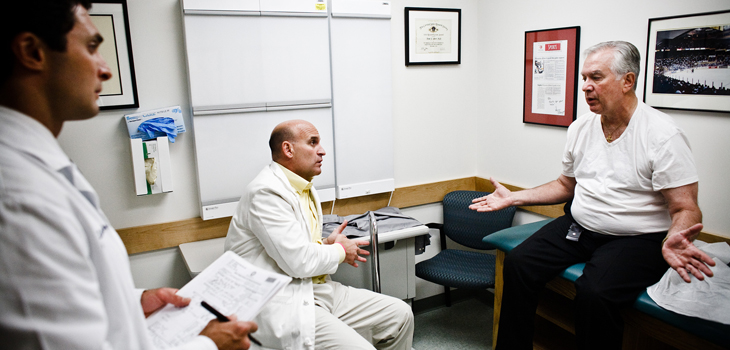
As a surgeon, you might hear lots of opinions and suggestions from patients on the type of treatment you are considering. And then, there may be a few who say, “No thanks, doc…I don’t want any say in my treatment.” Researchers from the Department of Orthopaedic Surgery at Stanford University in California set out to determine how much orthopedic patients truly want to be involved in the decision-making process. Their work, “Patient Preferences for Shared Decision Making: Not All Decisions Should Be Shared,” appears in the May 15, 2020 edition of The Journal of the American Academy of Orthopaedic Surgeons.
Co-author Robin Kamal, M.D., M.B.A., assistant professor and medical director in the Department of Orthopaedic Surgery at Stanford explained why he and his team decided to examine this very interesting research topic. “There has been a lot of work focusing on improving decision making, engaging patients in these decisions, and ensuring patients are aware of all of the options so their decision aligns with their values and preferences.”
“But a lot of shared decision-making models are based on primary care and not surgical management of conditions, where there are a number of decisions being made. The bounds of shared decision-making—where in theory you could present hundreds of decisions to patients—have not been studied. We asked this question because it is not feasible to discuss every decision with patients, while at the same time, we want to engage patients in decisions that are important to them.”
The team took a look at data from 115 patients at an orthopedic surgery clinic who rated their preferred level of involvement in 25 different clinical decisions. Involvement was categorized as follows: passive (0), semi passive (1-4), equally shared involvement between patient and surgeon (5), semi active (6-9), and active (10).
The authors wrote, “Patients preferred semi passive roles in 92% of decisions assessed. Patients wanted to be most involved in scheduling surgical treatments and least involved in determining incision sizes. No difference exists in desired decision-making responsibility between patients who had undergone orthopaedic surgery previously and those who had not. Younger and educated patients preferred more decision-making responsibility. Those with Medicare desired more passive roles.
Dr. Kamal commented to OTW, “Our results suggest that there are certain decisions we should stop and focus our efforts to engage patients in and create formal decision aids, and others where a simple educational handout that informs the patient of a surgeon’s typical practice will suffice to involve patients in their care.”
