
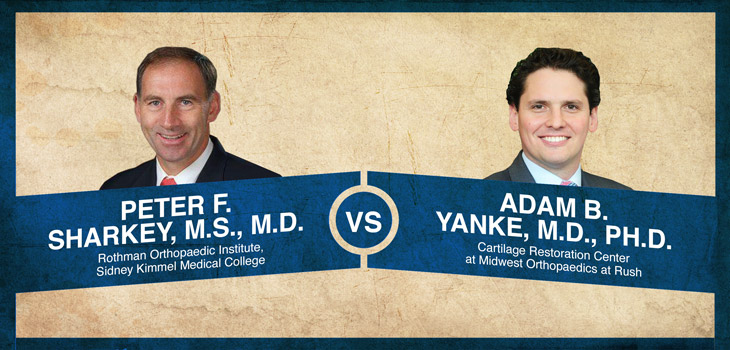
At the 2019 Orthopaedic Summit: Evolving Techniques (OSET) held in Las Vegas this past December, two well-respected orthopedic surgeons debated the issue of whether bone edema is a bone or a joint issue. Peter F. Sharkey, M.S., M.D., Professor of Orthopaedic Surgery, Rothman Orthopaedic Institute, Sidney Kimmel Medical College and Adam B. Yanke, M.D., Ph.D., of the Cartilage Restoration Center at Midwest Orthopaedics at Rush—debated the treatment of a 43-Year-Old Rock Climber With Pain On Medial Side Of Her Knee, MRI Confirms Bone Edema & A Narrow Medial Joint Line But Not Bone On Bone – What To Do?
Subchondral Bone: Importance in OA Pathogenesis, Focused Intervention and Results of Subchondroplasty
Dr. Sharkey: Thank you very much. Today we are debating the role of bone versus cartilage in the pathogenesis of osteoarthritis (OA)…and I’ve been tasked with the bone portion of this equation, i.e., the culprit. Adam is young and wrong! Let me say it again, this is a bone issue!
After 35 years of orthopedic experience, I can tell you that there are only a handful of principles that are absolutely true. We know that radiographs, at least when it concerns osteoarthritis, are not very good predictors of patient symptoms. I think we’d all agree on that, Adam.
Conversely, an MRI provides data that is very relevant to OA pathogenesis. Not only does an MRI show soft tissue and inflammation but—critically—it shows subchondral bone damage. And that damage is the most important finding related to the pathogenesis of osteoarthritis.
Here is why.
Reason number one. An abundance of literature demonstrates that OA-associated BMLs (bone marrow lesions) are a much better predictor of symptoms than cartilage loss. While we know that from X-rays, in addition, multiple studies have shown that BMLs are the strongest predictor of symptoms in patients with OA.
Reason number two. We know the histopathology and the effect on subchondral bone mechanical properties associated with these lesions because we have an enormous amount of retrieval data from total knees and total hips. This bone represents stress and fatigue fractures. And the bone is structurally compromised—irreversibly so. It does not resemble normal subchondral bone.
Reason number three. The weakened subchondral bone can no longer support the subchondral bone plate, which leads to collapse and progressive deformity, referred to by radiologists as subchondral bone attrition and accelerated cartilage loss. In a recent study, there was an incredible correlation between BML grade and the risk of developing subchondral bone attrition.
Reason number four. The progression of pathology leads to the need for a partial or total knee replacement, a fact that has been demonstrated in multiple studies. Many total joint surgeons are of the opinion that an untreated BML will lead to a total knee arthroplasty.
