
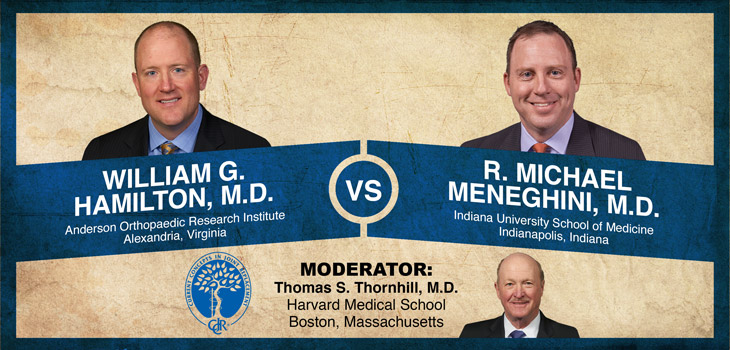
Moderator Thornhill: Show of hands, how many people routinely in primary hips do a direct anterior approach? That’s 63. How many people do a direct posterior approach? That’s 12. (more laughter) Bill, in primary hips, when would you not do the direct anterior approach?
Dr. Hamilton: I’m basically doing this on all primary hip arthroplasty patients with the exception of a Crowe 4 dysplasia where I have to do a subtrochanteric osteotomy. Maybe if I’m taking out a screw and side plate, DHS hardware that I would need to use a different incision. These are few and far between. Basically, I do all patients through the anterior approach.
Moderator Thornhill: Mike, do you think there are any people who should have a direct anterior approach rather than a mini muscle sparing posterior approach?
Dr. Meneghini: I think you could make an argument that it might be advantageous for the hyper-mobile female. We haven’t teased that out in the literature. That might be the one case where really preserving the entire posterior structures makes sense. But again, with larger heads and good technique, I think you can do those patients very well without.
Moderator Thornhill: Interesting. I have the same cost questions that Mike did in terms of the personnel and stuff. Because at our institution length of stay is no different. The complications are more in terms of fractures and stuff like that. And these guys have at least done over 300-400. How long is the learning curve?
Dr. Hamilton: It’s not short. The first 10 to 30 are the cases you need to do to get through the extreme stress. It’s probably 200-300 until you feel real comfortable taking on all comers. And I still learn tricks today and I’m at 3,000 or more. But isn’t that life? Isn’t that hip replacement? We’re always learning tricks on how to do it. So, the learning curve never stops. But to get to the point where everything is equivalent to the posterior approach, somewhere around 100 cases or more.
Moderator Thornhill: I’d hate to be in that 100. (laughter)
Dr. Hamilton: Once again, let me emphasize that the learning curve does not exist for the residents and fellows. All the residents felt most comfortable with the anterior approach. They had little exposure to the posterior approach. The learning curve is going away as we’re training patients and residency and fellowship.
Moderator Thornhill: Do you think the anterior approach should sort of get rid of the anterolateral approach?
Dr. Hamilton: Maybe.
Moderator Thornhill: We don’t use maybe. We use “Yes” or “No.”
Dr. Hamilton: I think it’s dropping significantly.
Moderator Thornhill: Mike, we talk about dislocation. What are your usual posterior precautions in somebody you do a mini posterior approach, which I assume you do?
Dr. Meneghini: We still tell them to take it easy for 4 weeks or so. I think one of the things that this rapid recovery has pushed us to realize is that maybe some patients need to take it easy for awhile just to recover better.
I use range of motion precautions as a way to slow patients down. Have them behave for a number of weeks.
Moderator Thornhill: I do a mini posterior approach and I generally put people, depending upon their rotation with their components in, or their trial components in, on no precautions. And then they go home, and the physical therapist puts them on full posterior precautions like they did 25 years ago.
Both of these were excellent lectures. I thank you both.
Please visit www.CCJR.com to register for the 2020 CCJR Spring Meeting — May 17-20, in Las Vegas.

Dr. Meneghini seems to have made his reputation by reporting the bad results of the anterior approach. He touts his use of the posterior approach but does not report his results regarding alignment, leg length and dislocation. He does not mention use of an alternative approach for cases of spasticity(cerebral palsy etc.)where a posterior approach is contra-indicated. He seems to have a prejudice for the posterior approach rather than an objective view in my opinion.