
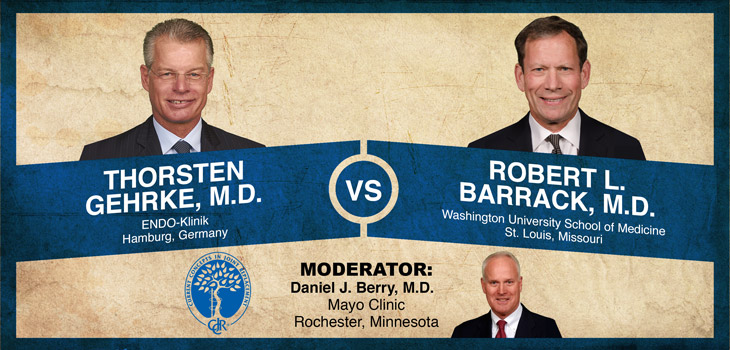
Moderator Berry: Thorsten, the associations might be explained by both selection factors that aren’t adequately controlled for or misdiagnosis of a few taper corrosion cases for infections. So, is it possible that Robert’s argument holds water or are you going to dispute it?
Dr. Gehrke: You’re absolutely right and Robert is right. I also have my criticisms regarding the registries, they are sometimes misleading. On the other hand, what objective data do we have other than registries? We cannot really ignore the registries. I know, there are many confounding factors. We should do a multi-variate analysis and exclude all the confounding factors like BMI, co-morbidities, so on. We need more robust data. And we have to look at the surface properties and formation of biofilm. That would be the most objective.
Moderator Berry: Robert, will you concede that there is a risk for taper corrosion if you do not use a ceramic head? If you use a cobalt-chrome head?
Dr. Barrack: Absolutely. I’ve used nothing but ceramic for years.
Moderator Berry: That’s fine. Will you concede that if you get taper corrosion—admittedly it’s a 1% problem area— and if you get a bad adverse local tissue reaction, that patient might be at a little increased risk for infection.
Dr. Barrack: That would be a good topic for an in-depth study. I think that 90% of the time it would probably be a false positive.
Moderator Berry: Sometimes you do know if there are positive cultures, right?
Dr. Barrack: Right. Have you seen that?
Moderator Berry: Yeah, we have. It does happen. The question is does it happen more often than just any other revision.
Dr. Barrack: But I approach that by just doing ceramic heads. I think that Thorsten’s point brings up the bigger topic about how we interrupt registry data. When you’re talking about failure rates of 3, 4, 5, 6% higher, registries are good. When you’re looking at hazard ratios of fractions of a percent the chances that you have confounding variables are more likely,
Moderator Berry: Your point is very well taken. The ability to adjust for confounding variables is just plainly never very good. Thorsten, the data does look as though ceramics probably are a little more resistant to formation of biofilm than metal. But we can’t say in hip replacement that you’re getting rid of the metal. There is still metal in there, even if you use a ceramic head and a ceramic bearing. Does getting rid of one-third of the metal really make a difference?
Dr. Gehrke: To be honest, no idea. But I think it can influence it a little. We need some more research about it, but I think it influences a little.
Moderator Berry: Gentlemen, both thank you for a stimulating and thought provoking discussion.
Please visit www.CCJR.com to register for the 2019 CCJR Winter Meeting, – December 11 – 14 in Orlando.

Hi – Super important topic and discussion. I am currently completing my Masters in Epidemiology and appreciate a sensible discussion of exposure, outcome, cause and association. But my question today, is where did the syntax “peri-prosthetic infection” come from? Years ago we were discussing PJIs – prosthetic joint infection. Has the description changed officially to “peri-prosthetic”? If so, is this to signify an infection that reaches beyond the joint into the surrounding bone?
Thanks for your consideration,
Jo Elliott