
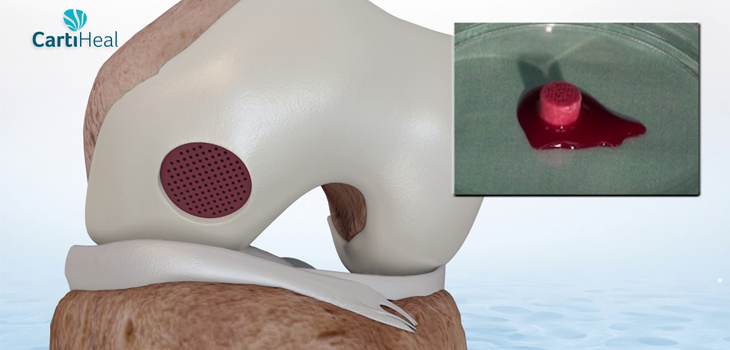
The landmark, 250 patient, Agili-C study took an important step to full enrollment with the news that the Joint Preservation Center at Peninsula Orthopaedic Clinic in Salisbury, Maryland, has enrolled its first patient bringing the total enrolled to date to 241—or 96% of CartiHeal Ltd’s enrollment goal.

Dr. Jason M. Scopp, orthopedic surgeon and director at the Salisbury, Maryland, clinic, described his inaugural CartiHeal study case this way: “Our first patient was a 50-year-old male with moderate osteoarthritis and with two large cartilage defects in a total surface area of 6.8 cm2.”
“One defect was located in the trochlea and the second defect was located on the medial femoral condyle. The patient was randomized to the Agili-C™ treatment arm and was treated with 3 implants.”
“Patients who have cartilage defects are looking for options to not only treat their pain, but also delay the need for joint replacements,” said Dr. Scopp.
“I was very pleased that this patient was randomized to the Agili-C group, as I believe it will provide the solution he is seeking. As the Director of the Joint Preservation Center at Peninsula Orthopaedic Associates, I am able to offer my patients the state-of-the-art techniques to preserve their joints and maintain an active lifestyle. I am excited to enroll more patients who meet the inclusion criteria.”
The Landmark Agili-C Study
The Agili-C study, sponsored by Israeli-U.S. based CartiHeal Ltd, and funded by Johnson & Johnson, Bioventus, Elron, Accelmed, Access Medical Ventures, aMoon and Peregrine Ventures, is one of the most ambitious and promising cartilage repair studies in history.
The following table is a comparison of cartilage repair studies BEFORE Agili-C and then the first-of-its-kind Agili-C study—FDA sanctioned.
| BEFORE Agili-C | Agili-C[1] | |
| Age of Patients | Usually up to 55 | Up to 75 |
| Presence of Osteoarthritis | NO | Yes (mild-moderate) |
| Number of Lesions | 1-2 | Up to 3 |
| Type of Defects | Cartilage | Cartilage and ostoechondral |
| Concomitant Procedures | Not allowed | Allowed: meniscectomy and HTO |
| Total Defect Size: | 1-4 cm[2] (usually 2 cm2) | 1-7 cm2 |
| Previous Failed Cartilage Treatment | Not allowed[3] | Allowed |
| Control/Comparator | Microfracture[4] | Microfracture and debridement |
| Malalignment Exclusion? | Yes[5] | No (up to 8⁰) |
| Defect Location: | Single Condyle Only | 1 or 2 Condyles, Condyle & Trochlea, 2 Condyles & Trochlea |
[1]https://clinicaltrials.gov/ct2/show/record/NCT03299959?term=cartilage&cond=knee+arthritis&cntry=US&draw=2&rank=48&view=record
[2] https://www.ncbi.nlm.nih.gov/pubmed/22637204?dopt=Abstract
[3] ibid
[4] Crawford DC, DeBerardino TM, Williams RJ 3rd. NeoCart, an autologous cartilage tissue implant, compared with microfracture for treatment of distal femoral cartilage lesions: an FDA phase-II prospective, randomized clinical trial after two years. J Bone Joint Surg Am. 2012 Jun 6;94(11):979-89. doi: 10.2106/JBJS.K.00533.
[5] ibid
