
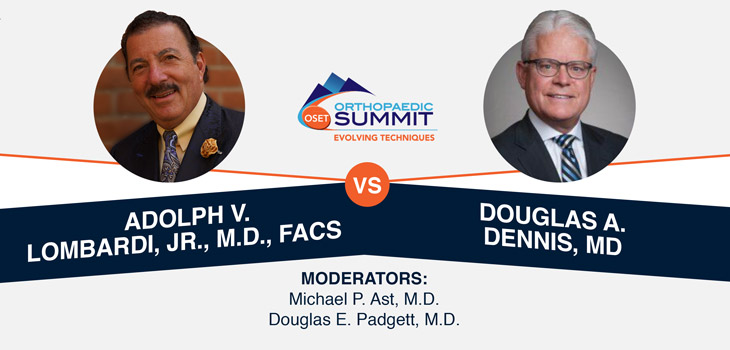
The following debate took place this past December at the 2018 Orthopaedic Summit of Evolving Technologies in Las Vegas.
The Topic: Same Day Total Knee Replacement Versus ‘The Classic’
Speaking in favor of same day total knee replacement (TKR) surgery was world renowned, Athens, Ohio-based surgeon Adolph V. Lombardi, Jr., M.D., F.A.C.S. According to Dr. Lombardi, “I’ve Been Doing It For Years! My Patients Love It!” Opposing Dr. Lombardi is one of the top 25 orthopedic surgeons in the United States, Denver, Colorado-based Douglas A. Dennis, M.D. In response to Dr. Lombardi, Dr. Dennis responded by saying, “Are You Crazy?!?! My Patients Are Well Cared For” Moderating this debate is Michael P. Ast, M.D. and Douglas E. Padgett, M.D.
Dr. Lombardi: I’ve been doing same day total joint for years and supposedly my patients love it. But, let’s start with how do we decide whether or not you’re going to be done as an outpatient?
Does the patient have an ongoing medical issue that cannot be optimized? If the answer is “yes,” postpone and optimize the patient. If it’s “no,” do they have organ failure? If they have organ failure, they have to be done at the hospital. If they don’t, they can be done at a skilled facility. Do they have support mechanisms at home? That’s how we decide.
We started in 2013. Through the end of 2017, we’ve done 6,000 hip and knee arthroplasties in 4,744 patients. Probably by the end of this year, we’ll have another 1,200 to add to this list. There were 1,765 partial knees. There were about a little over 2,000 primary knees, 1,880 hips, and yes, we did some revision hips and knees. There were 47% males and 53% females, up to 90 years of age, and BMIs [body mass index] up to 66.
We have a unit that allows overnight stays. We’ve had 19 patients transferred to an acute hospital and 346 or 5.8% of them stayed overnight; 2.3% of those were for convenience because they were two hours away and later in the day. Then there were 3.8% that stayed or were transferred including that 19 and 228 and mostly what you see is respiratory issues and some of those patients were OSA [obstructive sleep apnea] patients. There was some nausea, some urinary retention, and a smattering of other issues for why they stay.
About 50% of the patients had at least one major comorbidity, which translates to a little bit higher risk for staying overnight: 5% vs 2%. You see nothing really out of the ordinary or really high rates.
What about the complications within 48 hours? Remember, everyone who’s done within my specialty hospital goes home within 24 hours. If I operate on them at two in the afternoon, they are home the next day at two.
Just looking at the surgery center, there were 1% that had some sort of complication (that again includes the 19 patients that were transferred to the acute facility), 11 in hips, 18 partial knees, and 34 knees.
Unplanned care after 48 hours within 90 days was 1.3%. These numbers are very similar to the numbers that are specialty hospitals.
Surgical complications requiring a treatment. There were 74 of these. A lot of these were wound revisions. But we did have four patient deaths, one from a presumed PE [pulmonary embolism], one suicide, and two cause unknown.
What about outpatient revision knee arthroplasty? We did over 88 revisions in 84 patients. The mean age was 58 and BMI of up to 56. About 62% of these had at least one major comorbidity. There were 42 that were revisions of partial knee to total knee and 46 revisions of total knees. A lot of these were for instability and poly wear.
Overnight stays: 76 were discharged the same day. None were transferred to an acute hospital. Eleven stayed overnight: 4 for convenience. Seven stayed for medical reasons. OSA and respiratory issues and nausea as the higher numbers.
Complications within 90 days, no major complication within the first 48 hours. One ER visit readmission due to ileus. No patient deaths within 90 days. No surgical complications or re-operations within 90 days.
In the medically-optimized patient, despite large numbers of comorbidities, outpatient total joint is associated with a low rate of medical and surgical complications. The presence of major comorbidity was not associated with need for extended observation and patient education, medical optimization, and a multi-modal program are what’s needed to mitigate the side effects of narcotic use and to allow patients to go through this in a very safe fashion.
