
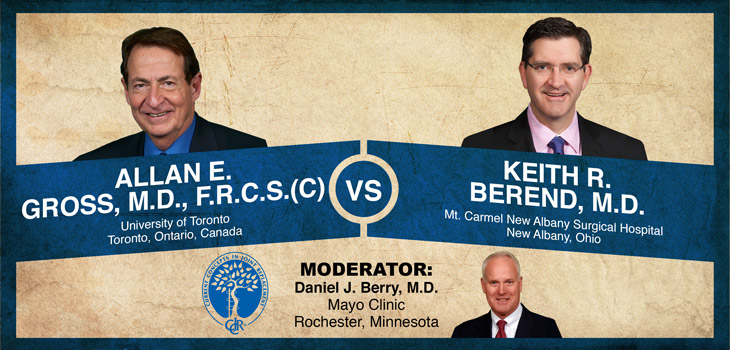
Moderator Berry: They are tough cases. Everybody will agree on that point. Allan, when you’re doing these cases, how do you try to protect the abductors?
Dr. Gross: I think actually doing a trochanteric osteotomy protects them to a degree. Because you are keeping them intact. Most of our cup cages are either a trochanteric osteotomy or what we call a fake trochanteric osteotomy where there is no trochanter but we kind of pretend there is one and we take the abductors and whatever is left of the greater trochanter and the vastus and retract it anteriorly.
The other thing is that you have to get down to bone and have to stay on bone. That’s really important. As soon as you wander off the bone when you’re going up into the ilium, you’ve got the superior gluteal branches and the nerve.
Dr. Berend: And that’s true of the pubis and that’s true for the ischium as well because you’ve got to get on bone and stay on bone. It reduces your risk of nerve and vascular injury. If you wander away, you’re in big trouble.
Moderator Berry: Finally, one of the big bugaboos about pelvic discontinuities is the sciatic nerve. Give me 15 seconds on how you protect the nerve, how do you avoid trouble with it with your technique.
Dr. Berend: I do an anterior-based approach so I’m away from it as far as possible. As Allan said, get on bone and stay on bone. You can dissect the entire ischium as long as you’re on bone when you get there.
Dr. Gross: We always slot that inferior flange into the ischium. Don’t put it on top of the ischium because your retractors are too close to the sciatic nerve.
Moderator Berry: Gentlemen, thank you both very much for an informative and very valuable debate.
Please visit www.CCJR.com to register for the 2019 CCJR Spring Meeting, – May 8 – 11 in Cleveland.

Great, two legends of the game. Do we have an audiovisual format for this debate?