
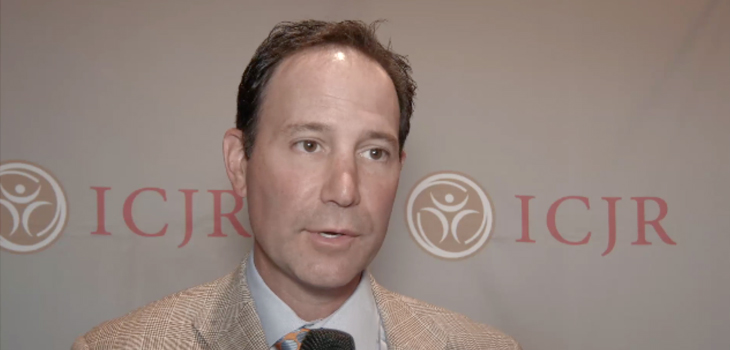
Goldberg’s Surgical Approach
“Obesity is not a contraindication, but I don’t do surgery on patients with a BMI greater than 40,” Goldberg explained. “And if you have a metabolic syndrome or components of it, your BMI has to go below 35.”
He added, “Then I identify where do you carry your obesity? Is it in your trunk or limbs? A patient who carries all their weight in their abdomen is easier to do. You can simply tape it up and get to the relatively thin hip.”
In his opinion, obesity is not predictive of the operative struggle, their TFL is. Big patients with big tensor muscles are the patients he predicts to be difficult in the OR.
“With every patient I ask, is this patient amenable to the anterior approach?” he said. “Preoperative planning is essential. And when you see hardware you have to ask yourself, does it need to be retrieved and can it be retrieved from the front?”
“And if it can, you can go from the front, but if you can’t, think about getting a CT scan. A CT scan can be vitally important to determine if you can take an anterior approach.”
If you decide to proceed with a direct approach THA with a difficult patient, Goldberg said that a generous femoral release is very important. Femur exposure is the key to successful, stress-free anterior surgery.
He explained that there are two restraints when it comes to releasing the femur. One is the pubofemoral ligament, the other is the ischiofemoral ligament.
“Those of us who are true believers in delivering the femur all the way forward will release both of these ligaments in their entirety. We are not releasing the piriformis or the obturator externus, but we are releasing these two pretty much every time.”
He added that with deformities, you also need to plan out using special implant techniques. You need to consider whether you need to do an osteotomy of the femur or sink the stem very low to preserve their leg length. You also need to consider if they have hardware from a previous surgery. You need to ask yourself, is there an alternative stem design or stem position that will allow you to proceed with the case from the front.
“Pre-operative planning is essential so you can identify ideal and difficult patients and do x-ray planning. Attention to surgical details can make for a well-executed and successful THA,” Goldberg emphasized.
Meet Dr. Goldberg at the Upcoming Direct Anterior Approach Hip Course

Goldberg’s presentation, “How to Handle Obese, Muscular, and Other Challenging Patients” was originally presented at the International Congress for Joint Reconstruction’s 2017 6th Annual Direct Anterior Approach Hip Course.
His presentation on handling obese patients is also on the agenda for the 7th Annual Direct Anterior Approach Hip Course from the International Congress for Joint Reconstruction which will be held September 27-29, 2018 in Houston, Texas.
The conference is designed for orthopedic surgeons and allied health professionals looking to learn the latest in orthopedic technology and optimum patient care when using the direct anterior approach to hip arthroplasty.
To register, click here.
