
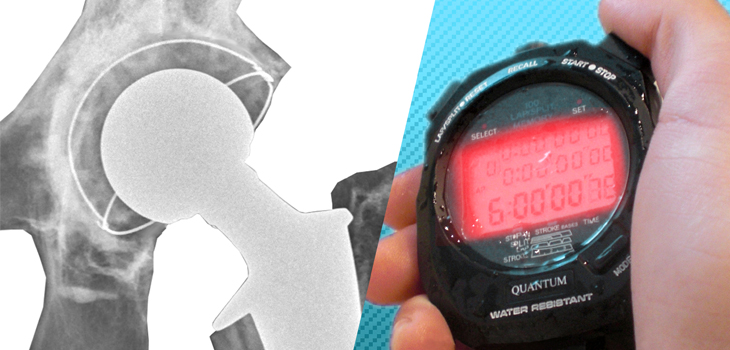
A Toronto, Canada. hospital (Women’s College Hospital) is offering joint replacement patents a “six-hour surgery and you are back hone” procedure.
It is not quite a drive-by joint replacement surgery, but it comes close.
Where patients once spent two or three days in the hospital recovering from the surgery, this Toronto institution has joint replacement patients back in their homes in six hours or less.
“We started about a month ago. We have had no complications so far,” said David Backstein, M.D., an orthopedic surgeon. “We are selecting fit, healthy people. I am picking people who want to go home and want to get better.”
Another innovation is their use of anesthetics.
Surgeons use a short-acting spinal block (anesthetics injected near the spinal cord that block pain) that last about 90 minutes—which is enough time for the surgery. They also use peripheral nerve blocks that can last as long as 24 hours and allow patients to move their legs relatively pain-free.
“We are fooling the brain to feel like they are not having surgery—local anesthetic like the dentist. That is one of the newer techniques,” said anesthesiologist Richard Brull, M.D.
Canadian experts say the program will make health care delivery more efficient, in the face of a national bed shortage and long waits for joint replacements. The hospital to home program, they say, frees up urgently needed hospital beds for other patients.
One patient, Greg Nemez, who was interviewed by a local news outlet about his experience, said that his arthritis was significantly reducing his quality of life. “It was very painful and every step I took I would cringe. I would have pain shooting down my leg and up my leg,” he told the local reporter. “Enough was enough, I couldn’t tolerate it.”
Nemez, a real estate agent from Mississauga, Ontario, had his knee replacement surgery at Women’s College Hospital and was home in about six hours.
Once home, he used crutches to give him stability when he walked and then had a virtual (via his tablet computer) visit with his medical team. The hospital gave Nemez a computer app which gives him 24/7 access to his medical team. In addition, he was given a tracker to wear on his belt which also collected information about his activity.
“I have a little bit of pain but not a lot, and I’m happy to be home,” Nemez said.
This week the government of Ontario released data regarding wait times for knee and hip replacement patients. Presently, a significant percentage of Ontario patients (30-40%) have to wait longer than six months to schedule their replacement surgery.
In many ways, this program will free up beds and shorten those overall wait times, says Dr. David Urbach, Surgeon in Chief at Women’s College Hospital in Toronto.
