
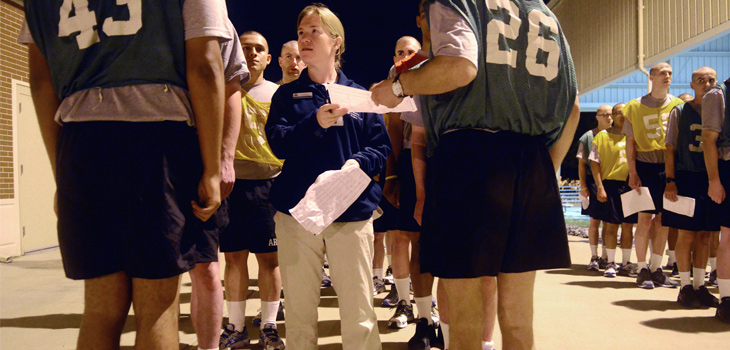
More than one in ten warrior athletes experienced at least one musculoskeletal injury during basic training. And those who were injured were three times more likely to be discharged. A new epidemiological study documents injury incidence, cost and other factors that affect the military’s battle readiness.
In their mission to protect the United States, military men and women put immense pressure on their bodies to be battle ready. However, while they along with firefighters and police are recognized as a special sort of athlete, they don’t always receive the same level of care from sports medicine teams as other athletes do.
A special issue of The Journal of Athletic Training recently highlighted the specific demands these “tactical athletes” experience and the need for more research in this critical aspect of sports medicine.
Co-Guest Editor JoEllen Sefton, Ph.D., ATC, director of Auburn University’s Warrior Research Center, associate professor in the School of Kinesiology and director of the Neuromechanics Research Laboratory in Auburn, Alabama, said in a press release, “Athletic trainers have been working with this population, especially military service members, for decades. We work with all the military branches, from the military academies to recruits to Special Forces. Implementing a sports medicine model of injury prevention and treatment to improve performance is vital and has been proven effective.”
Lt. Col. Todd Burkhardt, Ph.D., co-guest editor and director and professor of military science for Army ROTC, Indiana University, Bloomington, Indiana, also said in the release, “As members of the military, our goal is to succeed in a complex and uncertain environment. Our tactical athletes need to be physically ready for the rigors of their profession and athletic trainers are an essential component of facilitating this.”
Of particular note in the issue is an epidemiological study on musculoskeletal injuries in Air Force basic military trainees between 2012 and 2014, and a meta-analysis which examined whether lower extremity muscle strengthening should or should not be part of Military Knee Overuse Injury-Prevention Programs.
Each year more than 800, 000 military service members are injured, with the most common location of these injuries being the lower extremities. These injuries lead to trainees graduating late or being discharged as well as to more military service members on limited duty. (Source: Department of Defense)
Musculoskeletal Injuries in Basic Training
Nathaniel S. Nye. M.D., CAQSM, lead author and Major, United States Air Force, Medical Corps, 559th Medical Group, Joint Base San Antonio-Lackland, Texas. and colleagues collected musculoskeletal injury data for U.S. Air Force basic military trainees. They documented both injury incidence as well as the factors and costs associated with them. All data was collected at the U.S. Air Force Basic Military Training, Joint Base San Antonio-Lackland, Texas.
“Epidemiologic studies are extremely important, ” Nye told OTW. “This study identifies the true state of the musculoskeletal injury problem we are facing in basic training. It gives us a check point to determine if future interventions, such as embedding certified athletic trainers in training units, are effective. It also gives us something to compare with the other services.”
Nye and his colleagues found that 12.5% of the 67, 525 Air Force recruits between July 1, 2012 and June 30, 2014 experienced at least one musculoskeletal injury during basic training. And those who were injured were three times more likely to be discharged. For those who still go on to graduate they were more likely to graduate late.
“Almost half of all trainees discharged from [Basic Military Training] (714 of 1519 over the two-year surveillance period) were sent home as a result of a musculoskeletal injury, ” he said. “That may seem like just a number, but seeing this on the clinical side brings perspective that these are generally good young people with high hopes and promising potential, but will have to either reenlist or seek another pathway due to physical injuries.”
Nye explained that the rate of musculoskeletal injury is similar among all basic trainees in all services, and that “the finding of a 2:1 risk in females compared to males is notably consistent between Air Force and Army.”
He added, “We are all recruiting from the same population, and while each service tends to attract a slightly different type of person, the fact is that too many young Americans don’t spend enough time moving on their feet during adolescence. As a result, they show up to Basic Training unaccustomed to the level of marching and running they will have to do, and suffer overuse injuries.”
These musculoskeletal injuries also resulted in $42.2 million in direct (medical care expenses) and indirect (lost recruiting/shipping/training costs with attrition) costs over the two-year period, or about $21 million per year.
Nye said, “If we could invest a small fraction of that into efforts to prevent injuries and treat them early, such as embedding athletic trainers within the training squadrons, we could likely reduce those attrition rates and costs significantly.”
He did point out that Air Force Basic Military Training is already implementing several promising initiatives to mitigate the impact of injuries, including the VIPER Sports Medicine Clinic.
“The clinic will utilize “a ‘hub and spoke’ clinical model with a sports medicine physician, two family medicine physicians, and a physical therapist at the ‘hub’ and multiple Certified Athletic Trainers (ATs) in each of the ‘spokes, ” he said.
“These ATs are literally embedded in training squadrons with the mission to prevent injuries through running gait training and self-care training (e.g., foam rolling, stretching), as well as to diagnose and treat injuries early in their course.”
More Embedded Musculoskeletal Care Needed
Nye discussed the need for more embedded musculoskeletal care in Air Force training and operational units in an accompanying editorial he wrote with Sarah J. de la Motte, Ph.D., MPH, ATC, assistant professor and scientific director of the Injury Prevention Research Laboratory, Consortium for Health and Military Performance, Uniformed Services University, Bethesda, Maryland.
In August 2014, a primary care sports medicine physician was brought in to address the concern over musculoskeletal injuries at Joint Base San Antonio-Lackland, Texas (JBSA-Lackland) and in November 2015, six certified athletic trainers and a physical therapist and an occupational therapist were also hired to form the first embedded sports medicine team for the 350th Training Unit. Data collected from this unit will be used to potentially guide placement of more embedded sports medicine teams within other training units.
Nye and de la Motte wrote, “The argument for providing more robust sports medicine services (including personnel, facilities, and equipment) to training units at JBSA-Lackland is compelling. Physical training and rehabilitative facilities for the 350th currently include a 60-year-old off-site swimming pool, makeshift weight room, and part-time physical/occupational therapy space tucked into an old, repurposed dining facility (where barbells have been known to break the floor). Although great sports medicine can be delivered in almost any facility or any environment, there is a case for providing higher-level equipment and facilities to the tactical athletes who defend our Constitution on the front line each and every day. The time savings alone from offering on-site specialized care instead of appointment-based, referral-based, remote clinic care is just a start.”
“Many trainees (especially special operators) hide their injuries for fear of being removed from operational status. This fear is the result of a lack of trust and understanding between the trainee and the health care provider. Embedding health care providers into operational organizations to ensure that they understand the mission and know the people will significantly bridge this gap.”
Link Between Lower Extremity Strength and Knee Injury
Roger Kollock, Jr., Ph.D., ATC, CSCS, assistant professor of athletic training, exercise sports science, department of kinesiology and rehabilitative sciences at The University of Tulsa in Tulsa, Oklahoma, and colleagues through a meta-analysis of 25 studies (January 1, 2000-January 1, 2013) discovered that knee overuse injuries like patellofemoral pain syndrome and iliotibial band syndrome are the most common overuse injury in training, active-duty and reserve military personnel, and that this type of injury is associated with less normalized hip strength and absolute knee strength. Compared with study participants without injury, they had lower absolute hip external-rotator, knee-extensor, and knee-flexor strength, as well as lower normalized hip external-rotator, hip extensor and hip-abductor strength.
“This weakness at the hip and knee in those with knee overuse injuries were found in all three major planes of motion (frontal, sagittal and transverse), ” Kollock, Jr., told OTW. “This may point to a more global weakness in the involved lower extremity among those reporting knee overuse injuries. Thus, rehabilitation programs for those suffering from knee overuse injuries should include appropriate functional activities that integrate multiple muscle groups across the activity.”
While the results of the meta-analysis did offer evidence that patients with knee overuse injuries had less muscular strength, Kollock, Jr., explained that causality still cannot be inferred.
“The majority of the studies included in the meta-analysis were cross-sectional designs; thus, we were unable to determine cause and effect. It is therefore unclear if knee overuse injuries resulted from muscular weakness or muscular weakness resulted from the injury, ” he said.
“Investigators need to conduct more studies using longitudinal designs to help determine muscular weakness at the hip and knee as causal factors. This, along with research on other contributing factors, will help further the development of effective screening programs to identify those most at risk for knee overuse injuries.”
Check out the full special issue of The Journal of Athletic Training here.
