
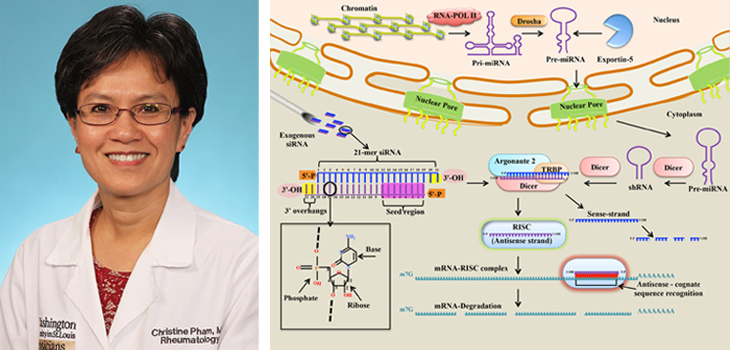
In a paper published September 2016 in the Proceedings of the National Academy of Sciences(PNAS) a peptide nanoparticle made up of NF-κB siRNA significantly reduced chondrocyte apoptosis and reactive synovitis when injected intra-articularly in a mouse model of knee joint impact injury.
The cell penetrating peptide acts as a carrier for silencing RNA (siRNA), allowing it to get into the cytoplasm for release, suppressing NF-κB. By suppressing NF-κB, inflammation and cartilage degeneration are lowered.
At least, that’s the plan.
Christine Pham, M.D. is an Associate Professor of Medicine at Washington University, and one of the authors of the study. She told OTW, “We know there is a robust inflammatory response immediately following a joint injury, so we hypothesized that the suppression of NF-κB would interrupt the early inflammatory cascade and alter the trajectory of post-traumatic osteoarthritis development.”
OK, so how much suppression of cartilage destruction (apoptosis) and inflammation (synovitis) are we talking about here?
“We found the reduction in apoptosis to be about 50% in our paper. The reduction in synovitis appears higher but we did not do a quantitative analysis. However, synovitis in this mouse model is modest at best, which is similar to the degree of synovitis in human osteoarthritis, ” Dr. Pham explained.
In 2014, Dr. Pham and colleagues published a paper entitled “Peptide-siRNA nanocomplexes targeting NF-κB subunit p65 suppress nascent experimental arthritis”. They found that the same particles used in the current study targeting the subunit p65 significantly and potently suppressed synovitis in a murine model of rheumatoid arthritis.
Side Effects
So far so good, but what about side effects? Could these complexes affect other signaling pathways?
Dr. Pham said, “We have shown in the current study (PNAS) and in the previous 2014 study that the particles are well tolerated with minimal off-target side effects, whether they are given intravenously or intra-articularly.”
In the 2014 study the nanoparticles did not stimulate an adaptive immune response, and in the PNAS study, the authors found that there was no antibody or type I interferon production from the intra-articular injections.
Dr. Pham continued, “We also show in the PNAS paper that suppression of NF-κB affects some other signaling pathways. These include pathways controlling autophagy (a cartilage protective mechanism) and Wnt/β-catenin signaling (a pathway involved in cartilage homeostasis). There could be other pathways that may be affected, and we are also working on this aspect.”
Autophagy genes which are cartilage protective are significantly reduced after trauma and the authors found in the PNAS study that treatment with a combined p65/p100 siRNA complex limited the injury-induced suppression by about 40%.
According to the authors, the Wnt signaling pathway when stimulated promotes the accumulation of β-catenin which activates catabolic target genes. Findings from the PNAS study suggested that impact injury stimulated the Wnt pathway. They also found the p65 siRNA complex significantly suppressed β-catenin expression.
So, multiple pathways are affected by these nanoparticle complexes and all seemingly in a positive manner reducing inflammation and cartilage degeneration.
Impressive.
The Problem of Osteoarthritis
According to the CDC (Centers for Disease Control and Preventation) about 50% of adults 65 years or older reported doctor-diagnosed arthritis, and the number is only growing.
The authors point out that there are limited treatment options for osteoarthritis and no disease-modifying drugs available. Also, drug delivery is an issue because of the avascular nature of cartilage.
If the therapeutic benefits of siRNA nanotherapy are to apply clinically in post-traumatic osteoarthritis as the authors contend that it may, the particles would have to penetrate into human cartilage and persist for some period.
Penetration and Persistence
The authors needed to determine if the attenuated chondrocyte apoptosis and synovitis persisted in the mice first. Three serial doses of p65 siRNA complexes were injected intra-articularly immediately after impact injury and on day 1 and 2 post-impact. A control group was also utilized. On day 14 the knees were analyzed. They found the partial suppression of the negative effects of impact injury persisted for at least 2 weeks. This far exceeded the half-life of siRNAs in the circulation.
OK but what about penetration and persistence in humans?
To see if the results could have a clinical application, the efficiency of penetration of siRNA complexes in human osteoarthritis cartilage was determined. Tissue from human osteoarthritic knee joints during arthroplasty was obtained and used. The nanoparticles “freely diffused into chondrocyte lacunae” and “deeply penetrated normal cartilage.” Amazingly the siRNA persisted in the cartilage for at least 14 days and still had a low level at 21 days.
The Competition
According to the authors oligodeoxynucleotides selectively block NF-κB, and they can be delivered intra-articularly. They have even shown the ability to partially limit osteoarthritis progression, but unfortunately have a short half-life, making these an unattractive option.
Viral vectors are another possibility that the authors discuss and again there has been some success. In a study entitled “Suppression of early experimental osteoarthritis by in vivo delivery of the adenoviral vector-mediated NF-kappaBp65-specific siRNA”, the authors conclude that the viral vector complex can lower inflammation and cartilage degeneration. However, there are concerns about genetic mutations and unwanted immune responses.
I think I’ll pass.
The NF-κB Family
Both p65 and p100 are members of the NF-κB family. Another important part of the study that the authors wanted to determine was the role of p65 and p100 in the breakdown of osteoarthritis cartilage. Injury stimulates both p65 and p100 pathways and although the p65 pathway has been suggested to play a central role in cartilage breakdown the role of the p100 has not been studied.
What the authors found was that there was no advantage in inhibiting both p65 and p100 pathways over just p65 alone, confirming the importance of p65 as the major player.
I asked Dr. Pham about the potential of this new treatment to limit the chronic consequences of joint injury. “Suppression of NF-κB interrupts the inflammatory cascade and alters the trajectory of post-traumatic osteoarthritis development. It could change how we treat joint injury, but whether and when to use this approach to alter the progression of primary established osteoarthritis is not yet known, but we are looking into this.”
Exciting!
