
The news was not good for those looking for a way to repair cartilage. An article in the journal of the American Association for the Advancement of Science informed its readers that research using radiocarbon dating suggests that joint cartilage cannot renew. Researchers used radiocarbon dating as a forensic tool to find that human cartilage rarely renews in adulthood. Instead, cartilage appears to be a permanent tissue in both healthy and osteoarthritic adults.
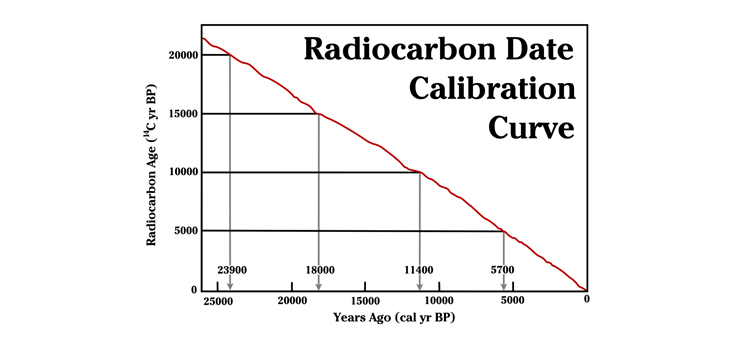
Radiocarbon dating (also referred to as carbon dating or carbon-14 dating) is a method for determining the age of organic material by using the properties of radiocarbon (14 C), a radioactive isotope of carbon.
The method was developed by Willard Libby in the late 1940s and soon became a standard tool for archaeologists. Libby received the Nobel Prize for his work in 1960. The radiocarbon dating method is based on the fact that radiocarbon is constantly being created in the atmosphere by the interaction of cosmic rays with atmospheric nitrogen.
When an animal or plant dies, it stops exchanging carbon with its environment, and from that point onwards the amount of 14 C it contains begins to decrease as the 14 C undergoes radioactive decay. Measuring the amount of 14 C in a sample from plant or animal tissue provides information that can be used to calculate when the animal or plant died. The older a sample is, the less 14 C there is to be detected, and because the half-life of 14 C (the period of time after which half of a given sample will have decayed) is about 5, 730 years, the oldest dates that can be reliably measured by radiocarbon dating are around 50, 000 years ago, although special preparation methods occasionally permit dating of older samples.
Measurement of radiocarbon was originally done by beta-counting devices, which counted the amount of beta radiation emitted by decaying 14 C atoms in a sample. More recently, accelerator mass spectrometry has become the method of choice; it counts all the 14 C atoms in the sample and not just the few that happen to decay during the measurements; it can therefore be used with much smaller samples and gives results much more quickly.
To conduct their research, Katja Heinemeier and her colleagues made use of the bomb pulse method that has been used to estimate the age of fat, muscle, and other tissues. This method exploits the fact that all living things incorporate carbon-14 from the atmosphere.
Atmospheric levels of this carbon isotope spiked during the Cold War due to the testing of nuclear bombs. This left a detectable imprint in all organisms living at the time.
Heinemeier’s subjects were 8 healthy and 15 osteoarthritic individuals born between 1935 and 1997. The researchers found that there was virtually no formation of new collagen in their cartilage—even when there was disease or the joints had been stressed by high loads. This suggested to the researchers that that the tissue is an essentially permanent structure.
Heinemeier suggests that her group’s findings may help explain why human cartilage has poor healing capacity after it has been injured. And it presents new challenges for treating osteoarthritis and other joint diseases.
