
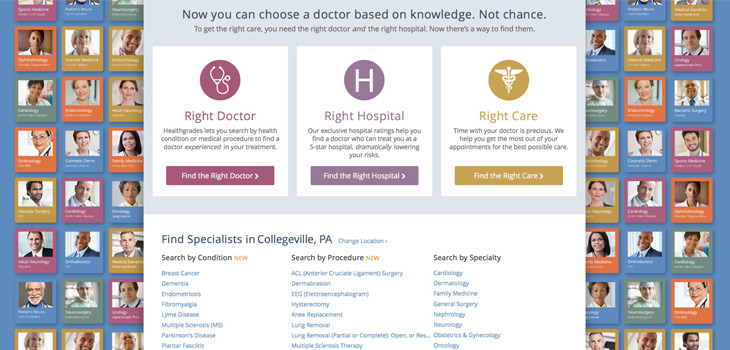
What are those physician rating sites actually measuring and can they help orthopedists to build their practices?
A 2014 American Board of Internal Medicine (ABIM) study concluded:
- Physician rating websites (PRWs) are extremely popular with patients
- But ratings have a strong upward bias
- And they don’t correlate with actual quality of care
Another study, this one from American Society for Surgery of the Hand (ASSH), found:
- More than 65% of physician don’t like the website ratings
- 62% found inaccuracies in their profiles
- 90% of physicians have not made any adjustments based on ratings
Bottom line, the popularity of physician website ratings is exploding. Patients use them for surgeon information before, during and after treatment.
But surgeons don’t know how to take advantage of these sites.
Since the ratings have an upward bias, is this generally good for surgeons? Since the information is highly flawed, is this bad for surgeons?
Let’s look at the details.
The ABIM Study
Researchers from the American Board of Internal Medicine (ABIM) sampled 1, 299 physicians who’d completed a Practice Improvement Module and asked them a series of question regarding physician ratings websites.
They found NO statistically significant correlation between the online ratings given by patients about their physicians and the clinical quality of care delivered by those same practices.
Their study results were published in the Journal of the American Medical Association (JAMA) and are available at: http://archinte.jamanetwork.com/article.aspx?articleid=1936577
The study came at a particularly good time. Physician rating websites are exploding in two ways. First, as a tool for patients to use to evaluate a prospective surgeon. And second, as way for surgeons to market their practices directly to patients.
According to the ABIM study authors: “One-third of consumers in the United States who consulted physician website ratings reported selecting and/or avoiding physicians because of these ratings.” A February 19, 2014 JAMA study bears this out. Said those investigators: “Fifty-nine percent of respondents reported physician rating sites to be “somewhat important” (40%; 95% CI, 36%-44%) or “very important” (19%; 95% CI, 16%-23%) when choosing a physician.”
The lead ABIM study author was quoted in the JAMA article as saying: “Our study is important because it is one of only a handful of studies to examine the ability of physician website ratings to reflect the quality of care patients are likely to receive. The results of our study should make consumers think twice about relying only on these website ratings as a source of quality information. This study also highlights the need for more valid and reliable physician quality information to be made publicly available.”
Details From the ABIM study
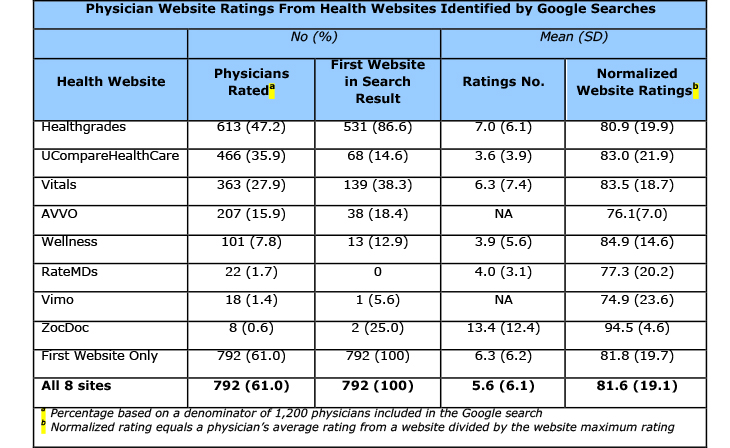
The study’s authors found that website ratings existed for 61.0% of physicians, with 5.6 patient ratings per physician and a mean normalized rating of 81.6% (which we interpret as a B+ rating).
BUT….the investigators found that the association between physician website ratings and clinical quality measures (QMs) was not only small, it was also statistically insignificant. Less than a 0.3 percentage point change was associated with a 20 percentage point rating change.
Looking at patient experience QMs, associations were also small but statistically significant. Just under 1.7% point changes in QM was associated with a 20% change in the rating.
Here’s the table that the researchers used to illustrate the findings of their study.
 The ASSH Study
American Society for Surgery of the Hand (ASSH) Ethics and Professionalism Committee took a fresh look at physician rating websites and considered their resulting ethical and professional implication on physician behavior.
The authors of the study were Julie Balch Samora, M.D., PhD. Scott D. Lifchez, M.D., and Philip E. Blazar, M.D.
The investigators sent a 14-item questionnaire to 2, 664 active ASSH members who practice in both private and academic settings in the U.S.
ASSH Results
Three hundred and twelve of the surveyed members responded to the survey, a 12% response rate. More than 65% of the respondents had a slightly or highly unfavorable impression of these websites. Only 34% of respondents had ever updated or created a profile for PRWs.
Importantly, 62% had observed inaccuracies in their profile. Almost 90% of respondents had not made any changes in their practice owing to comments or reviews. One-third of respondents had solicited favorable reviews from patients, and 3% of respondents have paid to improve their ratings.
Here is what the ASSH researchers concluded:
“There are several ethical implications that physician rating websites pose to practicing physicians. We contend that it is morally unsound to pay for good reviews. The recourse for physicians when an inaccurate and potentially libelous review has been written is unclear. Some physicians have required patients to sign a waiver preventing them from posting negative comments online. We propose the development of a task force to assess the professional, ethical, and legal implications of PRWs, including working with companies to improve accuracy of information, oversight, and feedback opportunities.”
More Ethical Issues
According to the Hay Group, two-thirds of physician pay incentives are based on patient satisfaction scores. The Centers for Medicaid and Medicare Services (CMS) is increasingly basing their hospital payments on quality metrics, with patient satisfaction surveys being a significant component.
Doing what’s best for the patient is not always popular. Physicians know this and, as a survey by Emergency Physicians Monthly reported recently, 59% of emergency room physicians said that patient surveys increased the number of tests they ordered.
Another survey, this one by the South Carolina Medical Association, asked its members whether they’d ever ordered a test they felt was inappropriate because of patient satisfaction survey pressures, and 55% of 131 respondents said yes. Nearly half said they’d improperly prescribed antibiotics and narcotic pain medication in direct response to patient satisfaction surveys.
Senators Dianne Feinstein, D-California, and Charles Grassley, R-Iowa, wrote a 2014 letter to Marilyn Tavenner, a CMS administrator saying: “There is growing anecdotal evidence that these (patient satisfaction) surveys may be having the unintended effect of encouraging practitioners to prescribe opioid pain relievers (OPRs) unnecessarily and improperly, which can ultimately harm patients and further contribute to the United States’ prescription OPR epidemic.”
And then there is the huge 50, 000 patient JAMA study which found that patients who were more satisfied with their doctors had higher health care costs, were hospitalized more frequently, and had higher death rates compared to less satisfied patients.
Bottom line: Doctors who have mixed patient reviews probably provide better care because they will say no to patients.
Train Has Left the Station
The physician rating train left the station a long time ago.
Payers, most notably CMS (see PhysicianCompare, a U.S. government directory of health care providers who accept Medicare beneficiaries), for profit physician rating websites and social media sites like Facebook or Twitter are putting physician ratings—as deeply flawed as they are—on the Internet for all to see and many to use.
No way this doesn’t continue to grow.
As the new studies are implying, it is time for a coordinated set of ratings which combine the subjective elements (staff friendliness, parking convenience, wait times) with basic information (where the physician practices, went to school, certifications for certain specialties, any disciplinary actions by a state licensing board) and objective information (long-term outcome data, recovery information, surgical infection rates and so forth).
Standardization. A Good Housekeeping Seal of Approval. For both the physician and patient’s benefit.
And finally, but most importantly, orthopedic physicians need an independent party to step in, seek out and correct inaccurate and flawed website information on their behalf.
Hello surgeon societies.
