
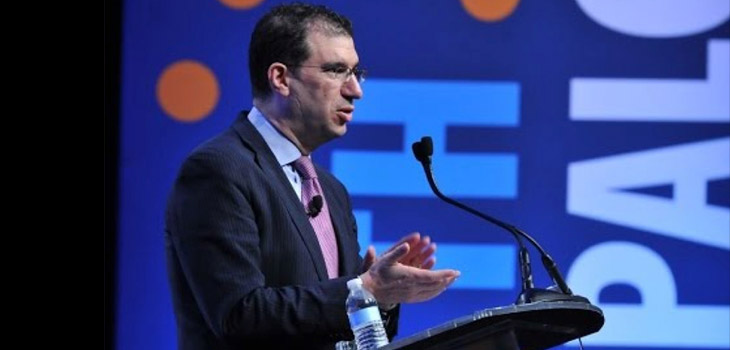
This past Tuesday (January 12) acting commission for the Centers for Medicare and Medicaid Services, Andy Slavitt, gave a major policy speech at the 2016 JP Morgan Healthcare conference in San Francisco.
Slavitt (who previously ran UnitedHealthcare’s Ingenix and Optimum data bases and health information systems) described CMS’s top goals for 2016. Contextually, Slavitt reminded his audience that 130 million Americans rely on Medicare, Medicaid or CHIP programs for their healthcare. Said Slavitt: “2016 will be an enormous and pivotal year for progress and it’s starting off with a bang.”
In reverse order, here are CMS’s top ten goals for 2016:
Goal 10: Talk regularly to the health care investor community.
Historically, CMS has had an adversarial attitude toward the health care investor community. To the investor community, CMS has often felt opaque and divining CMS’s agenda required poring through an often intricate set of regulations like they were Fed minutes. Slavitt promised to change that, beginning with this week’s speech.
Goal 9: Implement the next generation ACO model.
Beginning this year, CMS is introducing the second generation ACO model or “Next Gen ACOs.” These are provider groups who take full financial responsibility for a patient’s care and have innovative options like telemedicine, home visits, and direct consumer incentive and engagement options.
Accountable Care Organizations (ACOs) are groups of doctors, hospitals, and other health care providers who come together voluntarily to give coordinated care to their Medicare patients using a range of payment models (capitation, fee-for-service with asymmetric or symmetric shared savings, etc.). ACOs assume increased levels of responsibility for the quality, appropriateness and efficiency of the health care provided.
In CMS’s words; an ACO is “an organization of health care providers that agrees to be accountable for the quality, cost, and overall care of Medicare beneficiaries who are enrolled in the traditional fee-for-service program who are assigned to it.”
CMS plans to start with 21 new Next Gen ACOs which will be in addition to more than 475 ACOs already in place with 30, 000 physicians participating around the country.
Approximately 64 current ACOs are two-sided or full risk organizations, up from 19 just last year and of course zero before the Affordable Care Act.
Goal 8: Increase the number of existing ACOs.
In total, 8.9 million Americans receive healthcare services from ACOs in 49 states and the District of Columbia. For 2016, CMS hopes to increase that number by 1.6 million and serve these patients in better, more advanced ACO models.
Said Slavitt: “Many have wondered whether ACOs would succeed or would end up in the dustbin of health care’s three-letter acronyms. As a recovering entrepreneur, I can certainly tell you that the execution in the first stage is often the hardest part. But today’s news is strong evidence that ACOs will be part of ushering in the new wave of alternative payment models. They have demonstrated improvements in quality, patient experience and have been certified to reduce costs.”
Goal 7: Implement bipartisan MACRA legislation.
MACRA, which stands for Medicare Access and Children’s Health Insurance Program (CHIP) Reauthorization Act, is the legislation passed in 2015 which replaced the sustainable growth rate (SGR) formula with statutorily prescribed physician Medicare payments. It also extended for two years CHIP and reinstated global surgical bundles.
MACRA set up a two-track payment system designed to move patients into risk-based payment models.
In Slavitt’s view, MACRA is a program that brings pay for value into the mainstream through something called the Merit-based incentive program.
“The stakes are high for this program.” said Slavitt. “As any physician will tell you, physician burden and frustration levels are real. Programs designed to improve often distract. Done poorly, measures are divorced from how physicians practice and add to the cynicism that people who build these programs just don’t get it. Over the next several months, we will be rolling out details.”
Goal 6: Simplify.
CMS plans to combine, streamline and simplify as many old programs as possible in order to free up physicians to focus where they need to—on their patients.
CMS is working with front-line physicians, tech companies, and practice managers to learn which measures for each specialty work best and how to implement programs most simply.
Slavitt said that CMS is committed to building flexible and adaptable programs that reflect individual practice and patient goals.
Goal 5: End Meaningful Use.
“Meaningful Use” refers to a CMS program which tried to promote the use of electronic health records (HER) through a series of guidelines and incentives.
That’s ending.
Now that the vast majority of healthcare providers have electronic health records, Meaningful Use becomes, in effect, MACRA.
CMS laid the groundwork for this switch in late 2015 by consulting with physician organizations like the American Medical Association (AMA) to work out the end of Meaningful Use and the start of MACRA. Slavitt promised to release details over the next few months.
As envisioned by Slavitt, CMS still stop rewarding providers for using technology. Instead it will focus on patient outcomes. Under the new guidelines, providers will be able to customize their goals so tech companies can build around the individual practice needs, not the needs of the government.
Lastly, the new program will encourage technology start-ups and new entrants. CMS plans to require open APIs in order to allow apps, analytic tools, and connected technologies get data in and out of an EHR securely.
Goal 4: Increase interoperability.
Interoperability is the ability of different healthcare information systems and software to communicate, exchange data, and use information regardless of the platform they live on.
Slavitt says he is “deadly serious about interoperability.” CMS is initiating collaborations with physicians and consumers to, for example, close referral loops and engage patients in their own care—which can’t work without interoperability.
And, Slavitt warned: “Technology companies that look for ways to practice ‘data blocking’ in opposition to new regulations will find that it won’t be tolerated.”
Goal 3: Modernize Medicaid coverage.
More than 13.5 million people have entered the Medicaid or CHIP coverage programs in the last couple of years. To handle not only these people but the tens of millions on the way, CMS has to modernize—ASAP.
In 2015, CMS released proposed or final rules to modernize Medicaid’s management, access to care at both the state and CMS level and to manage incentive programs for value-based care with delivery systems.
Slavitt promised that in 2016 CMS would attract innovative companies to invest in the Medicaid IT space. He pointed to CMS’s actions this past December to extend the 90% federal match for Medicaid system investments.
For 2016, CMS will invest approximately $5 billion in state Medicaid IT. More than 30 states are currently redesigning their Medicaid IT systems, as a result.
Goal 2: Support private sector technology innovation.
Slavitt promised to make it easier in 2016 for innovative and differentiated technology solutions to get into the Medicaid and Medicare systems. Specifically, Slavitt would like to see greater investment in modular, reusable, and cloud-based solutions.
To make that happen, CMS is launching in 2016 a one-stop-shop program for innovative, disruptive technologies. This new program will offer resources to encourage private sector companies to step into what Slavitt described as a huge opportunity.
The Number One Goal for CMS in 2016: Insure the long term health and stability of the Health Insurance Marketplaces.
The number one goal for CMS in 2016 is the health and long term stability of the Health Insurance Marketplaces.
The Marketplace is still in the early stages. Consumers are getting educated. Health plans are experimenting with products and network designs.
Millions of new patients are signing up.
CMS has studied the data and met regularly with all market players—41% of all new consumers this Open Enrollment are under 35, compared to 38% a year ago. And if past patterns continue to hold, the percentage of young people will climb throughout the rest of Open Enrollment.
There are also high levels of consumer engagement—as over 60% of Marketplace consumers have made active decisions about their health insurance choices.
But, to move the current health insurance Marketplace from start-up stage to a more mature stage will require adjustments to more fairly compensate for risk and to keep the risk pool stable, balanced and to provide a predictable set of underwriting rules.
If successful, the customer base for health plans will look more attractive with a younger population and high levels of engagement and responsiveness to new offerings.
As Slavitt put it: “There is still a large untapped market to serve.”
Wrap Up
With these goals CMS is signaling that care delivery payments are changing in ways which are could reward providers who deliver superior care—as defined by CMS. The other signal is that CMS is increasingly friendly and encouraging to innovative technologies.
Under Slavitt’s leadership CMS is launching a number of start-up activities which makes an improved private sector relationship even more important.
Finally, in his talk Slavitt earnestly pushed a CMS culture of listening and learning. Whether that trickles down the organization is the big question.
