
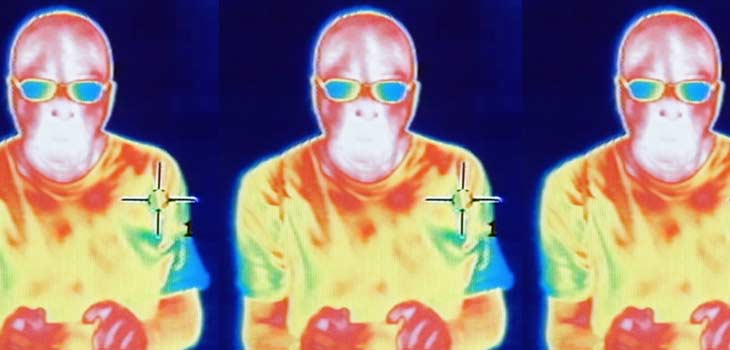
John Adamovics, Ph.D., a professor in the Department of Chemistry, Biochemistry and Physics at Rider University, Lawrenceville, New Jersey, has found a new way to evaluate runners’ injuries. He takes infrared (IR) pictures of them (read entire article here).
As he explained to writer Adam Grybowski at Rider, because injured muscles radiate heat, infrared cameras have the ability to “see” where injuries are occurring in the body. The pictures provide physiological information in contrast to an MRUI (magnetic resonance user interface) or CAT scan which provides anatomical information, he says.
One obvious advantage of IR imaging, Grybowski noted, is that an athlete does not need to visit a hospital and wait days for results. This camera provides real-time information on-site. “This is a cheap, effective way to get feedback instantly, ” says Robert Hamer, the head coach of the Rider men’s and women’s cross country and track & field programs.
Adamovics told Grybowski that he is the sole scientist in the United States to adapt this insight and technology for this particular use. He believes that infrared cameras hold the potential to revolutionize the way athletes monitor, track and cope with injury. The ideal use of the technology, he says, would be to identify the first stage of an injury before the athlete has even begun to feel symptoms. Hamer says that the camera detected hot spots in the legs of his athletes before they reported pain or discomfort.
Adamovics says that half of all athletes will deal with injuries at some point in their career. That number has not decreased over the past 20 years. By measuring the temperature of muscles, Adamovics can monitor the severity of injuries over time and potentially alleviate the sequence of events that lead to injury becoming worse and worse. “There’s no way for a trainer to do this quantitatively, ” he says.
According to Grybowski, Hamer has viewed the implementation of infrared cameras as an experiment. He has not yet sidelined a runner because of the data the camera provides. But he does appreciate the technology’s potential. “Trainers are still the number one tool we use, ” he says. “What John provides us with is additional information, and as we get more, I think it’s going to be extremely useful.”
