
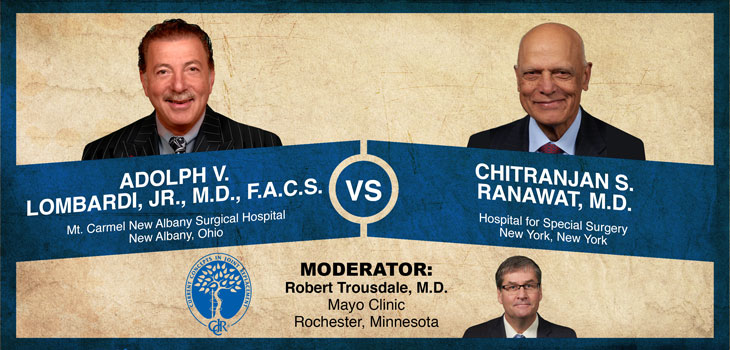
“With bi-cruciate retaining knees the patient has normal kinematics, improved range of motion, and pain relief is equivalent to a total knee, ” argues Adolph Lombardi. “We are repeating the mistakes of the past, ” counters Chit Ranawat. “You must match the lateral condyle posterior slope—very hard. Preserving both cruciate ligaments is technically challenging. And the most quoted paper on this (by Cloutier) found that the survival rate at 20 years was no better than other knees done at the same time.”
This week’s Orthopaedic Crossfire® debate is “The Bi-Cruciate Retaining TKA: ‘A Thing of Beauty is a Joy Forever.’” For the proposition is Adolph V. Lombardi, Jr., M.D., F.A.C.S. from Mt. Carmel New Albany Surgical Hospital in Ohio. Chitranjan S. Ranawat, M.D. of Hospital for Special Surgery is in opposition. Moderating is Robert Trousdale, M.D. of the Mayo Clinic.
Dr. Lombardi: “I thought about why Seth would pick Dr. Ranawat to challenge me on this topic. When he got to New York Chit lost his mustache—which is the ACL [anterior cruciate ligament]—and the hair—which is the PCL [posterior cruciate ligament]. I have them both.”
“If you look at the unicompartmental literature it’s clear that patients prefer these over a total knee because the cruciate mechanism is intact and therefore they have normal kinematics. So it feels better, range of motion [ROM] is better, and pain relief is equivalent to a total knee.”
“We looked at our dataset and found a lot of dissatisfaction being reported with total knees. Everybody quotes the statistic that 20% of patients are unhappy, but 80% are happy…so you can look at the data however you want to. We thought, ‘If the ACL is intact at the time of the total knee then the patient will have worse outcomes than the patient in whom the ACL is deficient at the time of the total knee. We looked at more than 2, 317 patients, and evaluated the ACL status at arthrotomy. There were 770 unis and 1, 547 total knees. Overall, 80% of the patients had an intact ACL.”
“The mean preoperative and Knee Society clinical and functional scores for ROM were higher in the ACL intact knees versus the ACL-absent knees. Postoperatively, the mean Knee Society pain and clinical scores were higher in the ACL-absent knees versus the intact knees. We noted this relationship preoperatively; postoperatively we found that those patients who had an intact ACL didn’t do as well as those who didn’t have an intact ACL.”
“Mike Berend’s 2005 data shows that 82% of his patients had an intact ACL at the time of arthrotomy. This is nothing new. Townley reported on this in 1985 with 532 knees, good ROM, good to excellent results (89%).”
“Stiehl did work comparing bi-cruciate sparing and PCL sparing, and showed that the former held promise of offering an improved wear mechanism and functional outcome. In 2007 Moro-oka said that while the ACL was not necessary for a well functioning knee, that it would provide more normal kinematics (especially in maximum flexion positions).”
“Pritchett has published several articles on this, mostly mentioning that there is decreased noise, clunks and clicks with the bi-cruciate sparing knee. One of his papers compared the ACL sparing knee to a variety of different knees. The only knee that came close was the medio-lateral pivot knee.
“We set out to make a design with 1mm increased bearings (a u-shaped design). We felt that preservation of both cruciates would lead to more normal kinematics. The process starts with making bone cuts to do the distal femoral prep and your four-in-one guide, which has a little protector so that you don’t cut the ACL.”
“Prepping the tibia involves setting the depth of resection, setting rotation for the island, carefully placing the device, and cementing it in place. Five surgeons did 119 cases; there were 11 intraoperative island fractures and four manipulations. We had to alter our technique a little, as well as our instruments. That way, we decreased the island fracture rate from 9.2% to 1.9%. We have had two revisions, and we have added some non-developer surgeons and the island fractures continue to decrease.”
“Normal kinematics is preserved when you have an intact ACL. It’s present in 60-80% of the knees you do…and I think new materials and refined techniques are what have helped us proceed with vigor and enthusiasm.”
Dr. Ranawat: “The rationale for these knees are that both cruciate ligaments are preserved, there is a normal patellofemoral joint, no significant deformity or instability, and the patient has significant symptoms warranting surgery. This would be a patient with a knee that is close to normal.”
“In the 1970s there were many attempts to preserve both cruciate ligaments. I designed the Duo-condylar knee with Peter Walker and we reported our results in 1972. My summary of the early experience with these is that they have come and gone. In the words of George Santayana, ‘Those who can’t remember the past are condemned to repeat it.’”
“I did over 150 surgeries where both cruciates were retained. Over a two year period there was progressive instability, failure of fixation, patellofemoral symptoms…and technically it was difficult to align both components and balance them properly. We abandoned the project because many other surgeons couldn’t balance it properly.”
“Now there is rebirth of the bi-cruciate concept. It is based on restoring normal kinematics, restoring the joint line and posterior slope (especially the lateral tibial condyle), preserving both cruciate ligaments, rigidly fixing the implant to the bone, and expect it to last 20 years.”
“Restoring normal kinematics cannot be done without matching the lateral condyle posterior slope—and that kicks in at about 125 degrees of ROM. Preserving both cruciate ligaments is technically challenging, and in a certain percentage of cases it will be weakened because you’re cutting the bone on the front and the side…and you could make a mistake medio-laterally on the cutting block.”
“Fixation with cement is technically difficult; cement penetration is difficult to achieve because of the limited exposure. Also, longevity to 20 years and beyond involves several issues, including progressive arthritis of the patellofemoral joint and compromise of the ACL due to the blood supply (we don’t know what that would be in the long term). In addition, wear-induced synovitis and fatigue fracture of the connecting bar of the condyles may occur.”
“The total knee has a good outcome out to 20 years…although they don’t give motion as good as a bi-cruciate knee. The most quoted paper on bi-cruciate knees was by Cloutier. Their survival rate at 20 years was no better than other knees done at the same time.”
“History provides an opportunity to study, analyze, and document things…and those who cannot remember the past are doomed to repeat it.”
Moderator Trousdale: “Adolph, in light of Chit’s comments, what patient is a candidate for this surgery?”
Dr. Lombardi: “The percent of patients to whom you will apply this technology is going to depend on your appetite for partial knee replacement. There is a continuum of constraint in total knee arthroplasty. You have to vary the degree of constraint based on the presentation of the patient. My utilization of this technology is about 15%. Go home, do an arthrotomy, and look at how many times the ACL is present.”
Moderator Trousdale: “It’s present, but is it pathologically normal?”
Dr. Lombardi: “The Oxford group has shown that even with ACLs that are a bit fragmented or frayed they still do a partial knee replacement and those patients retain stability.”
Moderator Trousdale: “Chit, 15-20% of our total knee patients are not perfectly satisfied, so if it’s not a bi-cruciate design that’s going to make our patients more satisfied then what designs do you feel will decrease our dissatisfaction rate?”
Dr. Ranawat: “Dissatisfaction after total knee is multifactorial. How much has the surgeon communicated with the patient about reasonable expectations? The more important issue is that the knee is preferentially innervated anteriorly with a lot more nerves antero-medially. Any time you disturb the front of the knee on the medial side that patient has an 8-10% chance of having residual discomfort with ROM. If you don’t explain that to the patient they will be dissatisfied.”
Moderator Trousdale: “Adolph, what’s different now with the bi-cruciates as compared to the geometric, the polycentric, Cloutier’s design, etc.”
Dr. Lombardi: “Go look at the technique described by Cloutier and you’ll see that he used an external fixation type device—pins in the femur and tibia—and distracted it in both flexion and extension. It was cumbersome and time consuming. We tried to design instruments to facilitate prepping the tibia. Matching the slope is virtually impossible because both sides have a little different slope; we try to match mostly the medial side and we try to ensure that the slope is symmetrical on both the medial and lateral sides to prevent rocking.”
“Chit commented on the ultimate breakage of the device in the center. In the design I’m involved with we have a locking bar mechanism that requires extra metal across that center post. The lab testing of the largest size—the 91—showed that this was very strong.”
“Another important issue is that the number of patients who need this procedure are very small…and if you’re not doing this procedure 10-12 times per month then you will never be good at it.”
Moderator Trousdale: “A lot of surgeons have trouble with routine total knee replacements.”
Dr. Lombardi: “You must be good technically, and attention to detail makes the difference between a somebody and a nobody.”
Moderator Trousdale: “Chit, 10 years from now are we going to be using bi-cruciate total knee replacements?”
Dr. Ranawat: “Maybe…but at 15 years I don’t think so.”
Moderator Trousdale: “Thank you, gentlemen.”
Please visit www.CCJR.com to register for the 2015 CCJR Spring Meeting, May 17 – 20 in Las Vegas.

Entertaining conversation, Thank you both. The critical acknowledgement is that CR and PS TKA are inherently sagittal unstable to some degree or another. When’s the last time you did a Lachman or pivot shit test on a CR or PS knee? The answer is you don’t because you accept the inherent limitations of the procedure. As a result of these limitations, the activities that TKA patients score poorest in are activities that include weight baring in flexion. This is likely a leading reason today’sTKA patients have 20% relative dissatisfaction rates. Bicruciate TKA is a possible solution. But as Dr Ranawat points out, bicruciate TKA is a complex surgery with unique complications and survivorship that is no better than Cr or PS TKA.
Dr Lombardi even admits that in the Pritchitt article the medio-lateral pivot knee was equally preferred by patients as the bicruciate knee. in fact, the media-lateral knee had the best ROM and Knee Scores (although not significantly better than bicruciate). Medial stabilized and laterally unconstrained cruciate sacrificing TKA implants with 1mm poly thickness are currently available and do not require unique surgical techniques or expertise and are not limited in applicability. This design concept is likely the best alternative for most surgeons who wish to create more normal knee kinematics today, in ten years and in 15 years.