
The underpinnings of Obamacare appear to be cracking.

U.S. Senator Chuck Schumer, the third ranking Democrat in the U.S. Senate and a chief proponent of Obamacare, dropped a bombshell at the National Press Club on November 25, 2014.
Schumer said the Democratic Party had made a political mistake by pushing for Obamacare. He said that after passing a stimulus package to jumpstart the economy during the economic downturn, Democrats “put all of our focus on the wrong problem” by turning to the healthcare reform effort.
“[I]t wasn’t the change we were hired to make, ” Schumer said, noting that 85% of Americans receive healthcare coverage from their employer or the government.
Schumer was explaining why he thought voters punished Democrats in the 2014 mid-term elections and returned control of the Senate back over to Republicans and increased the Republican majority in the U.S. House of Representatives.
It’s Called Balance of Power
The odds of either repealing Obamacare or the medical device tax, say knowledgeable Washington insiders, are small. Democrats can still filibuster and the President will certainly veto anything that threatens to upset his legacy legislative accomplishment.
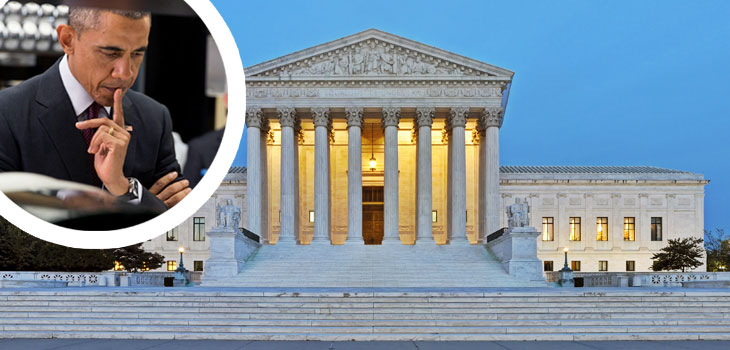
While Schumer’s backtracking will certainly be red meat for those pushing to repeal and replace the healthcare law and dump the medical device excise tax, the real threat to Obamacare isn’t going to come from the legislative branch. It’s likely going to come from across the street from the Capitol building, the less public and more deliberate judicial branch, the U.S. Supreme Court.
The Court has agreed to hear King vs. Burwell and Chief Justice John Roberts will have a chance for a “do-over” after he enraged conservatives by siding with liberal justices in 2012 and writing the opinion that Obamacare was constitutional.
Obama’s Legacy Meets Robert’s

The healthcare law may well define the legacies of the President and the Chief Justice.
Obama’s historic legacy is already set if for no other reason than being the first African-American elected to the White House. But he will also be remembered as the President who successfully steered the country’s fiscal policy through the worst economic crises since the Great Depression. But as far as healthcare is concerned, Obama’s policy legacy is still up for grabs. Roberts, now in his tenth year as Chief Justice, is still searching for his place in history. To date, his decidedly tortured logic regarding the Affordable Care Act is his signature accomplishment.
Before we dig into King vs. Burwell and Roberts’ second bite of the apple, let’s get back to the politics of repeal and the device tax.
Device Tax Repeal
With dissension among Democrats, Congressional Republican efforts to repeal the medical device tax have a chance to succeed. The new Senate Majority Leader Mitch McConnell immediately targeted the tax in his victory speech, calling it a “big, big mistake.”
The 2.3% excise tax on medical devices will raise $29 billion over the next decade. Last year, the Senate voted 79 to 20 to repeal the tax, with 34 Democrats joining the majority on a nonbinding sense-of-the-Senate measure. Hardcore liberal senators like Elizabeth Warren of Massachusetts and Al Franken of Minnesota, who have device manufacturers in their states, voted against the tax.
“Red Herring” Issue
Industry leaders continue to complain that the tax is costing jobs and stifling innovation. Wall Street analysts have said the cost of the tax and the extra business from newly insured patients is almost a wash.
The Congressional Research Service estimated in a November report that the tax will have “fairly minor effects” on the industry’s output and jobs (reducing them by no more than 0.2%) and a “negligible” effect on the price of health care.
“With relatively small effects on the U.S. medical device industry, it is unlikely that there will be significant consequences for innovation and for small and mid-size firms, ” the report said. “To the extent that the tax does fall on profits, economic theory indicates that there would be no effect on output or jobs. Stockholders, however, would lose money, but that loss would be reduced because of device exemptions and income tax offsets.”
Allan Lichtman, distinguished professor of history at American University in Washington, D.C., told U.S. News & World Report that the device tax is a “red herring issue.”
So why is device tax repeal getting so much attention?
“Not one American in 100 can tell you what a medical device tax is and why it matters, ” said Lichtman. But given Democratic internal dissension and support from liberal senators with large device makers in their states, Lichtman says it’s the best shot Republicans have of taking a bite out of Obamacare and demonstrating bipartisan support for dismantling the law.
Device Tax and Obamacare Delinked
As leaders of AdvaMed had told us, the device tax and Obamacare are not directly linked because the device tax goes into the government’s general coffers. Repealing the tax only lowers tax collection and increases the federal debt. Politicians don’t have to vote to repeal Obamacare to repeal the tax.
If the device tax can be skillfully maneuvered through the legislative process and placed on the President’s desk, it has a chance. If however, it gets muddled into something the President can veto (like a repeal of Obamacare or tax reform), chances of repeal are slim.

King vs. Burwell
The future of Obamacare in its present form may rest on the definition of one word—“State.”
King vs. Burwellis likely to be heard by the Supreme Court in March and decided in June. The justices will dissect the meaning of one word on page 95 of the 906-page Patient Protection and Affordable Care Act—one word that could render health insurance premiums unaffordable for millions of Americans.
Meaning of “State”
The law says that tax credits will be available through exchanges “established by the State.” When the law was drafted, it was assumed that all 50 states would create their own exchanges. After it passed in March 2010, 36 states, many controlled by Republicans, decided to opt out and let the federal government operate the exchanges, as the law allows.
In 2012, the Internal Revenue Service made the subsidies available in all states. The challengers of the law claim those subsidies cannot be offered in exchanges operated by the federal government. Without subsidies, insurance costs would likely skyrocket.
The meaning is clear, say the challengers. Subsidies can be offered only in state exchanges because that’s what Congress intended.
The administration’s lawyers say the word, “State, ” must be read in the context of a law clearly intended to make health insurance available to everybody.
To make their case that this wasn’t just a drafting error and that Congress meant what it said, the law’s opponents say lawmakers purposely made tax credits available only in state-run exchanges as an incentive for governors and legislatures to create their own exchanges. Otherwise, the argument goes, their residents would get cheated out of a major benefit.
In other words, if you’re a citizen in a state that doesn’t set up an exchange, you still pay the tax but don’t get the tax credit.
What if…
Richard Wolf, writing for USA Today on November 22, 2014, says legal and public policy experts speculate on what might happen to the law if Roberts shoots for his own legacy and rules against Obamacare this time.
There could be a chain reaction, beginning with the impact on premiums. More than seven million people could lose subsidies in 2016, according to the non-partisan Urban Institute. On average, the subsidies pay more than 75% of premium costs, or about $4, 700 per year.
Without subsidies, wrote Wolf, more than eight million people would be exempt from the requirement that individuals purchase insurance, because it no longer would be affordable. Hundreds of thousands of employers would be exempt from penalties for not covering employees, because their workers would not be subsidized in states with federally operated exchanges.
But even that would not necessarily kill the law, wrote Wolf.
First of all, individuals in the 14 states operating their own exchanges would still be eligible for tax credits. Additional states, such as those with Democratic governors or with Republican governors who have accepted increased Medicaid funding—another of the law’s carrots—might set up exchanges.
Other sections of the law would remain intact. Those include a guarantee that insurance companies cover everyone, the Medicaid expansion, Medicare cost containment measures and allowing young people under 26 to remain on their parents’ policies.
Roberts In the Middle
Roberts could be in the middle again, as the law has four likely votes on the court—Justices Ruth Bader Ginsburg, Stephen Breyer, Sonia Sotomayor and Elena Kagan. Where the other four justices who dissented in Robert’s 2012 opinion—Antonin Scalia, Anthony Kennedy, Clarence Thomas and Samuel Alito—stand is unclear. But, writes Wolf, it takes four votes in private conference to hear the case, and they are the most likely antagonists.
Courts are historically known by its chief justice. Roberts knows the “Roberts Court” will be remembered at least in part for its battles with Obama over his most cherished domestic policy achievement.
What is Roberts likely to do this time?
Wolf concludes that Roberts’ vote in a recent voting rights case suggests he might not step in to save the health law this time.
Roberts voted to strike down a key provision of the Voting Rights Act. The provision the high court declared unconstitutional defined which states had to get federal approval (or pre-clearance) before making changes to their voting laws. Roberts’ opinion for the majority ordered the provision struck because it was based on old data. Congress, he reasoned, could simply update the formula to respond to “current conditions” if it wished to.
If, in June, Roberts redeems himself with conservatives and says Congress should clarify the definition of “State” and sends Obamacare back to Congress, it’s going to be a long hot summer in Washington, D.C.
