
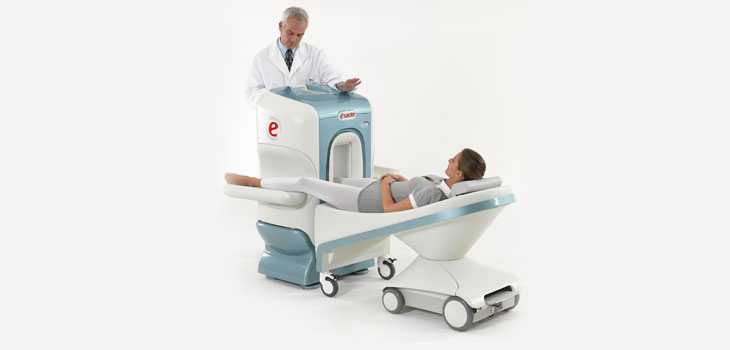
Spectators scanning the sidelines during World Cup Soccer matches may note a new component positioned at the ready when Argentina’s team takes to the field. The device is a blue and white box with an opening into which a player can insert his leg for faster diagnoses of injuries. Called Esaote’s O-Scan, the device is defined as a small but efficient MRI system used to image extremities such as knees and ankles. It contains a fully portable MyLab ultrasound system.
When a team is competing at the world-class level, adequate preparation is everything. This applies to the medical teams as well as the coach and players. Fast diagnosis followed by rapid treatment is fundamental in the rush to get star players back on the field playing as quickly as possible. When Alejandro Rolon, M.D., doctor for the Argentina team, brings his equipment onto the field for the World Cup competition, it will be the first time a dedicated MRI system will have made an appearance at a World Cup match.
“There is no other system like the O-scan MRI that allows for an easy installation directly in the stadium. I will also have one of Esaote’s fully portable ultrasound systems over my shoulder for immediate on-field diagnosis, ” he said, adding, “This is definitely the trend in elite sport and the future of sports medicine. Being able to instantly and correctly identify and classify the lesion will speed up athletes’ recovery time. The best opportunity for intervention, treatment and rehabilitation is right after the injury.”
Esaote North America, Inc. was founded in 1979 and is headquartered in Indianapolis, Indiana. The company has over 1, 360 employees and has industrial and research units in Italy, the Netherlands and China. The firm’s press release states that it is internationally recognized as being one of the “top ten” diagnostic imaging companies in the world and works with numerous scientific and clinical research universities. Esaote has installed MRI systems at the ATP Madrid Masters’ tennis tournament. Many top class club sites around the world have similar systems in their stadiums and training grounds.
