
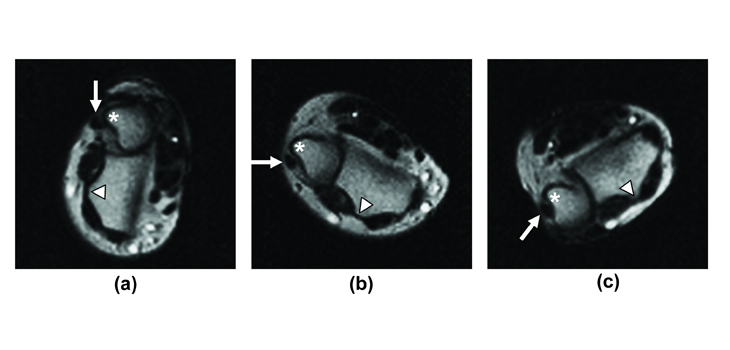
If a still picture won’t work, try a movie. Orthopedic surgeons at the University of California have learned to create “movies” of the wrist in motion—images that are useful in diagnosing the subtle changes in physiology that indicate the onset of conditions such as instability of the wrist.
The films are made by creating a series of brief magnetic resonance imaging scans—a technique they call an “active MRI.”
Philip Briggs, who reported on the work from UK’s Spire Gatwick Park Hospital, quoted Robert Boutin, M.D., lead author of the study, who said: “Now patients can reproduce the motion that’s bothering them while they’re inside the scanner, and physicians can assess how the wrist is actually working. After all, some patients only have pain or other symptoms with movement.”
Investigators believe that the imaging technique could also be used to determine what the best treatment option is and whether or not the patient requires orthopaedic surgery.
