
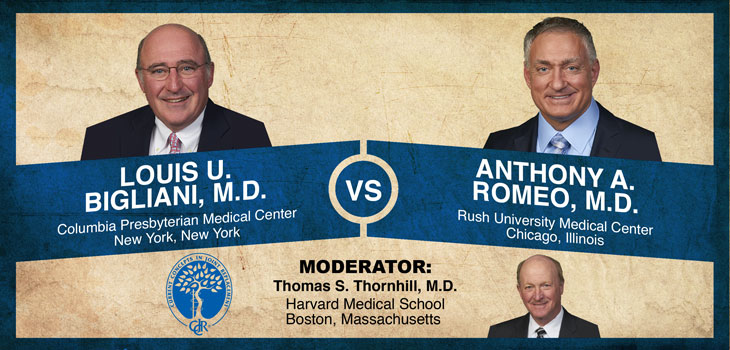
“The literature shows that total shoulder replacements way outperform hemiarthroplasties, ” states Louis Bigliani. And, furthermore…“that’s what this 68-year-old glenoid patient needs.” Au contraire counters Tony Romeo, “I believe this is best treated by removing the glenoid and bone graft.”
This week’s Orthopaedic Crossfire® debate is “This Glenoid Revision is Best Treated with a Glenoid Implant.”
The case at hand is a 68-year-old female, right hand dominant, who’d been treated with an uncomplicated total shoulder procedure in 2004. She has been doing well for six years, but in year eight presented with painful glenoid loosening.
Her elevation against gravity is still good at 160 degrees and her passive and active external rotation is 70 degrees. Despite taking non-steroidals, Embrel, and methotrexate, her pain is a problem and she hasn’t used oral steroids in more than five years.
For the proposition is Louis U. Bigliani, M.D. of Columbia Presbyterian Medical Center in New York; against the proposition is Anthony A. Romeo, M.D. from Rush University Medical Center in Chicago. Moderating is Thomas S. Thornhill, M.D. from Harvard Medical School in Boston.
Dr. Bigliani: “The literature shows that total shoulder replacements way outperform hemiarthroplasties. A 2007 study by Radnay found that hemis resulted in an 80% satisfaction rate versus total shoulders, which had a rate of 97%. Even if you have a loose glenoid it’s not the worst thing in the world.”
“Generally, you should make three holes and remove as little bone as possible and cement it in. There have been various studies showing that there are a small percentage of lucent lines. Unfortunately, our patient today has a lot of bone loss.”
“So you could re-implant without bone graft, you can bone graft, you can do a staged implant, you can bone graft and then put in a glenoid, but that takes two operations. You can use an augmented bone graft. If you remove it you can do a biological resurfacing and the results are reasonable…but not as good as when you have a glenoid in. With mild/moderate/severe bone loss in the central/peripheral/combined positions if you are putting in a glenoid you must do a structural bone graft.”
“In a loose glenoid case where there’s a lot more bone destruction, the CT shows that there is a cavity and there may be some bone to work with. So one might be able to put in a traditional glenoid with bone graft and have the patient have good results.”
“My colleague and I first reported on this in 1998, and we showed that when you put a glenoid back in that re-implanation is better as far as pain relief and function. In 2001 Antuna from the Mayo Clinic reported on 48 shoulders and they too found that re-implantation patients were more satisfied and had an increased range of motion. A 2008 follow-up study by Cheung at Mayo also showed that when you re-implant the glenoid there was higher patient satisfaction and more ‘excellent’ results.”
“As for our patient here, I would say that there’s probably a rotator cuff tear or a thin rotator cuff. So I’d want to use a glenoid with a long peg that would penetrate the bone she has with bone graft. I probably would use a reverse in this patient because I bet her rotator cuff would not expand back out and would not be great.”
Dr. Romeo: “This 68-year-old rheumatoid patient with a large glenoid defect: we should not put a glenoid in this patient. The radiographs show superior migration and the superior tilt of the glenoid, and we must be suspicious that the rotator cuff isn’t functioning. As for the glenoid, while we have a contained cavity there is little left except for the cortical bone. To fix a glenoid in this environment is going to be challenging at best. And do we really know that the loose glenoid is the cause of her pain…or is it her rotator cuff?”
“For this debate we’ll assume the cuff is functional. I believe this is best treated by removing the glenoid and bone graft. In a 2012 retrospective review by Bonnevialle of 42 total shoulder arthroplasties with symptomatic failed glenoids that were revised to a new glenoid, their complication rate after revision was 45%; 21% required reoperation, and the overall loosening rate was 67% at 74 months. There were variable things on their radiographs such as broken screws and graft resorption.”
“In 2008 there was a study by Cheung at the Mayo Clinic that looked at 33 shoulders with glenoid re-implantation and 35 shoulders with bone grafting. There was no difference in the overall outcome; and certainly the complication rate in most surgeons’ hands would be less with the bone graft alone. Another 2008 study, this one from Elhassan at Harvard where they showed that they could get a glenoid in and it did seem to work slightly better in terms of function…but that was only in 14% of the cases because of the associated problems with soft tissue and bone loss. So if you can’t do proper glenoid preparation—which includes machining the glenoid bone to fit your glenoid implant and pressurizing your cement to a contained vault then your likelihood of being successful with re-implanting a glenoid is going to be very low.”
“A 2010 study by Raphael at HSS [Hospital for Special Surgery] addressed symptomatic glenoid loosening complicating total shoulder arthroplasty. They showed that if you did a re-implantation versus resection the overall results were no different and complication rates were less. They even showed that arthroscopic management of these may be helpful.”
“In the case presented here there is a superior tilt of the glenoid; we agree that we have a centralized defect based on our CT scan. So I propose that we prepare the glenoid and ream the surfaces gently to smooth off any rough edges. We’re not trying to take away bone. Then we consider bone graft options: cancellous impacted, structural iliac crest autograft, or an allograft.”
“A nine-patient study by Gilles Walch from France looked at corticocancellous bone grafting (autograft). Eight of the nine patients did extremely well in terms of pain relief; function was not dramatically improved. The one failed patient had a massive rotator cuff tear. We like using iliac crest graft because as we’ve shown in our instability patients, this is a nice graft to reconstruct the forces on the face of the glenoid.”
“And revision arthroplasty using allograft? This does not work as well, especially when you just stuff in cancellous bone or when you use a large structural allograft as opposed to autograft. Autograft seems to work much better. A study by Tom Norris in California showed that patients with cancellous bone grafting had satisfactory pain relief, although many did resorb over time. So as Dr. Bigliani mentioned, when you have these glenoid revisions you have a contained vault then something like a metal-backed implant without cement may be a reasonable option.”
“My decision tree on this case goes as follows…I look at that first X-ray and I see superior tilt of the glenoid. I’m very suspicious about the rotator cuff, and I’ll order a CR arthrogram to look at the infraspinatous and subscapularis to make sure I have a cuff where I can reconstruct and put in a glenoid bone graft. Then I decide if there’s a need for revision based on the glenoid alone. The rotator cuff is presumably intact; we look at the CT scan and I suspect there’s insufficient bone stock to reconstruct it with the glenoid. Thus I use a corticocancellous autograft iliac crest for the management of this patient.”
Moderator Thornhill: “Lou, your comment?”
Dr. Bigliani: “When I saw this case I thought, ‘It’s riding up superiorly and after eight years there’s not going to be much rotator cuff to work with.’ And if you’re going to put a structural graft in…this is a case where you might get away with not putting in a glenoid and using the rim if there were any rotator cuff. But if you’re going to go to a glenoid replacement without a rotator cuff I think you have to go to a reverse arthroplasty with a structural bone graft.”
Moderator Thornhill: “Tony, your decision is to take iliac crest and bone graft this and leave it unresurfaced?”
Dr. Romeo: “Yes.”
Moderator Thornhill: “When would you consider using another surface?”
Dr. Romeo: “We have looked at our biologic grafts in the face of a hemiarthroplasty in young patients. We’ve seen the work at Harvard where they did a revision of a glenoid failure with a bone graft and a biologic graft. For the added cost and complexity of the procedure it seems highly cost ineffective. So we’ve moved away from using biologic grafts in this setting. We use the iliac crest…using the smooth inner surface as our articulating surface and the back cancellous part which we impact into the contained defect.”
Dr. Bigliani: “We have a paper that will hopefully be published where we’ve used bone chips and have grafted and have had reasonably good results.”
Moderator Thornhill: “Louis, how do you do a glenosphere in this reverse shoulder?”
Dr. Bigliani: “Ken Yamaguchi has shown that if you use a structural bone graft and an extra long peg then you can penetrate that area and get good healing. Rheumatoids will heal with excellent results.”
Moderator Thornhill: “How are you going to actually fix the graft to the glenoid?”
Dr. Bigliani: “You basically wedge it in there.”
Moderator Thornhill: “Are you going to try to get the tilt right?
Dr. Bigliani: “You try to get the tilt inferiorly a bit.”
Moderator Thornhill: “If you do it and you don’t really like your fixation will you stop there and come back another day and if it incorporates, then do a reverse?”
Dr. Bigliani: “If there’s enough bone left and I can’t get a bone graft.”
Moderator Thornhill: “Tony, how do you differentiate whether the pain is coming from the loose glenoid or the rotator cuff?”
Dr. Romeo: “We start with a physical examination and identify whether the patient has rotator cuff signs. You become suspicious when the patient is complaining about a lateral arm pain that’s being going on for one year…that this is more rotator cuff than something deep inside. We do selective injections and if we’re suspicious that it’s primary cuff then we’ll do subacromial injections. If we think it’s glenoid we’ll do the glenohumeral joint. Then we proceed with the CT arthrogram and you get subtraction of the artifact; you can look carefully at the infraspinatus and subscapularis muscles. If you can see a good infraspinatus and a good subscapularis then that would lead us to try and reconstruct the glenoid as opposed to doing a reverse. But if you see a bad infraspinatus or subscapularis then we’d do a reverse.”
Dr. Bigliani: “Usually people with loose glenoids have pain posteriorly in the joint line and they will feel a click or a hitch when they go up. That’s the tipoff that it’s the glenoid rather than impingement.”
Moderator Thornhill: “Thank you both.”
Please visit www.CCJR.com to register for the 2013 CCJR Winter Meeting, December 11–14 in Orlando, Florida.

“You may now view CCJR meeting content on your mobile device on the CCJR MobileTM App. Please scan the QR code to download from iTunes.”
