
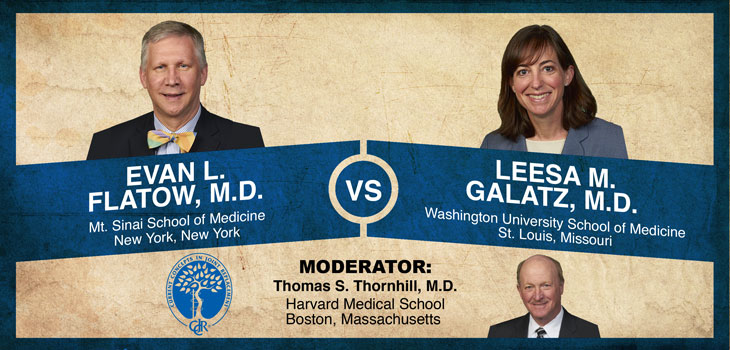
“A reverse is an excellent option for elderly patients, those with poor bone, and patients with compromised rehab, ” states Evan Flatow. Leesa Galatz argues, “Hemiarthroplasty still has a role: the outcomes are equivalent and complications are much lower, among other things.”
This week’s Orthopaedic Crossfire® debate is “This Fracture Should Be Treated With a Reverse Shoulder.” It involves a 69-year-old woman in good health until she fell on some ice and sustained a fracture to her right, dominant shoulder. She had no other injuries and her neurovascular status was intact throughout the limb. She has a sedentary lifestyle, but does do some gardening and takes care of her grandchildren. For the proposition is Evan L. Flatow, M.D. of the Mount Sinai School of Medicine in New York; against the proposition is Leesa M. Galatz, M.D. from Washington University School of Medicine in St. Louis. Moderating is Thomas S. Thornhill, M.D. from Harvard Medical School in Boston.
Dr. Flatow: “There looks to be a head split, comminution, soft bone and osteoporosis; perhaps there is some callous. This would be a challenging case for internal fixation, especially if it’s not a day or two old. There are fewer fracture indications for hemiarthroplasty because we have better percutaneous fixation options, and better internal fixation options. In addition, there’s an awareness that avascular necrosis (AVN) is not always a disaster.”
“These fracture tools can be useful, although in this case where there is a crack through the head, comminution, soft bone, and an elderly patient, and perhaps a few weeks of early healing, I don’t think these would do very well.”
“Many stems have been made specifically for fractures. These stems don’t often do well…unless you happen to be one of the designers. These are episodic and depend on tuberosity healing, good rehab, and the ability to do this complex operation well.”
“The study with the best data comes from Dan Mole’s randomized, prospective study of complex proximal humerus fractures; 19 were treated with reverses and 19 were treated with hemis. Tuberosity fixation was with graft in the hemi and without graft in the reverse, so perhaps a technical advantage for the hemi. The results showed that the reverse had better average elevation (115 degrees) versus the hemi (96 degrees). The hemi had better external rotation (15 degrees) versus the reverse (11 degrees); hemi beat reverse for internal rotation as well (L3 versus sacrum). Remember, the reverse has built-in internal impingement in all directions, so you do have more of a check on rotation.”
“With a hemi you either get miraculous results and then a lot of terrible results…but you don’t have many people at the average. They may report an average of 100 degrees, but no one has that…they are either 40 or 160. With the reverse, however, there was a much more normal distribution and a more predictable outcome.”
“Tuberosity healing is not automatically unnecessary in a reverse. In fact, if the tuberosity heals you do better than if it doesn’t. But even if it doesn’t heal you don’t get down into these dismal 30/40 degrees of elevation.”
“A system that allows convertibility between a hemi and a reverse—as most do—is very useful. So in summary, reverse is an excellent option for elderly patients, those with poor bone, and patients with compromised rehab.”
Dr. Galatz: “Factors to consider when approaching any patient with a fracture are age, comorbidity, osteopenia, how many parts to the fracture, what is the displacement, is it a high/low energy injury, and whether there is joint incongruity.”
“Over the past several years we have seen an evolution of treatment concepts. Locking plates have offered interesting options; percutaneous pinning—which isn’t always applicable—is applicable to certain fracture types…and hemiarthroplasty shouldn’t be ignored.”
“Indications for fixation include minimal metaphyseal comminution, two-part surgical neck fractures, selected three-part fractures, and valgus impacted four-part fractures. Remember that not all four-parts are created equal. Also, patients do better with their own bone. So in my opinion if a fracture can be fixed it should be fixed.”
“Regarding AVN, in a valgus-impacted fracture there is about an 11% risk of AVN, compared to a situation where there is a lot of lateral displacement (high risk of AVN). I think fixation should be considered in every case because outcome is far and away better if patients are better with their own bone and if they heal anatomically. Age and activity level are relative. Advanced age and osteopenia are not contraindications to fixation.”
“If a fracture is not amenable to fixation then you can do a humeral head replacement. This could be with older patients, those with a high risk of failure of ORIF, and patients with articular incongruity. In older people you want to minimize the likelihood of a second procedure. This must be done correctly. You have to restore soft tissue anatomy, restore bony anatomy, and with fracture specific stems.”
“Failure of tuberosity healing is our main indication for converting to a reverse after a fracture. But here is why hemiarthroplasty still has a role: the outcomes are equivalent, reverse implants are more expensive, complications are much lower, and the reoperation rate is not demonstrated to be higher with a hemiarthroplasty. In looking at a risk value analysis we see that superior outcomes with a reverse are not established. There are mostly Level 4 studies and few contain both groups. There is poor reporting of results as well. In the literature you find that there are not huge differences in active forward elevation between a hemi and a reverse.”
“One of our fellows did a review of all of this literature and found these differences in the ASES scores: 65-80 for hemi, 47-67 for reverse; the constant score was 44-68 for both groups. The reverse is also significantly more expensive ($12-15K versus $7-8K). But here is what’s really important. A 2007 study by Bufquin found a 4X higher chance of a complication with a reverse. Possible complications are: neurologic injuries, pain syndrome, dislocations, acromial fractures, periprosthetic fractures, and deltoid dehiscence. These complications are unique to a reverse—dislocation, acromial fractures, and deltoid injury—we don’t hear about these after hemiarthroplasty. Importantly, there is a very high incidence of neurolotic injury after a reverse.”
“Complications such as dislocation, loosening, scapular notching, and tuberosity migration are significant. So overall, the results of a hemi and a reverse are similar if tuberosity healing occurs. And it is true that the hemi often results in these disparate groups and a reverse may find this middle ground. But be aware of this complication rate…a good hemi is not necessarily a bad operation.”
“So always consider your bone preserving options because with an anatomic reduction and stable fixation, if that person heals, they will have a superior result to any arthroplasty. Hemi and ORIF have lower complication rates and reverse has introduced new complications not previously seen in the fracture setting. Valgus impacted fractures are very amenable to fixation in all age groups. Age and osteopenia are not contraindications to fixation.”
Moderator Thornhill: “What about nonoperative therapy?”
Dr. Galatz: “Age and activity level are important considerations. In this fracture with the superior migration of the tuberosities relative to the head I’m not sure this person would have a good result. She is also a lower-demand person, but she does enjoy gardening so I think we could do better. There is a report of nonoperative treatment of valgus impacted fractures in the British Bone and Joint Journal that showed reasonable results, but we need to consider head position. When there is a lot of inferior luxation those patients often don’t do well…then you’re dealing with a malunion or a nonunion.”
Dr. Flatow: “I agree with Leesa. I think the difference in the shoulder is because there’s so much scapula-thoracic motion—remember you can fuse the shoulder and still be functional—but if there’s not a lot of pain a bad result after a fracture is often livable. So conservative treatment is an option, and they can often have good function with what we would consider displacement. But in patients who want great motion and great function you have a somewhat higher standard.”
Moderator Thornhill: “Leesa, are you going to go in with the idea of trying to fix this, and will you do any other studies—like a CT? What will be the thing that makes you abandon that and go to a hemi? Then, what would make you abandon that and go to a reverse?”
Dr. Galatz: “I usually get a trauma series of X-rays, and if I have good films then I don’t necessarily need a CT. However, if this was my only X-ray, I would get a CT scan. I might try and reduce this. The one thing I look at to determine whether or not I can get this stable is metaphyseal comminution. Her medial metaphysis looked fairly good. What is concerning is the joint incongruity. I always try reduction; I have fluoroscopy in the room with every arthroplasty because I think that not only with fixation, but if you do a hemi it’s helpful to have fluoro there to ensure the tuberosities are reduced correctly. So I probably would put something under the head and try to gently lift it up; if I can’t get it in a few minutes then I would consider arthroplasty.”
Moderator Thornhill: “Evan, would you try to fix this or go right to a reverse?”
Dr. Flatow: “I’d have to see more films. I agree that in general fixation is always better if it is possible. In some cases like the valgus impacted four-part they are candidates for pinning (which seems to work better in older patients because you keep all the soft tissue). What’s troubling is that it looks like there is some early healing and a bit of head incongruity…and those are harder. So I’d have that discussion with the patient, and I may go in ready to fix it…or I may go in ready to do an arthroplasty.”
Moderator Thornhill: “What about the subscapularis if you do a reverse?”
Dr. Flatow: “I always try to get some repair.”
Moderator Thornhill: “How are you going to get enough length in your reverse to get the construct tight enough so that you’re not going to have a dislocation?”
Dr. Flatow: “Most of us do a mixture of deltopectoral and superior approaches, and for fractures the superior approach can be useful because if the tuberosities are pulled apart you’re looking right down on the glenoid. There is a much lower rate of instability after a superior approach because you leave everything inferiorly.”
Moderator Thornhill: “Leesa, who should fix this?”
Dr. Galatz: “I’m on the shoulder service, so of course it should be fixed by the shoulder service. There are very talented trauma surgeons, but sometimes in the trauma setting you can do some things to make conversion to an arthroplasty more difficult.”
Moderator Thornhill: “Thank you.”
Please visit www.CCJR.com to register for the 2013 CCJR Winter Meeting, December 11–14 in Orlando, Florida.

“You may now view CCJR meeting content on your mobile device on the CCJR MobileTM App. Please scan the QR code to download from iTunes.”
