
“You can get excellent clinical results with a cementless device…and cementless is equal to cemented.” Or so argues Aaron Hofmann. “Hold on, ” counters Thomas Thornhill. “There are advantages of cementless total knees, however, we will be doing cemented knees consistently at some point in the future.”
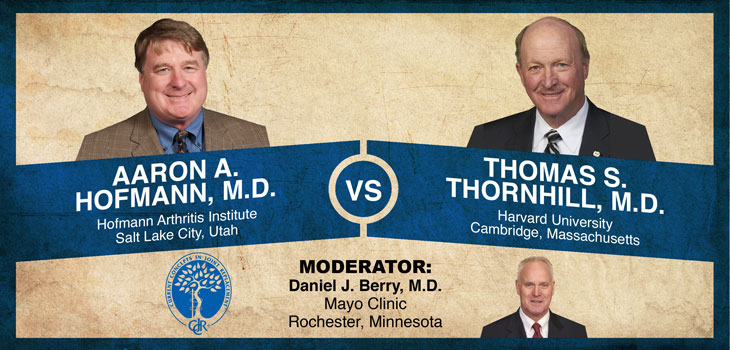
This week’s Orthopaedic Crossfire® debate is “Cementless Fixation: It’s Time for the Wine.” For the proposition is Aaron A. Hofmann, M.D. of the Hofmann Arthritis Institute in Salt Lake City, Utah; against the proposition is Thomas S. Thornhill, M.D. from Harvard University. Moderating is Daniel J. Berry, M.D. from Mayo Clinic in Minnesota.
Dr. Hofmann: “I want to thank Seth for letting me debate my father. Twenty-six years ago I thought everything should be cementless. After listening to Dr. Thornhill and others I’ve done fewer cementless procedures each year, basically due to cost.”
“The basic premise is that cementless must be at least equal to or better than cement. We were taken astray a bit because we did some animal studies and found that after six weeks there was solid ingrowth…but it didn’t work on humans. So 20 years later we’ve seen a lot of changes, and now we have lots of surface technologies available.”
“Some of our early data showed that titanium has an advantage over cobalt chrome; you get deeper and more penetration than if you use the latter material. There’s really never been a problem on the femoral side…it’s always the tibial side. The proximal tibia is only 24% bone, 76% marrow; that’s the problem with trying to get attachment, so we use cement in every case. It’s biologic cement if we’re doing a non-cemented fixation. We grind up a slurry of bone from the underside of the tibial wafer, put it across the proximal tibia, and that becomes our biologic cement. The particles are there at the interface; it keeps the gaps away and drives particles into the porous coating to jump start that.”
“Over the years we were accused of this being dead bone at the interface. But if you do tetracycline labeling of this bone and see that it lights up and shows that there’s about 45% better immediate integration of that slurry of bone to the porous coating. And there’s about 65% better ingrowth with the biologic cement.”
“Regarding the tibia, you have to match the patient’s slope to avoid subsidence. It’s more critical if you’re doing a cementless device. You also must be careful not to cook the bone while you’re preparing it, so thermal necrosis occurs at 55 degrees and you have to irrigate that saw blade or make sure you’re using new saw blades on the tibia and on the femur.”
“Over the years we’ve learned that it doesn’t matter how old the patient is…you can get good ingrowth into the porous coating. We also found that we had a 98% survival at 6-10 years, first of all on the patella. We don’t use metal backed patellas because they have fallen out of favor, but they do work. When we examine our longer term follow-up of our first group of knees (360 patients with 89% cementless) the metal parts—the tibia and femur—survived 98% of the time.
These were all cruciate-sparing types of implants. We did have bad poly at the time so we were down to 94% poly survivorship and 95% of the patellas at 10-14 years. It wasn’t the metal backing that failed. It was the poly that was 1.9mm on the edge that was a problem.”
“The proof in the pudding is always in implant retrieval. We’ve been doing this for 25 years and you get great ingrowth into these implants—an average of 6-12%. This is good because there’s only 26% bone in the proximal portion of the tibia. You can’t get more into the porous coating than you have outside of the porous coating.”
“So you can get excellent clinical results with a cementless device, and I think cementless is equal to cemented. You have a minimal amount of aseptic loosening and wear and excellent ingrowth upon retrieval. The cost of porous implant is the biggest question in my mind; it must be addressed.”
Dr. Thornhill: “Aaron, my son…I have not taught you well. The best way to disarm your opponent in a debate is to go second, tell him the day before that you’re going to be very benign and not say anything. But Aaron, I’m from Harvard, and you don’t believe anybody at Harvard. I plan on beating you like a rented mule.”
“There are advantages of cementless total knees, however, we will be doing cemented knees consistently at some point in the future. The operative time is shorter; we’re moving away from tourniquets, it’s better for MIS (though I have concerns). If the systolic pressure is up in a knee I don’t like to cement. Cement extrusion is something that I tell residents and fellows to look at very carefully because this is third body wear.”
“When we looked at this in the first cohort of our patients, we could say some things about cemented femurs. We were not as good because our numbers were not as good in the patella and in the tibia. At that time our institution had a disproportionate number of rheumatoids, who have a slightly high risk for cementless. We had over 50% uncemented femurs with 100% survivorship of the cementless femoral component at 10 years. We didn’t have enough uncemented patellae or uncemented tibias to make any conclusion at that time. But at Mayo Clinic—and granted these were earlier cemented designs—they had 92% 10 year survivorship for cemented implants compared to 61% for their cementless counterparts.”
“We know the problems of access to debris and the affected joint space, as well as the problems with well-fixed screws and osteolysis that has been changed in many hands. There’s a variable substrate, particularly in the tibia.”
In a typical varus knee you might see sclerosis and cysts; the fact is that cement in this area creates a uniform proximal tibial mantle. That, I think, makes it easier for loading the tibia in a cemented situation. It also allows for antibiotic delivery and potential for other drug delivery of biologic agents.”
“Regarding the surgical cut precision that many people say is important, well, we are not always that good. ‘A little putty and a little paint makes the carpenter what he ain’t.’ Cement does help a bit in that situation. I have a 58 year old patient with a cementless knee. There was no failure of fixation; it was a failure of soft tissue balance. There was over-resection on the femur; it was loose, globally unstable.”
The problem is that when we removed the components we put a dental dam around the patella and got a bit too close to the bearing surface. We restored the joint line, restored the stability, and everything was good. But there ended up being a lot of debris after the surgery, and I’m concerned about third body problems.”
“So what will be the tipping point to cementless TKA [total knee arthroplasty]? It’s going to be new material technology. There are many companies now that have trabecular metals that are very good: better coefficient of friction, better surface roughness, better cutting potential, and very good porosity, ultrastructure, and biocompatibility for ingrowth. As for high flex designs there has been some femoral failure, both cemented and uncemented. But cost is going to be ‘the thing.’”
“So Aaron, fine…take the wine out, put it in bottles, but at least for the present time, leave it in the cellar.”
Moderator Berry: “Aaron, you said that you have seen the percent of uncemented implants in your own practice go down. What percentage of your standard primary knees now are uncemented?”
Dr. Hofmann: “I went from 89% cementless to about 10% cementless and that’s purely based on cost. I’m in charge of keeping implant costs down, and if the implant costs an extra $1, 000 because it has porous coating then that’s hard to justify in a Medicare patient.”
Moderator Berry: “So for the entire healthcare system, if the technology is more expensive, if the results are maybe as good (but not necessarily better), if it’s technically tougher, then why do it even in that 10%?”
Dr. Hofmann: “Durability. I’ve written about total knees in patients less than 50 and those things are as durable as anything we’ve seen…more durable than a cemented knee. So I think there’s a logic to looking at that patient group. There’s no logic in looking at an older patient group. If you can justify $1, 000 total for a porous implant then that takes up the cost of the cement and the extra OR time.”
Moderator Berry: “So if you’re going to use it in 10% of your patients—and they’re younger—what are your indications for doing an uncemented knee?”
Dr. Hofmann: “They must have good quality bone. The post traumatic patient, the smoker…they are not good candidates for cementless. I even cemented a 31 year old recently who had terrible bone with hardware still in place. That isn’t good biologic material for ingrowth.”
Moderator Berry: “Tom, do you do any uncemented knees anymore?”
Dr. Thornhill: “I resurface the patella every time and I don’t have a good option, so once I’ve bought into it I’ve got the cement in hand. So if I’m doing a cruciate retaining rotating platform knee, it’s actually easier to use a femoral trial. I don’t do any uncemented tibias, but I will do uncemented femurs…particularly with some of these newer materials. That way I can get my trial femur out, let the tourniquet down, make sure I’ve got the debris before I put my final insert in. I think there may be something to this loading of the bone. I think it will be a thing of longevity. We published a paper this year looking at what price people are willing to pay for an implant to gain xyz. So in a 75 year old person there’s probably no benefit, as opposed to a 45 year old. And we’re tending to look at knees as commodities now, which is a real problem.”
Moderator Berry: “Aaron, if you’ve decided to do an uncemented knee do you do anything to test the fixation of the implant as you pound it in (or afterwards)?”
Dr. Hofmann: “Not after the implant is in, but there’s a crude test that we use routinely. When we put the broach in, if you can hit on the broach with your mallet hand (not with a metal mallet) then that bone in the central portion of the tibia will not support a cementless implant. I’m also still using screws on the tibial side, so I have to get good initial fixation.”
Moderator Berry: “Tom, do you have any way of testing your femoral component once you pound it on or do you judge that it’s sufficiently fixed as you pound it on?”
Dr. Thornhill: “It’s like anything else…when you get a component you must know the nuances of the system. You can tell from your implant related to your trial fit and then it’s literally the fixation. I want to be able to get it to start to scratch fit anteriorly and posteriorly. It’s the AP fit…if I can pull it off or move it then I would bail.”
Moderator Berry: “Thank you both.”
Please visit www.CCJR.com to register for the 2013 CCJR Winter Meeting, December 11–14 in Orlando, Florida.

“You may now view CCJR meeting content on your mobile device on the CCJR MobileTM App. Please scan the QR code to download from iTunes.”
