
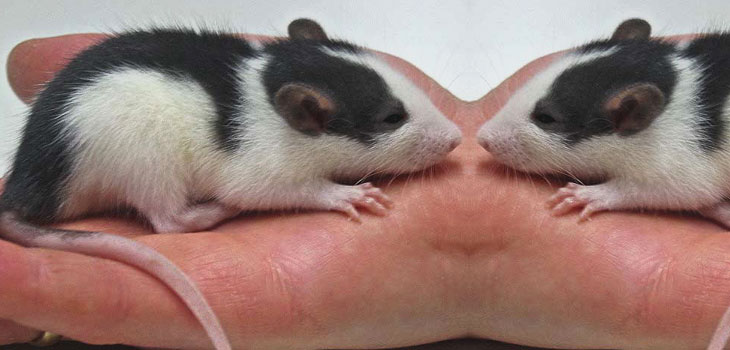
ALS (amyotrophic lateral sclerosis) is a horrible disease. Only half of patients are alive three years after their diagnosis. Now, from the University of Wisconsin at Madison, is news that the transplantation of human stem cells improved survival and muscle function in rats used to model ALS.
Masatoshi Suzuki, an assistant professor of comparative biosciences, and his colleagues used adult stem cells from human bone marrow and genetically engineered them to produce growth factors that can support damaged nerve cells. They implanted the cells directly into the muscles of rats that were genetically modified to have symptoms and nerve damage that resembled ALS.
A primer on nerves: motor neurons are often the first to suffer damage in ALS, but it is unclear where the deterioration begins. Many scientists have focused on the end of the neuron where it meets the spinal cord. But Suzuki has observed that the far end, where the nerve touches and activates the muscle, is often damaged early in the disease.
The connection between the neuron and the muscle, called the neuro-muscular junction, is where Suzuki focuses his attention. “This is one of our primary differences, ” Suzuki says. “We know that the neuro-muscular junction is a site of early deterioration, and we suspected that it might be the villain in causing the nerve cell to die. It might not be an innocent victim of damage that starts elsewhere.”
Previously, Suzuki found that injecting glial cell line-derived neurotropic factor (GDNF) at the junction helped the neurons survive. The new study, published in the journal Molecular Therapy, expands the research to show a similar effect from a second compound, called vascular endothelial growth factor.
Suzuki found that using stem cells to deliver vascular endothelial growth factor alone improved survival and delayed the onset of disease and the decline in muscle function. That result mirrored his earlier study with GDNF.
But the real advance, Suzuki says, was finding an even better result from using stem cells that create both of these two growth factors. “In terms of disease-free time, overall survival, and sustaining muscle function, we found that delivering the combination was more powerful than either growth factor alone.”
The injected stem cells survived for at least nine weeks, but did not become neurons. Instead, their contribution was to secrete one or both growth factors. “We aim to keep the neurons alive and healthy using the same growth factors that the body creates, and that’s what we have shown here, ” Suzuki said, adding, “Because this is a fatal and untreatable disease, we hope this could enter a clinical trial relatively soon.”
