
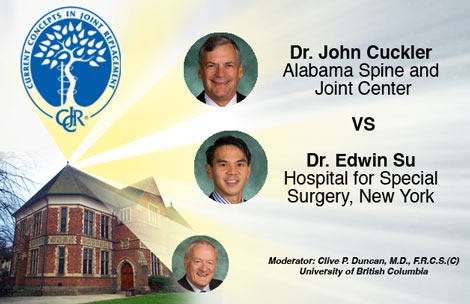
Rumors about the effects of resurfacing are “a load of crap” says Dr. Edwin Su. Dr. John Cuckler disagrees and asserts that surgeons should “rethink resurfacing.”
This week’s Orthopaedic Crossfire® debate is titled “Metal-Metal Surface Replacement: A Triumph of Hope Over Reason.” For the proposition was Dr. John Cuckler of the Alabama Spine and Joint Center. Against the proposition was Dr. Edwin Su of the Hospital for Special Surgery in New York, and moderating is Clive P. Duncan, M.D., F.R.C.S.(C) of the University of British Columbia. Let the fireworks begin.
Dr. Cuckler: “This should be easy. Ed, I’ve watched you operate and I admire your technical skill. Ten years ago I was very enthused about surface replacements. I occasionally do some for situations such as a man with extreme metaphyseal deformity. But the short and intermediate term data aren’t reassuring, and for that reason I’ve changed my stance, and changed my mind about metal-on-metal articular couples in general. So, Ed…just push the ‘easy’ button for your patients…let’s go to a conventional total hip and be safe and effective.”
“There are some advantages—such as conservation of femoral bone stock—to the resurfacing concept. But the disadvantages far outweigh the advantages: things like the risk of femoral fracture; acetabular bone stock removal, which is greater than with conventional hip arthroplasty; significant anatomic limits, which affect the younger patients who need total hip arthroplasty, such as large cysts associated with avascular necrosis, severe head/neck deformities, small sockets…the biomechanics are somewhat constraining with regard to restoring offset and leg length.”
“So, what are the short- and long-term results compared with total hip replacement with regard to pain relief, function, and patient satisfaction? The outcome of revisions is equally important…and you’re all aware of the process of pseudotumors that have been reported from the Oxford Group which significantly compromise the results of revision in some cases.”
“Look at the early data. You might say, ‘Well, it is old and not relevant.’ But consider the wide discrepancy in revision rates that occur even in the hands of extremely experienced resurfacing surgeons such as Derek McMinn. Even in experienced hands, the results of resurfacing are still not as good as conventional total hip; and there is a steep learning curve.”
“Looking at the results of the Australian Joint Registry from 2010…the cumulative revision rate at nine years was around 8%, and this is almost regardless of age. It gets worse when you segregate the data according to gender and head size. Females and males with small sockets do far worse than those with more conventional anatomy. Older females do even worse, approaching a 14% failure rate at nine years. This is not acceptable, Ed.”
“How do surface replacement arthroplasties compare with metal-on-metal conventional total hips? About the same. Which tells you that there may be something that we don’t yet understand about metal-on-metal articular couples. In a comparison of metal on metal versus metal/polyethylene articular couples from Australia, at eight years the failure rate is approaching 4% for metal-metal, compared with about 2% for metal/polyethylene. How can we justify that…that significant difference between these couples, given this data?”
“How do you choose a patient for surface replacement arthroplasty? Paul Beaulé, an expert in this field, developed a surface arthroplasty risk index in 2004 and it’s still valid. If you add up to more than three—[wherein previous surgery=1; weight=2 if <180lbs; femoral cyst>1cm=2; activity level=1]—you have a twelve times increase in your failure rate.”
“Do these conserve bone stock? No, in fact you have to ream a little more acetabular bone in order to accommodate the diameter of the femoral head. There is a higher metal ion release with any metal-metal articular couple. Pseudotumors: probably related to component malposition and high socket angles leading to advanced wear.”
“So Ed, let’s just push the ‘Easy-THR’ button…not this one: ‘Bullshit-SRA”…and do the right thing for our patients.”
Dr. Su: “Thank you, John, for an eloquent opening salvo. This video shows how I think this debate may go: Dr. Su: ‘I will convince you through scientific argument that there is still a role for hip resurfacing. Dr. Cuckler: They say that if you have a hip resurfacing you will lose your hearing, your kidneys will fail, and your pecker will fall off. Dr. Su: That is a load of crap.’”
“Fact #1: Hip resurfacing preserves bone. It is indisputable that it does this on the femoral side. It is, however, a possibility that it does so at the expense of acetabular bone…we investigated this. We performed hip resurfacing and hip replacement on 10 cadaveric specimens—matched for size. In all cases the femoral bone was preserved with the hip resurfacing, and we found no difference in the amount of acetabular bone removed. Then we did a clinical prospective study, matching for native femoral hip size…and we found a greater tendency to upsize the acetabular component in a hip replacement due to the desire for a larger head size.”
“Fact #2: Not all implants are created equal. We’ve heard a lot about the Durom and the ASR [Articular Surface Replacement], and that’s because these implants had design flaws that led to problems and early failures. The Durom had problems with acetabular fixation, and the ASR had a small arc of coverage and tight clearances that have led to a high failure rate. Looking at that Australian registry…from their revision curves you can see that they were failing at higher [rates] than the other cohort of hip resurfacing implants. But my point is that these two implants are not representative of the whole class of resurfacing implants.”
“Fact #3: Most problems with hip resurfacing can be avoided by good surgical technique and a good implant. We know that hard-on-hard bearings are more sensitive to malposition; a ceramic-on-ceramic bearing, that probably leads to squeaking and stripe wear. With a metal-on-metal bearing, edge loading will lead to metal ion debris and possibly metal reactivity. In a hip resurfacing socket positioning is more difficult due to the difficulty of exposure and the lack of screw fixation. This may lead one to put the cup in a position that is sub-optimal just to gain stability of fixation. This is further compounded by the smaller arc of coverage in which there is less room for error.”
“Fact #4: “Metal-on-metal resurfacing performs better in certain subgroups. The Australian registry: women are failing at about twice the rate of men. However, if we look at those men and break them down by age, we find that at seven years the revision rate is about 3.6%. With a hip replacement, men at the 7/8 year mark are failing at around the same rate, 3 to 4%; women also are failing at a higher rate with a hip replacement.”
“I will use my opponent’s own words to make my point: hip resurfacing, in the hands of a surgeon with sufficient experience, appears to produce results at intermediate follow-up comparable to a conventional metal-metal total hip replacement. Many of the reasons not to perform hip resurfacing are based on FEAR…fear of fracture, fear of difficulty of the technique, fear of metal reactivity and sensitivity. We should not allow fear to triumph over reason.”
Moderator Duncan: “Can each speaker give us data that will convince this audience that a surface replacement will outperform a well done hip joint replacement today. Ed?”
Dr. Su: “The best study is the randomized controlled study coming from Canada. They did two sets of experiments where they compared a metal-metal total hip with smaller head size, compared to resurfacing and looking at gait studies and activity levels they found that these studies were improved with the resurfacing group at one year. When they further did a study controlling for head size there was no difference.”
Moderator Duncan: “So if you have a larger head size that will equalize the results?”
Dr. Su: “Correct.”
Moderator Duncan: “John? Any data that will convince us that surface replacement will outperform a total hip replacement with a larger head in conventional practice?”
Dr. Cuckler: “In one word…no. We must remember that the three of us on the podium have had the luxury of being highly specialized surgeons who do a lot of arthroplasty. Our job is to look at the performance of articular couples and implants, not for the highly specialized surgeon, but for the community surgeon who may do less than 60 or so hip arthroplasties a year. Resurfacings have had a great loss of enthusiasm in Australia over the last five years because the community is aware of the problems of this design. I’m not saying it doesn’t work in Ed’s hands.”
Moderator Duncan: “A second question: are you convinced—each of you—that the outcome measures we use are sensitive enough to pick up the increased performance, increased satisfaction that some of the surface replacement patients claim?”
Dr. Su: “I agree that it is not sensitive enough. Most of us use the Harris Hip Score which, I think, has a ceiling effect. We’re not picking up the small factors that may separate out the two.”
Moderator Duncan: “Studies suggest that even though we go to great pains with patient reported outcome data, that we are still not picking up what potential advantages there may be.”
Dr. Cuckler: “I agree…we can’t measure these subtle differences, and the vast majority of studies on resurfacing have had huge biases of selection…selecting people who are more active to begin with, less disabled to begin with…you’re comparing apples and oranges.”
Moderator Duncan: “Tell us what you’re doing with your patients on an annual basis when you bring them back.”
Dr. Cuckler: “Patients need to be seen every two years, but more importantly you should tell the patient that if they develop new pain you need to see them. I suggest you do an ultrasound of the hip looking for abnormal fluid collection, which can be the first sign of the ALVAL [Aseptic Lymphocytic Vasculitis Associated Lesions] response, or runaway wear, which can occur with malposition…and it’s the pseudotumor type reaction.”
Dr. Su: “I agree that these metal-on-metal bearings need closer surveillance. I follow them every year with X-rays, clinical exam…and if they have symptoms I send metal ions.”
Moderator Duncan: “As far as I’m concerned it’s still unresolved how you should deal with these patients who insist on a surface replacement. Please join me in thanking our speakers.”
Please visit www.CCJR.com to register for the 2012 CCJR Spring Meeting, May 20-23 in Las Vegas, Nevada.
