
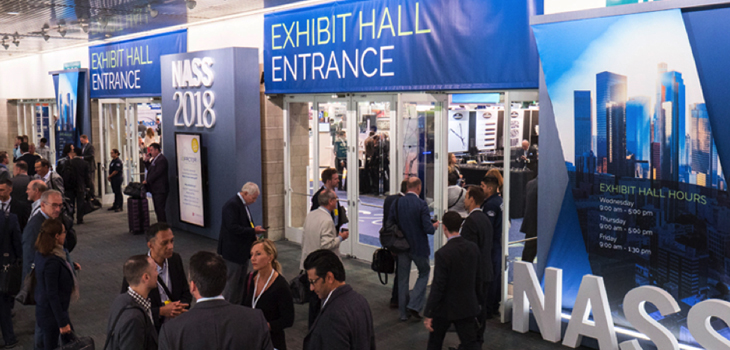
Several spine companies held meetings for Wall Street’s analysts at the 2019 North American Spine Society (NASS) annual meeting. NuVasive unveiled its Pulse robotics platform, Globus featured a new integrated imaging platform, JNJ’s Synthes talked robotics and getting back to market growth rates, SeaSpine featured clinical studies and promised accelerating sales growth rates while Zimmer Biomet provided more ROSA details.
Did Wall Street like what they heard? They did.
Here are the details.
Overall Sentiment Is Positive for Spinal Implants, Instruments and, Yes, Robotics
Wells Fargo’s Larry Biegelsen and Shagun Singh told clients, “We came away from our NASS meetings with the view that the overall sentiment around spine is positive. The companies are now operating in a stable to modestly growing spine market with estimated y/y growth of 2-3% in 1H’19. There is a focus around innovation in enabling technologies (imaging, navigation, and robotics or INR), products offering procedural integration (e.g. Pulse), and those to target faster growth sub-segments within spine (e.g. complex spine).”
Cantor’s Craig Bijou came to the same conclusion saying: “Sentiment on the spine market is modestly positive. Spine market growth remains in the low single digits, but most of the industry is happy with the stability seen over the last few quarters, especially in the U.S. after the negative growth two years ago. Volumes appear to be growing and pricing pressure remains negative, but stable. MDT [Medtronic] called out adult deformity as one area of the market that is seeing healthy procedure growth.”
In terms of specific companies, here’s what these top analysts took away from 2019 NASS:
Globus Medical Inc.
Wells Fargo said that Globus (GMED) is extending its technological leadership with a new imaging platform that consolidates O-Arm and C-Arm capabilities.
Cantor’s Bijou noted, specifically, that Globus appears to be moving faster than its competitors in terms of enabling technologies like robotics and imaging. As he wrote to his clients, “GMED showcased the next evolution of its Excelsius, which included its Interbody Solutions platform. The Excelsius interface has a much-more modern look and faster software.” Indeed, said Bijou, “We think GMED took the biggest step forward among its peers, as it launched a software update and showcased a new imaging system that is to be fully integrated with its Excelsius robot.”
Wells Fargo wrote to clients, “The most notable new product featured at NASS 2019, thus far, has been the unveiling of a new imaging platform by GMED that it built in-house. The platform is being targeted for a U.S. launch in mid-2020 and aims to offer a fully integrated INR (imaging, navigation, and robotics) platform to its customers.”
“The new imaging platform will be fully integrated with GMED’s own robotic and navigation system offering a seamless experience to its users as the three systems will have better ability to communicate with each other.”
“The more notable benefit is that the system will consolidate the capabilities of three systems into one by offering CT scans, fluoroscopy and digital radiography. Our surgeon checks suggest that it could lead to material time savings as it takes 20 minutes to cart in an O-Arm for a CT scan that takes 90 seconds.
