
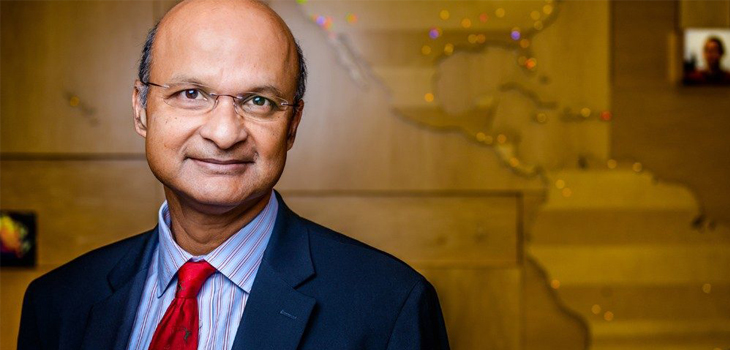
Over its 70+ year history, two-thirds of Medtronic’s CEOs were Minnesotans. The non-Minnesotans were Art Collins from Ohio, Bill Hawkins from North Carolina and Syed Omar Ishrak from Bangladesh.
This past week, after nine years as CEO, Omar Ishrak announced that he will retire in 2020.
Aside from, perhaps, Earl Bakken or Art Collins, Omar Ishrak will be remembered as the most transformative leader in Medtronic’s history.
Before Ishrak, Medtronic was a Minnesota-based medical device company with global scope.
Under Ishrak, Medtronic became a fully global company where diversity and cross-fertilization between technologies, business units and, indeed, cultures made Medtronic more competitive, dramatically more valuable and decidedly more effective at bringing medical tools and instruments to every healthcare provider everywhere.
By the Numbers
When Ishrak joined Medtronic, he staked out three core strategies to revive Medtronic’s sales, earnings, value and market share—Innovate Therapies, Build Economic Value and Increase Globalization.
At the time, it was no secret that U.S. growth had slowed. Medtronic needed to get its mojo back.
By the numbers, how did he do?
- Sales increased from $15.9 billion in 2011 to $30.6 billion in 2019 – up 92%
- Earnings increased from $3.1 billion in 2011 to $4.7 billion in 2019 – up 50%
- Investors increased Medtronic’s P/E from 14.53x in 2011 to 31.2x in 2019 – up 114%
- Investors increased Medtronic’s Price-to-Sales from 2.82x in 2011 to 4.75x in 2019 – up 68%
- Medtronic’s market value increased from $45 billion in 2011 to $145 billion in 2019 – up 222%
Beyond the Numbers
Three transactions highlight Ishrak’s tenure to date at Medtronic.
The 2012 acquisition of China’s medical device company Kanghui Holdings for $816 million, the 2015 purchase of Covidien for $50 billion and the 2018 purchase of Mazor Robotics for $1.7 billion.
With the Kanghui acquisition, Ishrak made China an integral part of Medtronic’s global footprint.
Ishrak, in fact, came to Medtronic with a long history of opening up the emerging markets for his previous employer, General Electric (GE). One way he did that was to champion the concept of “frugal innovation.” Frugal innovation refers to adapting advanced technologies like miniaturization, mobile communications and/or advanced materials to build cheaper, high performance devices.
His poster child for this at GE was Brivo, a line of MRI and CT scanners developed in India which used the same digital technology found in higher-end systems but without expensive automation features and then miniaturized and packaged into a smaller box.
One year before joining Medtronic, Ishrak launched Brivo in China.
And one year after joining Medtronic, Ishrak bought one of China’s largest medical device suppliers, Kanghui.
