
U.S. hospitals report 8.7 recordable injury or illness events per 100 employees each year according to the October 29, 2015 Bureau of Labor Statistics, Employer-Reported Workplace Injuries and Illness report for 2014.
(You can obtain a copy of the report here: http://www.bls.gov/news.release/pdf/osh.pdf)
That’s higher than heavy construction (7.5), wood product manufacturing (6.8) or animal production (7.1). In fact, it is close to police work (9.5).
The Occupational Safety and Health Administration (OSHA) tracks injuries for all sectors of American commerce and they report that:
- 40% of total work-related injuries and illnesses are strains and tears, and an additional 29% are pain (8 days).
- Work-related musculoskeletal disorders in the U.S. account for more than 600, 000 injuries (34% of lost workdays).
- Median lost time for specific disorders include carpel tunnel syndrome (27 days); tendonitis (14 days); general musculoskeletal disorders (11 days); sprains, strains and tears (10 days); and soreness or back pain.
- Employers spend as much as $20 billion a year on musculoskeletal work-related injuries and five times that for indirect costs (hiring, training replacements).
Ignoring the Hospital Athlete
At the recently concluded NATA (National Athletic Trainers Association) conference in Baltimore several speakers presented strong data that the athletic trainer model—which is a basic fact of life for both amateur and professional athletes—can effectively lower work place musculoskeletal injuries by 40%, 50%, 60% or more.
And a wide variety of industries are trying this out.
Aerospace, auto manufacturing, law enforcement, military and virtually every college or university are embracing the concept of certified athletic trainers in their workforce to assess and treat employees at work.
But not, it would seem, hospitals and clinics—despite the high rate of musculoskeletal injuries and workplace injury absenteeism.
When asked, executives who set up industrial athlete programs told OTW that hospitals and clinics were among the worst industries at adopting the principles of athletic trainers.
Is it turf issues, or NIH (Not Invented Here), or perhaps a dismissive attitude toward the “junior physicians” otherwise known as athletic trainers?
Whatever the cause, it’s a fact that the hospital athlete could benefit significantly from the athletic training model.
The Non-Sports Athlete
Athletic trainers prepare athletes for the game, keep them in the game and when an injury does occur, apply a rehab program which prepares the athlete to get back into the game and to perform at a high level.
Jim Allivato, Director of Operations with ATI Worksite Solutions, a provider of athletic trainer services to industry, describes how his firm applies these same principles to the industrial athlete.
“In recent years many employers have moved from traditional occupational medical care, typically onsite nurses and physicians, to utilizing Certified Athletic Trainers who are experts in early intervention and injury prevention to mitigate escalating costs and subpar outcomes.
“In practice, these industrial athletic trainers spend more than 80% of their time in the work area with employees delivering prevention techniques and health education. When minor discomfort is present, they address those symptoms early, often and in employees’ work area. Athletic trainers use an intervention model which encourages early reporting of injuries and eliminates the traditional medical model where injured employees go to the clinic only after loss of function or inability to do their job.
“Most soft tissue injuries can be effectively treated through conservative or self-care measures. Early intervention programs yield an 85% resolution rate for employees’ reports of work related discomfort and pain WITHOUT the need for traditional medical care.”
Jim’s firm, ATI, has brought the athletic training model to more than 50 companies in a variety of industries.
According to Allivato, the economic benefits are compelling.
“Here are two examples from our experience of embedding Certified Athletic Trainers in the workplace.
- A large Aerospace manufacturing company used 2 certified athletic trainers onsite for early intervention for approximately 1, 800 employees and, in the first 11 months, achieved 61% decrease in musculoskeletal recordable injuries.
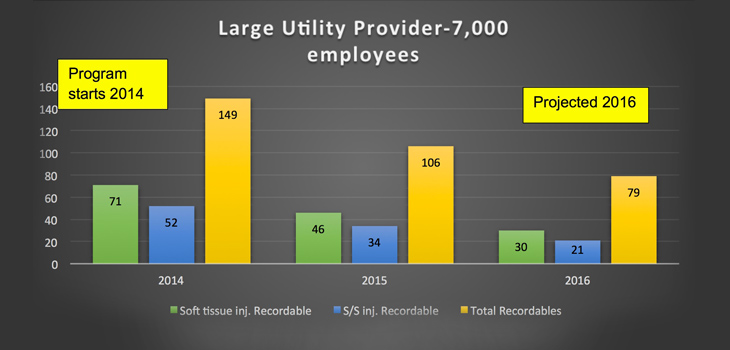
- A large Utilities provider hired 19 certified athletic trainers to work with over 7, 000 employees and achieved the following milestones:
- 30% reduction in total injuries (lowest number in company history) with only 32% of those being soft tissue injuries.
- 45% reduction in 2016 which, if maintained for the rest of this year, would represent a record setting low of 79 total recordable injuries. That’s coming just two years after starting the program.”

The Fairfax Police Force
The Fairfax, Virginia, police force hired an athletic trainer to implement a classic training model for their 1, 900 department and academy employees. The trainer they hired put in place a 24/7 wellness clinic designed according to the needs of the academy and police patrol shifts.
The most common police and academy injuries were sprains and strains from physical training and job-related activities. Not unlike the typical sports athlete.
The most frequent cause of injuries was vehicle rear or head-on collision, pursuing suspects on foot or “hands-on” contact with recalcitrant offenders.
Nancy Burke, MS, ATC, VATL, the athletic trainer who set up and ran the Fairfax program was quoted in the local paper as saying: “Utilizing an athletic trainer in the academy setting has proven to reduce overall medical costs by 49.5% and musculoskeletal medical costs by 86.3%. And, by having the athletic trainer treating sworn and civilian employees in a large county police force, we’ve tracked reduction of overall medical costs by 22.05% and musculoskeletal medical costs by 21.2%.”
Athletic Trainer Model Versus Traditional Healthcare Model
The athletic trainer model was developed over several decades on the crucible of professional and college athletics. Getting multi-million athletes back into the game pushed athletic trainers to develop strategies which improve the athlete’s mental and physical resilience.
No different for the industrial (and hospital) athlete. Athletic training programs include individual physical assessments, job-specific wellness education and musculoskeletal injury prevention. Athletic trainers who are embedded with employees can catch early signs of discomfort and promote stretching and other self-care techniques. They also observe body mechanics on the job and promote improved industrial ergonomics.
When injuries do occur, the athletic training model emphasizes quick assessment as to the severity of the injury as well as its cause—which, of course, becomes essential to building an overall prevention plan. If an injury falls within the scope of practice, the athletic trainer is trained to set up and implement a rapid rehabilitation program—on site, several times a day with no insurance billing.
Again, no different than the type of care which the professional athlete receives. This type of on-site multi-session therapy process has been shown to significantly increase recovery speeds as well as lower rates of injury reoccurrence.
By contrast, the traditional “patient” model normalizes sending employees to a healthcare facility. The rehabilitation process may not start for several days and even then it may only be provided a few times a week!
Can you imagine a professional sports team treating their key athletes in this way?
More Data From NATA
At the recently concluded 2016 NATA meeting, the following stats were released:
- 100% of companies employing an athletic trainer had a positive return on investment (ROI) with 83% reporting an ROI of more than $3 for every $1 invested.
- 94% of companies reported a decrease in the severity of injuries.
- 88% of companies noted a decreased number of injuries.
- 50% or more reductions in OSHA’s DART rate (“Days Away, Restricted duty and Transfers”) are routine, depending upon the type of industry.
Hospitals Can’t Heal Themselves
When it comes to the hospital athlete, the athletic training model has many advantages over the traditional health care model.
According to the U.S. Bureau of Labor Statistics 650, 000 work-related musculoskeletal disorders occur annually resulting in costs to employers of more than $20 billion, and with hospitals and clinics ranking near the top of all industrial sectors in terms of worker injuries and absenteeism, the economics for a change are self-evident.
Aerospace, power companies and every major college and professional team have cut costs and raised employee satisfaction with embedded athletic trainers.
Time for orthopedic hospitals and clinics to jump on the athletic trainer bandwagon.
