
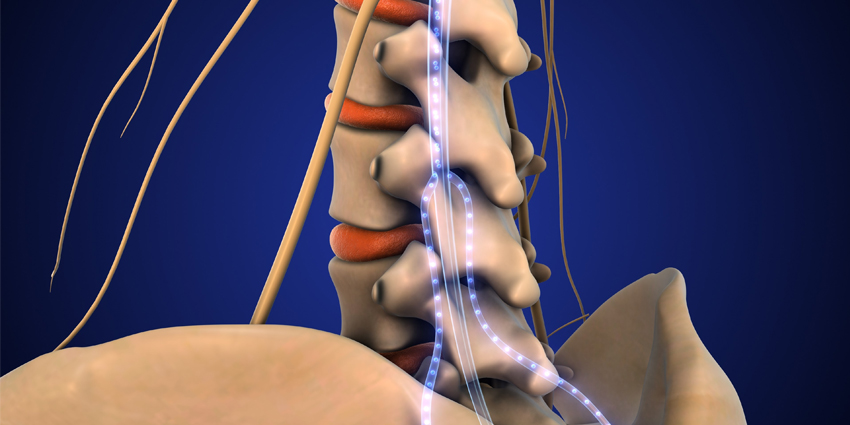
How effective is spinal cord stimulation? And compared to what?
A research team led by the chairman and founder of The American Society of Pain and Neuroscience, Timothy Deer, M.D., designed a prospective, randomized control, multicenter study to compare dorsal spinal cord spinal stimulation to medical management for the treatment of low back pain.
Patients who had experienced chronic, refractory axial low back pain and had yet been treated with lumbar surgery and for whom surgery was not an option were selected for the study.
The results were published in August 2024 edition of The Journal of Pain Research under the title: “Comparing Conventional Medical Management to Spinal Cord Stimulation for the Treatment of Low Back Pain in a Cohort of DISTINCT RCT Patients.”
According to Dr. Deer, “The orthopedic spine surgery community and the interventional spine community felt there was a need to investigate how patients with chronic low back pain and no surgical options would do with spinal cord stimulation compared to typical medical management. There have been several articles showing efficacy and safety for Failed Back Surgery Syndrome, Complex Regional Pain Syndrome, and Diabetic Peripheral Neuropathy, but there had not been a high-level evidence-based study on non-surgical correctable lumbar pain.”
According to the study authors, the particular technology being employed, a passive recharge burst spinal cord stimulation, is a unique stimulation design characterized by a five-pulse train with an internal frequency of 500 Hz delivered at 40 Hz, with a 1-millisecond pulse width. The charge accumulates during the intraburst phase, and after the burst packet, there is a period of passive discharge of energy.
“The accumulated charge gradually dissipates over time…and uniquely mimics neuronal burst firing patterns in the nervous system and has been shown to modulate the affective, attentional components of pain processing in addition to the nociceptive components.”
In total, the researchers enrolled 269 patients: 162 were randomly assigned to spinal cord stimulation and 107 were assigned to conventional medical management (supervised medical care, including physical modalities, medication optimization, and interventional therapies).
The researchers found that patients treated with this novel form of spinal cord stimulation reported a 72.6% pain scale improvement while patients in the conventional medical management arm reported 7.1% pain scale improvement.
The team then calculated a composite measure of function improvement or pain relief and found that 91% of the spinal cord stimulation patients reported either functional or pain improvement or both while a much smaller 16% of the medical management patients reported either function or pain or both improvement.
Using the Oswestry Disability Index, the spinal cord stimulation group reported a pain/function improvement of 30 points during the testing term, while the conventional medical management group reported a 1-point change.
Dr. Deer summarized the study to OTW, “We were surprised that spinal cord stimulation was so much better for not only pain but also much better with function and quality of life. I think it will lead to improved patient access, reduce the need for high-dose opioids, and reduce disability.”

SCS in an opioid naive patient helps for a period of time – all studies essentially revealing a waning analgesic effect over mos./years. There is minimal correlations with SCS short term trials and long term VAS pain scores. Studies from the 90s with lumbar pain reveal high incompletely treated psychiatric disturbances in the cohorts of chronic lumbar pain. Studies also revealed consistent limited effect with SCS with prior instituted opioid therapy. There was little change in VAS pain scores over time with opioid pts. and SCS implants. No study to our knowledge reveals with SCS long term lowering of VAS pain scales, return to work, or lowering of opioid dosages. The costs associated with long term SCS use with lead migrations, ineffective long term treatment, battery issues, etc. only justify treatment in an opioid naive populations that has minor associated resolved mental health issues, Pain generally is too diffuse for PNS; though like SCS is amazing technology. We recommend periodic neurolytic tx., psychiatric supports, limited opioids, non narcotic adjuvants, and RTW PT. The work comp studies reveal that 90 % of patients not RTW by 3 weeks are lost forever (no return) – which is a motivational psychiatric issue relating to chronic pain/depression/fitness/etc. Our clinic is stuffed with patients wanting SCS removals. Enough said.