
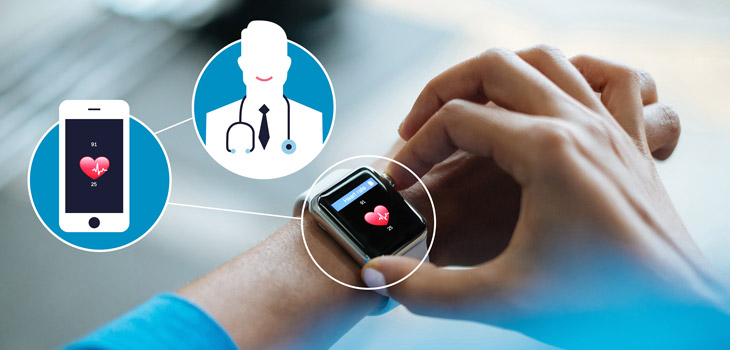
We might not like it when technology seems to spy on us. In some instances, however, it might be handy. Consider the case of wearable devices linked to your phone that can help ensure a faster, smoother recovery from surgery.
Stephen Lyman, Ph.D. is an associate scientist at HSS and has made the testing and development of wearables a focus. In his view, wearables are uniquely suited to improving large joint surgery outcomes: “There are more than one million people annually who undergo hip and knee replacement in this country. Ensuring that we have a complete picture of their surgical recovery is an enormous job—one that can be helped by the emerging technology of wearable sensors and data collection.”
Elaborating on the history of wearable technology, Dr. Lyman talked about his experience at HSS “We were initially interested in these devices as a way to monitor patient activity after treatment in order to see whether their activity level increased, decreased, or remained the same. We wanted to know the signal—the relationship between how the patient is feeling and the information we were getting.”
“While these measures were available via off the shelf devices, the data points may not tell the full story. For example, if a smartphone is sitting on the counter instead of in the patient’s pocket or purse, we can’t capture their additional steps. Additionally, data points like step count can be misleading as a measure of mobility.”
“So, for patients after knee replacement surgery, we might not see an increase in the number of steps they take in a day, but that doesn’t mean mobility hasn’t improved and that they’re walking around with less pain.”
Dr. Lyman undertook a study of postoperative data collection from 150 hip surgeries and 150 knee surgeries which were performed at 12 doctors’ offices.
“We started with step counts tracked by an app on a smartphone. After hip or knee replacement we assessed recovery over time as patients increasing their steps per day. Originally, we expected that their steps were going to exceed their preoperative activity levels.”
“We monitored patients’ steps for a month preoperatively to obtain a baseline; then, interestingly, we found that they didn’t walk more after surgery. Upon digging into the data, however, we found that one cohort doubled their step counts while the other returned to baseline. Those patients who were less active before surgery were the ones who returned to their ‘normal.’”
“My hypothesis is that patients in the group that returned to baseline were walking just a little preoperatively, and doing so in pain. I think the other group, however, included patients who were preoperatively more active, had been limited by their disability, and after surgery could return to their active lifestyles.”
“Ideally, we would have collected data on expectations so that we could differentiate more clearly what these patients hoped to achieve from their surgery.”
“Unfortunately, mobile phone tracking is limited in females because they may place the phone in their purses or on a counter, meaning that the steps are being under counted. And there is fact that some elderly patients are not comfortable interacting with smartphones.”
“We had one patient who, despite being enthusiastic, was not at all familiar with apps. He had the TMobile staff load the app necessary for the study…then when he was done, he returned to TMobile and had them remove it from his phone.”
“Our next step was to use a Fitbit to assess stress fractures of the lower extremity in athletes. If someone is too active then he or she is not going to recover well, so the activity needs to be limited. Our goal is to determine the safe threshold for daily steps without aggravating the injury or keeping it from healing. To date we have enrolled about 30 patients.”
“In addition, we plan to examine commercially available trackers that have been developed for medical purposes. Specifically, we are looking at technologies that are designed to manage postoperative rehab for knee replacement patients.”
