
It’s not a pill, it’s not surgery, it’s not a panacea. It’s self-administered pain relief.
What is “it”? It is such mind-body therapies as tai chi, qigong, and/or meditation.
The new multi-center stury, titled “A Tai Chi and Qigong Mind-Body Program for Low Back Pain: A Virtually Delivered Randomized Control Trial,” appears in the September 24, 2024 edition of The North American Spine Society Journal.
“In our multidisciplinary spine center we are always looking for the best way to treat patients effectively,” stated co-author Roger Härtl, M.D., the Hansen-MacDonald Professor of Neurological Surgery and director of Spinal Surgery at Weill Cornell Medicine in New York City.
“Only a small fraction of patients require surgery, so it is important to be able to offer those who are not surgical candidates successful treatment options. We have worked with Master Yang Yang for many years and have always been impressed by the results.”
In this randomized controlled trial, the researchers compared those who did tai chi, qigong, and meditation (n = 175) to a waitlist control (n = 175) over 12 weeks. (The waitlist control group was offered the option to participate in the free program one week after the final study follow-up.)
The team found that when compared to the control group, patients in the treatment group reported statistically and clinically significant improvement in the Oswestry Disability Index score by -4.7, -6.42, and -8.14 points at weeks 8, 12, and 16, respectively. The treatment group also experienced statistically significant improvement at all time points in the other outcomes.
Dr. Härtl: “Covid taught us how to teach and communicate remotely via ZOOM. The possibility to do the sessions via ZOOM really was one of the keys to success. For me stillness is an important way to listen to my inner self and calm down and relax, I am happy we could bring this into the way we treat patients.”
“Going forward we want to see how this treatment affects the use of pain medication and opioids, and even the success of surgery. For me as a surgeon it would be interesting to see if patients after surgery recover faster or better with tai chi.”
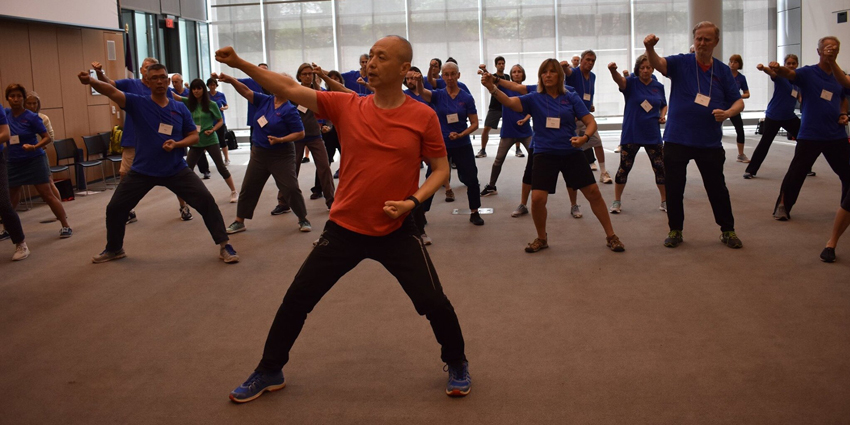
Also co-author on the study was Yang Yang, Ph.D., (University of Illinois) a leading tai chi and qigong educator and researcher. He explained the genesis of this program with Weill Cornell Medicine to OTW, “The program is an outgrowth of my personal recovery journey and my extensive tai chi expertise. After a 2014 bike accident, I spent three years overcoming severe back pain using tai chi. My personal experience became the foundation for this program.”
“In 2019, the pandemic forced me to cancel in-person classes, so I began offering them on Zoom. A few years later, Dr. Härtl and I began studying the effectiveness of virtual classes.”
“My background includes training under top tai chi grandmasters in China, where I became a martial arts champion before bringing my expertise to the U.S. I later earned a doctorate in kinesiology at the University of Illinois at Urbana-Champaign to study the health benefits and mechanisms of tai chi. This deepened my understanding of its healing power. My own recovery inspired my passion to help others with chronic pain by sharing this ancient healing art.”
