
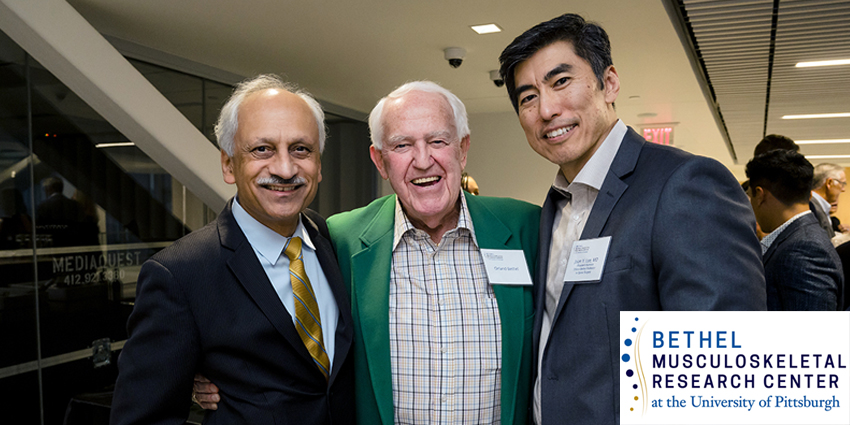
When Orland Bethel, founder of Hillandale Farms, walked into Dr. Joon Lee’s office 10 years ago with severe back pain, he would set off a chain of events that truly exemplifies “giving back.”
Bethel, who runs one of the top five egg producers in the country, had already undergone one procedure for spinal stenosis—but was still in terrible pain.
“Mr. Bethel had been to several surgeons, all of whom proposed that he have a spinal fusion,” said Dr. Lee, the clinical director of the Ferguson Laboratory, which focuses on the biology and mechanics of intervertebral disc degeneration. “He was understandably concerned about having rods and screws in his body and so we discussed additional options. We settled on a laminectomy and non-instrumented fusion, which worked out very well for him.”
Two years later in 2016 Bethel returned to Dr. Lee and was in even more pain that now encompassed his neck and his arm. “He couldn’t raise his arm and had deltoid palsy that turned out to be cervical spinal stenosis and myelopathy. I operated on him immediately and he had a great outcome. We remained connected from 2016 to 2019 during which time we talked about our families and my research.”
“He liked the fact that my family immigrated to the U.S. and over time we bonded. We often talked about our early financial struggles, our collective ‘grit’ to survive and emphasis on education. Initially, he donated several thousand dollars to the department for education and research,” said Dr. Lee, now also the Orland Bethel Endowed Professor, University of Pittsburgh School of Medicine (Pitt).
“In 2019 Mr. Bethel established an endowed orthopedic spine research chair, supporting the Ferguson Lab and the legacy of our longtime department chair, Dr. Freddie Fu.”
Paying It Forward, Again and Again
“In 2022 Bethel asked me to give some consideration to what type of large project he might fund in the way of a legacy donation,” stated Dr. Lee.
“I had always hoped to establish a musculoskeletal research center based on orthopedics, in part because so many talented researchers are siphoned off from academia because they cannot reach the stage of being self-funded.”
The Dean of the University of Pittsburgh School of Medicine matched Bethel’s $25 million donation and the Orland Bethel Family Musculoskeletal Research Center (BMRC) was born.
“Roughly 90% of those who apply for NIH [National Institutes of Health] funding are rejected,” said Dr. Lee to OTW. “While research on cancer and Alzheimer’s and dementia are more encouraged by the NIH, musculoskeletal (MSK) research is often overlooked…this despite the fact that 100% of people will suffer from some type of MSK-related pain in their lifetimes.”
Now Executive Director of the BMRC, Dr. Lee notes that early to mid-career researchers and clinician scientists face the greatest funding challenges and barriers to generate critical preliminary data. “Without preliminary data to serve as a springboard for larger funding, these researchers are deterred from pursuing promising research and are sometimes forced to undertake ‘safe’ but uninspiring topics. This is obviously detrimental to innovation and is not how we will move the field forward.”
Indeed, says Dr. Lee, approximately 50% of young postdocs leave academia due to a lack of funding.
“Research is a core part of the identity of PittOrtho,” said MaCalus V. Hogan, M.D., M.B.A., David Silver Professor and Chair of the Department of Orthopaedic Surgery and Chief of the UPMC Orthopaedic Service Line. “The Orland Bethel Family Musculoskeletal Research Center will position us to drive high impact translational research in a transformative way. We are excited for this future.”
Funded and enthused, you might say that Dr. Lee and his colleagues are “putting all of their eggs in one basket.” The three-part framework for the new BMRC facility is as follows.
Core Laboratories and Research Groups
The core laboratories and research groups, housed in the Department of Orthopaedics and the Department of Physical Medicine and Rehabilitation, include already existing entities such as the Ferguson Laboratory for Orthopaedic and Spine Research and the Joint Tissue Biology and Engineering Laboratory, for a total of nine groups. The group consists, roughly in equal parts, of basic science research labs and clinical research groups. As they grow, says Dr. Lee, they will also expand into other MSK-related departments within the School of Medicine.
Dr. Lee: “Normally, there is little crosstalk between the basic scientists and clinical research groups…we speak different languages. Those of us on the patient care and outcomes side don’t always understand the basic science side of things and conversely, those folks don’t see patients, so it’s hard for them to understand what we do. Our solution is to make combined meetings obligatory and support researchers with funding. The requirements are that they must incorporate cross collaboration, attend yearly seminars, and attend monthly meetings on translational research.”
New Investigator Program
Much as they are seeking cross collaboration amongst the labs, the Bethel administrators are also putting that in place via new research proposals. “It can be challenging for universities to fund and launch multi-center research studies, but we were convinced that we can elevate the field by expanding knowledge and collaboration across universities. We have partnered with the Orthopaedic Research Society to fund 4-5 Bethel Research Fellows—totaling up to $100,000 annually.”
In this, their first year, the program has received over 100 applications from early- to mid-career scientists across the U.S. At this point, they have selected the finalists who will be asked to apply with a full proposal; the winners will be announced this September.
“We are prioritizing those research proposals that have a reasonable chance of obtaining future governmental grants,” stated Dr. Lee to OTW. “In particular, those deemed ‘high risk/high reward’ are given additional consideration.”
Thinking long term, Dr. Lee notes, “We are hoping that the Bethel Research Fellows will remain in academia and become teachers, mentor graduate students, and encourage them apply to become Bethel Fellows.”
Education
“I stayed in academia because of the vital interactions with my mentors,” stated Dr. Lee. “As such, we will hold yearly seminars and conferences with invited guests. The first one, to be held in 2025, will be known as the Bethel Musculoskeletal Research Retreat. Both invited guest lecturers and Bethel Fellows will come to Pittsburgh to present their work.”
Also on the education front, the BMRC offers student stipends to undergraduates, medical students, and Ph.D. candidates. Students will spend two months in one of the core labs, attend weekly lectures and be paired up with a mentor. The first cohort of BMRC student scholars started this summer.
Lastly, to publish and promote the work of the new facility, Dr. Lee and his colleagues are planning a journal: The BMRC Journal.
Going Forward
“We have been in discussions with the Bethel family about going further and facilitating a spinoff of the center, namely, a musculoskeletal biobank. The concept is that we would collect tissue and data about the tissues—imaging, demographics, associated diseases, treatment, outcomes, cellular and molecular data. The last of these is known as ‘omics’ as in DNA (genomics), RNA (transcriptomics), protein, (proteomics), and metabolite (metabolomics). To date, patient evaluation methods have been rather embryonic—patient history, imaging, etc., and we often have difficulty deciding how a patient might fare with one surgical method over another. The biobank will help us narrow things down tremendously, essentially allowing us to take the guesswork out of musculoskeletal care.”
“Dr. Freddie Fu truly revolutionized Pitt’s department of orthopedics, making it much more academic- and research-oriented. Before him, the department was more practice-oriented and less nationally recognized. The residents he recruited were quite focused on research. Now, thanks to an extremely generous patient, we will be able to continue in this vein. I would like to think that if Dr. Fu was still with us, that he would be extremely excited and proud of this development and our efforts.”
In 1956 Orland Bethel borrowed $4,000 from his parents and in-laws and started a business that grew to 10 locations across the U.S. Both now and in the future, Bethel’s support will establish a legacy of musculoskeletal scientific discovery, education, and healing.
“He is an extraordinarily unassuming man,” says Dr. Lee. “Our team is so thrilled to have his support.”
Orland Bethel…a good egg.
