
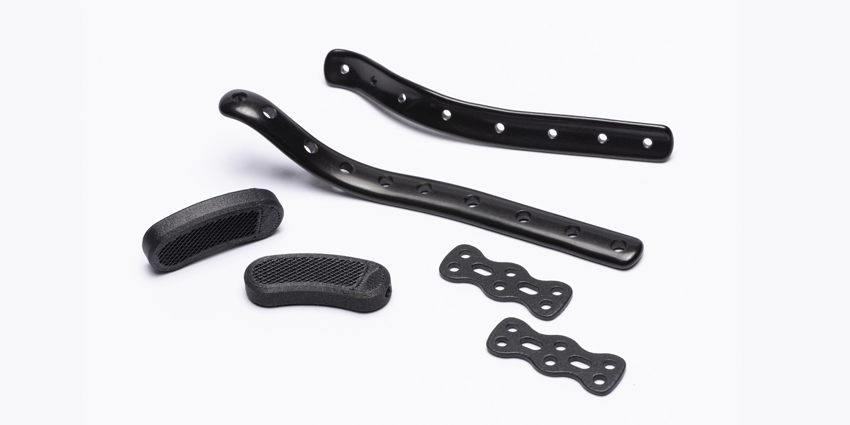
A novel reinforced PEEK material designed for 3D printing of implants and instruments has been launched by German-based supplier Evonik. The material, brand named VESTAKEEP® is a filament and comes with either 12% or 20% carbon fiber content.
The purpose of adding carbon fiber, according to Evonik, is to increase the strength of the implant or instrument which, in turn, allows manufacturers to explore, using the 3D process, a wider range of implant or instrument architectures.
VESTAKEEP, said the company, offers manufacturers of orthopedic and spine implants the “ideal balance of high strength, ductility and low weight makes PEEK an ideal metal-free alternative for implants.”

Marc Knebel, Evonik’s Head of Medical Systems said, “By introducing the world’s first carbon-fiber reinforced PEEK filament for long-term medical implants, we continue to design biomaterials that open up new possibilities in today’s medical technology for patient-specific treatment.”
“As passionate experts with decades of experience in polymer chemistry, we combine a unique set of competencies in materials science, manufacturing technologies and regulatory expertise to customers to accelerate time-to-market of new medical technologies for people’s lives beyond limits.”
Evonik has initially launched two versions of VESTAKEEP, VESTAKEEP® iC4612 3DF and VESTAKEEP® iC4620 3DF. The two filaments feature 12% and 20% carbon fiber content, respectively, and, therefore, offer two levels of strength and flexibility for such 3D printed implants as bone plates and other reconstructive prostheses.
Of course, the other benefits of PEEK remain, specifically high biocompatibility for metal allergy-patients, and the no x-ray artifacts.
Evonik is offering the two versions of VESTAKEEP in the form of 1.75 mm diameter filament and in 500g and 1,000g spools that can be used directly in standard FFF/FDM 3D printers for PEEK materials. Evonik also mentioned in their announcement that this new material meets strict quality management for medical materials.
“No other application field showcases more the advantages of 3D printing, such as individualization or design freedom, than medical technology,” added Knebel. “In trauma applications, for instance, 3D printed solutions offer an enormous time advantage over traditionally manufactured medical devices. It is conceivable that patient-specific solutions can be manufactured within two or three days, significantly improving the recovery phase.”
Evonik Background
This German-based supplier is, in fact, a world leader in specialty chemicals, supplying products in 100 countries, with 34,000 employees and generating an annual revenue of around $17 billion (18.5 billion euros). It has been active in the additive manufacturing field for more than 20 years.
If you want to learn more or contact Evonik, here are a couple names, numbers, and email addresses.
Main press contact
Janusz Berger
Head of Market Communications
High Performance Polymers
Phone +49 2365 49-9227
janusz.berger@evonik.com
Alternative press contact
Nina Peck
Head of Market Communications Smart Materials
Phone +49 201 177-2223
nina.peck@evonik.com
