
Now the residents expect simulators. They get into medical school. It’s part of the USMLE Step II and Step III. National requirements. It’s required. Yesterday at the Brigham we had Dr. David Martin from ABOS talking about all of the new requirements. This is something that’s coming. Simulation is clearly going to be here.
We have a boot camp where all the interns have an uninterrupted month. There’s a curriculum based on particularly orthopedic skills to make sure that when they start their PGY-2 they’re all roughly at the same level. Our core curriculum has a combination of labs and exercises. And there is the progressive credentialing experiment based upon the milestones.
Our boot camp basically is full time. They have stuff in basic skills, fractures, arthroplasty and arthroscopy. Much of it by simulation.
So, the “see one” is now practice many on simulation showing competency. Do one, teach one. The fact is Halsted’s thing now includes simulation, coaching, curriculum and validated assessment.
My major concern is it not a surrogate for operating on live patients.
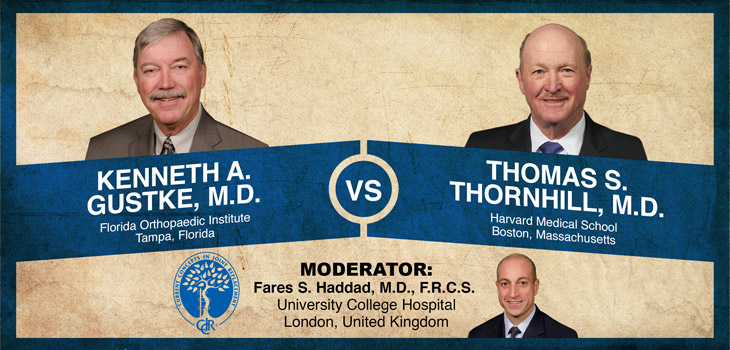
Moderator Haddad: Ken, can you actually teach the patient interaction, the patient journey, and the reality of dealing with the problem live under stress?
Dr. Gustke: Absolutely not and I totally agree with Tom that this is the first step to get the resident or fellow to the operating room with a learning base that is higher than what they come with currently. You still have to have the real patients, the real tissues, blood in the field…all the issues that we all go through on a surgical basis.
It’s hard to simulate every single scenario that you’re going to have in the operating room. I totally agree that this is not a substitute for training. This is an assistant to get the doctor to the operating room in a better fashion.
Moderator Haddad: We have agreement that simulation has a role. Tom, what bits are missing? What do we need to fill around simulation? The hours are only going to go down…the outlook of the residents is going to change?
Dr. Thornhill: It’s getting us through both areas. The fact is …ASCs and satellites, everybody there works for you, and people work together…you go to many of the academic medical centers where the residents train and you can learn inefficiency. You’ll have a different scrub nurse every time and it becomes very frustrating. But it is also one of the burdens of all of us. It is what we must do in order to have the next generation of orthopedists work. Simulation ain’t there yet.
Moderator Haddad: In terms of surgeons getting more robotic, more computer-assisted tools, is this going to become more relevant to arthroplasty?
Dr. Gustke: Yes, I think it because we get more information on screens. If we can actually have simulators that go through the balancing aspects of total knee replacement, for example, and show different scenarios on the screen, I think that will be better and help them utilize this information.
Dr. Thornhill: You’ve got to have a downside for everything and whether it is showing competency in simulation and transferring over to the operating theater, or whether it is some other downside in terms of advancement, if you don’t pass those requirements. It’s the real people that I think are important.
Moderator Haddad: Gentlemen, I think we’ve learned that simulation is important, but it’s not the whole answer. Thank you very much.
Please visit www.CCJR.com to register for the 2020 CCJR Spring Meeting — May 17-20, in Las Vegas.
