
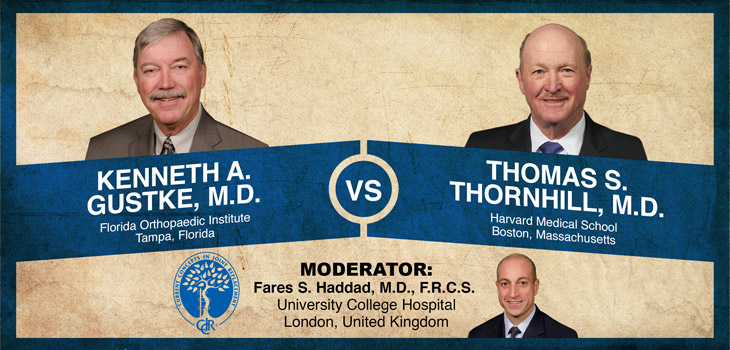
This week’s Orthopaedic Crossfire® debate was part of the 35th Annual Current Concepts in Joint Replacement® (CCJR®), Winter meeting, which took place in Orlando. This week’s topic is “Simulation Training: This is the Future.” For is Kenneth A. Gustke, M.D. – Florida Orthopaedic Institute, Tampa, Florida. Opposing is Thomas S. Thornhill, M.D. – Harvard Medical School, Boston, Massachusetts. Fares S. Haddad, M.D., F.R.C.S. – University College Hospital, London, United Kingdom is moderating.
Dr. Gustke: I’m in favor of simulation training. I think it is the future.
Historically, resident and fellow training has followed the apprenticeship model where trainees enhance their skills under supervision by more experienced mentors.
In this model, residents got to do many surgical procedures and work long hours with no hour restrictions. And we were less aware of legal ramifications and complications. Also, the hospitals weren’t all over us about surgery times.
This historical training model is now in conflict between best surgeon training, patient safety and OR efficiency.
Reduced resident work hours in the United States has meant decreased learning opportunities and longer learning curves for our residents. Multiple studies now report that residents are actually graduating without sufficient exposure and technical ability to perform some key procedures well (Zuckerman, et al. JBJS-Am, 2005; Bell, et al. Ann Surg, 2009; Mauser, et al. Int Orthop, 2014).
One interesting study surveyed senior orthopedic surgeons who took on junior associates that just finished their residency training program and asked them what they thought (DiSegna, et al. J Surg Orthop Adv, 2018). The consensus of those surveyed said that junior associates had inferior technical skills, required more assistance completing cases and had more major operative complications. Their recommendation was that the residency training programs have competency milestones and also increase the role of simulators.
Attending orthopedic surgeons as part of this paradigm have learned new procedures by going to conferences like this. Watching how surgery is done. Maybe watch a surgery in person. Watch a video. Or perhaps do a procedure at a cadaver course. And then they go do surgery on a patient.
Cadaver labs, which probably are the best mechanism that we have today, lack pathology, have minimal repetitive practice opportunities and they’re very expensive.
So, the advantage of simulation training is that you’re able to learn new skills with no impact on patient care. You can practice as often as you want. You have no time pressures. You can make mistakes and you get feedback. You can also improve your performance prior to actually working on patients. These also can be adjusted for fidelity so that the skill level of the learner can be appropriate for that particular training.
The classic example of a simulator—a flight simulator—there’s no pilot in the world that’s flown a plane without going through a simulator first. And they have to keep retraining on simulators.
