
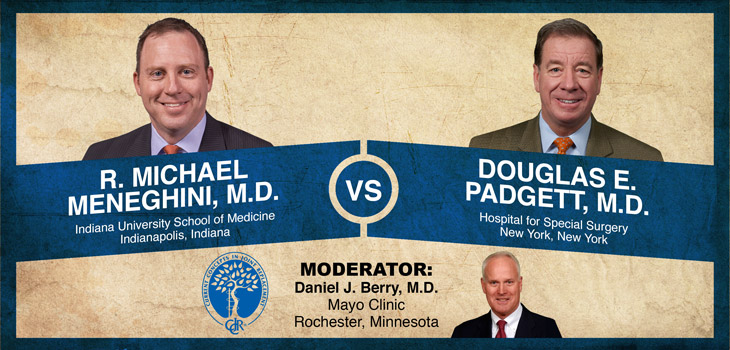
This week’s Orthopaedic Crossfire® debate was part of the 34th Annual Current Concepts in Joint Replacement® (CCJR®), Winter meeting, which took place in Orlando. This week’s topic is “Posterior Stabilized Knee Designs: Vestigial Organs.” For is R. Michael Meneghini, M.D., Indiana University School of Medicine, Indianapolis, Indiana. Opposing is Douglas E. Padgett, M.D., Hospital for Special Surgery, New York, New York. Daniel J. Berry, M.D., Mayo Clinic, Rochester, Minnesota is serving as the moderator.
Moderator Berry: Maybe surprisingly or shocking. “Posterior Stabilized Knee Designs: Vestigial Organs” is an interesting topic because 60% of the knees in the United States are now posterior stabilized [PS] knees. Speaking in the affirmative with a bit of an uphill battle is Michael Meneghini.
Dr. Meneghini: Yeah, an uphill battle. More importantly an uphill battle because moderator Berry taught me years ago during my fellowship to use a posterior stabilized design. Awkward? We’ll see.
I truly admire and respect Dr. Padgett, so it’s really going to hurt me to crush him in this debate. Well, not that much.
Twenty years ago, a younger looking Tom Thornhill and a very distinguished Robert Booth debated cruciate retaining versus posterior stabilized tibial inserts. Why are we bringing it back 20 years later? Why did even it fade away?
I would argue that total knee replacement has evolved. Twenty years ago, there was no clear advantage of cruciate retaining or posterior stabilized designs. The pros and cons were largely theoretical. The focus was on survivorship, not on patient outcomes. The metrics that we used back then were not sensitive enough to pick up small differences between implant designs.
I would argue that newer tibial inserts have enhanced sagittal conformity with anterior lipped designs to substitute for the posterior cruciate ligament, if it’s not competent. The cam-post mechanism is now obsolete.
So vestigial organ, appropriately named, what is that actually? The definition is “a structure in an organism that has lost all or most of its original function in the course of evolution.”
I’m going to use two arguments. An intuitive argument and then a scientific and data-driven argument.
The intuitive one starts something like this. So, the total knee, all of our body, is more fluid. The four-bar linkage, the total knee moves in very fluid, smooth mechanisms. So, it doesn’t really seem intuitive that you would replace that with something like a cam and a post.
I would argue that nothing in the human body really wants to slam into a post repetitively, over and over again as you walk or bend. That can’t be good either externally or internally in the long-term. The post-cam mechanism is not benign. You can have post wear and impingement. You can have fatigue fractures; patella clunk, which albeit has improved over time. And then just removing the extra step…removing the bone for the box prep…you can have additional bone loss at revision and a potential for condyle fracture, which has also been seen in PS designs.
