
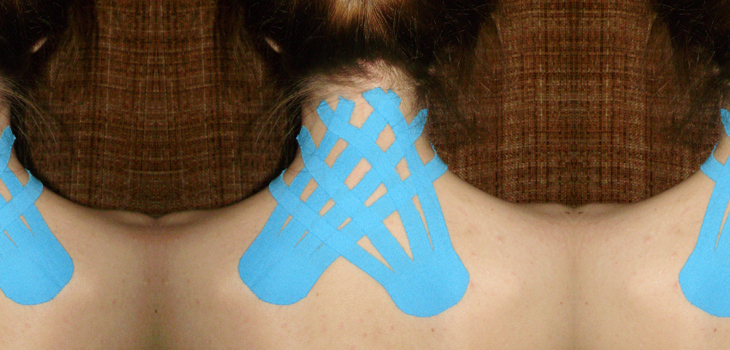
Tape has gone to the races.
If you have attended a foot race lately you may have seen runners peeling strips of brightly colored tape off their legs and from around their knees or ankles. The tape they are using is called kinesiology tape or kinesio tape, according to a recent article titled “What Exactly Is KT Tape and How Does It WorK?” by Ashley Mateo in Runners World.
Laurey Lou, a physical therapist and certified strength and conditioning specialist at the Hospital for Special Surgery Sports Medicine in Westchester, New York, says that the tape is “an elastic tape that provides sensory input into an area, but still allows for full range of motion.”
The kinesiology tape was developed in Japan in the 1970s by Kenzo Kase, a chiropractic doctor. He was looking for something that would mimic the elasticity of human skin. The tape product he put together did not gain wide acceptance until the 2008 Summer Olympics “… when volleyball player Kerri Walsh wore the tape on her shoulder and subsequently won the gold medal. Now, kinesiology tape is well known in the athletic world.”
“Most kinesio tape is made from a combination of cotton, spandex, and adhesive. ‘Traditional athletic tape is made of just cotton, so it doesn’t have the stretching ability that kinesiology tape has,’ explained Grayson Wickham, a physical therapist and founder of Movement Vault. “Kinesio tape … can actually stretch up to 40 percent of its original length while retaining its elasticity. This is what allows it to provide support without hindering your body’s movements.”
“It’s the tape’s elasticity that matters most. ‘We can use more tension to turn on or excite a muscle,’ says physical therapist Kellen Scantlebury. ‘For example: If someone gets surgery to repair their ACL, their quad will likely be weak. Taping the quad with maximum tension’, he explains, ‘brings those muscle fibers together, essentially causing a contraction, If someone has plantar fasciitis and is experiencing a lot of tightness in their calves, taping with limited tension can turn “off” the muscle so the person isn’t receiving pain signals.”’
When Scantlebury first works with a client, he has them wear the tape while they’re exercising, it typically lasts for three to five days. “… the constant wear is to re-educate the body to perform in a more optimal way. You want the tape to give that consistent feedback over a sustained period of time, so the body becomes aware that this is now the new normal.”

Thank for the great content. I cant wait to read much more from you.