
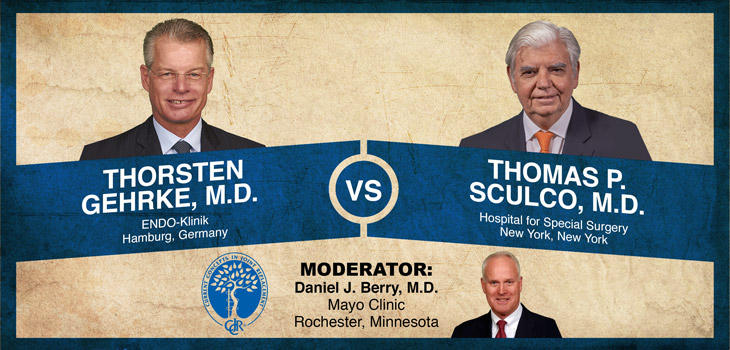
This week’s Orthopaedic Crossfire® debate was part of the 18th Annual Current Concepts in Joint Replacement® (CCJR®), Spring meeting, which took place in Las Vegas. This week’s topic is “Routine Use of Antibiotic Bone Cement in Primary TJA is Justified.” For is Thorsten Gehrke, M.D., ENDO-Klinik, Hamburg, Germany. Opposing is Thomas P. Sculco, M.D., Hospital for Special Surgery, New York, New York. Moderating is Daniel J. Berry, M.D., Mayo Clinic, Rochester, Minnesota.
Dr. Gehrke: The story of antibiotic bone cement started with Buchholz and Lodenkamper—two microbiologists who had the idea to mix antibiotic to the bone cement. Buchholz wrote a letter—almost 50 years ago—to a company that produced bone cement and asked them to mix antibiotics with their cement. The company agreed. He found that he could reduce the infection rate to 0.5%.
One of Buchholz’s good friends, Sir John Charnley, said to him in a letter ‘nothing leaks out of a stone, my dear Buchholz’. But his friend was wrong. We now know there are two kinds of antibiotic release from bone cement. First, the highest release of antibiotics out of the bone cement is within the first 10-20 minutes. And then after that is the second phenomenon of a very low, but very stable level of antibiotic leakage. During the first two hours you can reach such a high concentration that you have 1,000 times higher than MICs for staphylococci, for example.
Not every antibiotic behaves the same way. For example, vancomycin is bad regarding the release. It’s released only for the first 2-3 weeks and then it stops. It’s not the best antibiotic for the bone cement. And another issue is that the release depends on the surface properties of bone cement. Cement that incorporates water quickly is the better for antibiotic elution.
There are two kinds of industry manufactured antibiotic loaded bone cement—gentamicin and vancomycin or gentamicin and clindamycin. We did a clinical trial for both of them. The question was, “Are there any side effects if we add antibiotics to the bone cement?” We looked after 20 patients and the antibiotic concentrations. And we found that we can be really, really relax because at maximum concentrations in the serum are far below the toxic concentration.
Is there any evidence? The Norwegian registry showed that the outcome of the antibiotic loaded bone cemented stems are much better than the unloaded. If you look at a systemic review (PLOS 2013), all studies without any exception favor the antibiotic loaded bone cement.
And the Finnish registry where they looked after more than 43,000 knees, they came to the conclusion that the lack of use of antibiotic impregnated cement had a more dramatic effect than did the lack of use of intravenous antibiotics.
In Norway, again, much better results with antibiotics. That led to the fact that in the UK almost 100% of the surgeons are using antibiotic loaded bone cement routinely. Because they have seen that the cost effectiveness and the risk of infection is much, much lower.
