
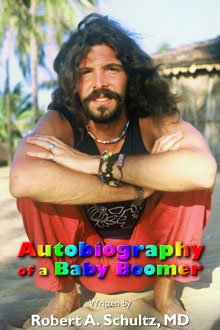
Twenty-three-year-old Robert Schultz sat in a squalid prison cell thousands of miles away from home…all he could think was, “I’m going to die in a Turkish prison and I could have been a doctor.” Like many other young people of his generation, he considered a career in medicine as something overly conventional that lacked real meaning. “Surely, ” thought Schultz, “there is something better out there.”
Robert Schultz, who eventually built a successful private practice, came to see that the “something better” didn’t involve a guru in India or a wise man from Marrakech…it was right inside him (even in his native Fair Lawn, New Jersey). It was living with an attitude of being in the present moment and accomplishing something every day. It was about living up to his own expectations of himself.
Dr. Schultz is the author of Street Smarts for the Practicing Physician and Surgeon, a forthright primer on how to avoid the pitfalls of private practice. “There are numerous ways we can ‘get in trouble’ as private practitioners, such as selecting the wrong partner, failing to eliminate disruptive patients from the practice, and not providing a sense of safety and belonging to our patients. My goal in writing this was to give some hard facts and practical solutions to these types of issues.”
While he wrote the book as sort of a retirement gift to the profession, Dr. Schultz admits, “You can’t expect that people will fully understand a situation because they read about something. In order to ‘get it’ you must live it.”
Medical—and life—experience is nothing that Robert Schultz lacks. Like a bachelor who is not quite ready to settle down, a young Robert Schultz crisscrossed the world, running away from the acceptance letter he had received from Cornell Medical School. “I went abroad the summer after college and felt myself being drawn to the exciting people I met who were in search of nirvana. I was distancing myself from medicine as the summer went on, and then fell in love with a French girl with a drug problem. I’ll never forget sitting in café in Marrakesh thinking, ‘In three weeks I’m going to medical school, the most conventional thing I could do.’ I tried to ignore this…then summer ended and I returned to the U.S. and headed for Cornell.”
These days, Dr. Schultz can be found at Duke University, reviewing cases with residents and fellows. He has found the excitement within the conventional. And to a great degree, it was all of that searching as a younger man that created a doctor who knows how to find things.
“Much of the value and allure of our work lies in the subtly of getting the diagnosis right. A surgeon must be a detective, and must be patient enough to get the details of the patient’s complaint. When a resident says, ‘Can I run this by you?’ and tosses up an X-ray, I say, ‘Wait. Tell me about the patient.’ While the OR is exciting, if you’re doing the wrong operation then what is the point?!”
This sense of thoroughness and doing the right thing has always been with Robert Schultz. “I remember walking out of Mass General one evening, crying and wiping my eyes on my shirt. I had logged 500 knee arthroscopies alongside attendings, and that day I had been alone. It was a simple torn medial meniscus but I kept scuffing up the surface cartilage—in part because I was using a cumbersome forearm camera. I thought, ‘I can’t do this. I am going to hurt people.’ Shortly thereafter handheld cameras were available, which changed everything.”
But back to his first, ambivalent days as a medical student. Whereas he would later experience real jail cells, Dr. Schultz says that walking in the doors at Cornell felt very much like confinement.
One day, a surgeon in a significant position of responsibility said to me, ‘I am entrenched here, and I have a family. I envy you. Go take a year off. And if you tell anyone what I said I’m denying it.’
Robert Schultz’s parents, who were happy because “at least” he wasn’t quitting medical school, took him to the airport. “My folks thought I wasn’t thinking clearly, and we had a fight at the gate. I wouldn’t see them for four years.”
 What now seems like a conventional, stereotypical path for “seekers, ” i.e., heading East, was novel in the ‘70s. “I wandered around India, but couldn’t find a guru. After awhile, it felt like I was just ‘hanging out’—and I was lonely. I was beginning to realize that travel is totally self-indulgent…I wasn’t responsible to anyone but myself.”
Ironically, when asked about the career experience that most changed him, Dr. Schultz notes something that involves responsibility…failure. “I have had outcomes that were not to my liking or to the patient’s satisfaction. It’s best not to beat oneself up, however…we can only look for self-acceptance. Think about the feedback you get when you do something right. Then your thoughts and/or actions change for the better because you have made yourself live up to the part of you that is noble.”
Some of what Dr. Schultz learned about patient care emanated from his time as an apprentice to a Filipino faith healer. “I spent time working with Bobby Deleon, who served those living on the garbage heaps of Manila. He was the judge, jury, doctor, and peacemaker of this realm, and it was a revelation to see how he worked. I witnessed the power of creating an ambiance where you give the patient confidence in you, and are extremely attuned to them and invested in their care.”
Years later, it was a sobbing OR nurse who led Dr. Schultz to see that he needed to work on his own ambiance creating skills. “I used to get really upset with incompetence in the OR, and I would go to a corner, face the wall, and try to regroup. One day a nursing supervisor came into the OR and told me to ‘Calm down.’ My response? ‘Get out! You’re part of the problem!’ I later found her crying, and she said, ‘People don’t want to work with you.’ She took me into another OR that had a hole in the wall. She said, ‘Dr. X threw a mallet through the wall once and he will not repair the hole. He wants it to be a reminder not to ‘lose it.’ Ever since, before I walk into the OR I say a mantra—‘I know things are going to go wrong today, but I refuse to act like an asshole.”
Dr. Schultz homes in on his point that while he can try to teach others, it is the residents’ and fellows’ daily experiences that will make the biggest impressions on them. “During a recent case I told the resident, ‘The only way you’ll have an unhappy patient is if you get an infected nonunion.’ I told him not to leave the wound open while he tries to make things perfect. He said, ‘I know you’re frustrated with me because I’m working slowly.’ I responded, ‘It’s not that. It’s that the principle of moving along is not that important to you. When you have had the experience of a patient with an infected nonunion you will feel differently.’ I can’t give someone that experience…I just don’t have that much control over their development.”
There are several experiences that he wouldn’t want to give anyone. Namely, jail. During his peregrinations, Robert Schultz experienced the ambiance of foreign prisons on several occasions.
“My friends and I were in Turkey and came upon an accident scene. We took two injured people to a hospital where the local authorities concluded that I had caused the accident. When I was released it was a freedom like no other—and yes, I was thinking that medical school didn’t look like so bad.”
Not that an Afghan prison is much better. “I was driving a van near Kabul when a kid slammed into the side. My friends and I took him to a hospital and took the cop who had witnessed the event. I was still thrown in jail, however, because the guy on the bike was the brother of the local commandant. This man told my friend that I would get out of jail when his brother’s leg healed. I got out sooner that that, but my passport was held for three months…they wanted to make sure that leg was going to heal.”
My goodness, he should write a book. “I didn’t think my life story was so special, but then I got nostalgic. That, coupled with the fact that my children were asking about my youth, led me to write Autobiography of a Baby Boomer. Philosophizing is a turnoff, so I just had fun with it, and wrote it in a way that the reader would get lost in this era.”
So how and why did he finally get back to Cornell? “Once my parents heard that I was going to get involved in a shrimp boat business in the Philippines they had had enough. They flew over, said, ‘You’re throwing away an outstanding opportunity.’ I let their words sink in for several months and then I was on a flight home.”
“I don’t regret a thing. If I had not taken that time, I would not be as satisfied with my life. You must at least try to pursue your dreams.”
The unconventional-conventional Dr. Schultz says, “My wife and I have raised three kids, all of whom have good values and good judgment. Yes, I play the doctor’s game—golf. I also meditate every day. I had heart surgery last year and nearly died. From that I learned two things: first, if this is my last day I’m OK with that…that was comforting. Also, I am still here so each day is really a gift.”
To read more about Dr. Robert Schultz’s experiences, please visit www.autobiographyofababyboomer.com.
